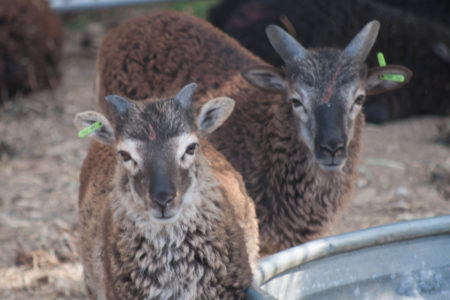
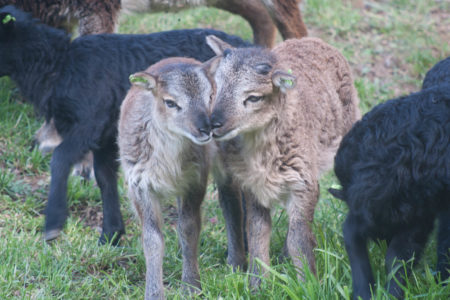
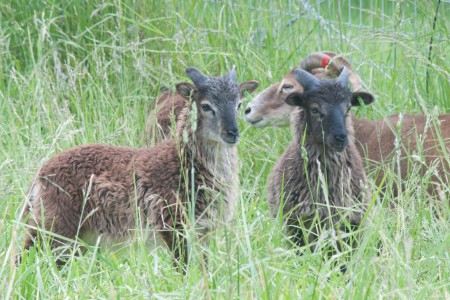
Little could we imagine two years ago when we were bottle feeding Patterdale in our kitchen that she would survive, grow up, and produce her own healthy lamb, but that is just what has happened here in the last few days.

You may be wondering, what’s the big deal, since Patterdale obviously lived through her difficult first few weeks. What we didn’t know then was whether she would mature properly and be capable of getting pregnant, carrying a pregnancy to full term, and delivering a lamb successfully. The plain fact is that bottle-fed lambs present issues beyond merely keeping them alive. They really cannot eat on the same schedule as their nursing cousins, who take very small amounts of milk at frequent intervals, up to several times an hour. No matter how diligent we were in feeding Patterdale, we could not match the schedule her mother would have provided had she not rejected Patterdale out of hand. In addition, there is a substantial risk of the lamb scouring because it wants to drink more each time it is bottle fed than its digestive system can accommodate. Later, when Patterdale had no choice but to go out in the pasture with all the other lambs and their big mothers (but without a mother watching out for her), we learned the hard way that she could not compete at the feeders. In short, we had no idea whether her reproductive system had successfully matured in light of her compromised growth process.

Against this background, Steve was delighted when he arrived at the Maternity Ward late in the afternoon of April Fool’s Day to find Patterdale fussing and giving off signals that she was about to go into labor. Because she is so tame, she followed Steve right into a jug and quietly lambed there while Steve went about evening feeding chores. By the time I grabbed my camera and ran over to the Maternity Ward, Patterdale had nearly finished cleaning up her lamb and getting her up to nurse:

Patterdale's first lamb

This movie requires Adobe Flash for playback.

Later that evening when we worked the lamb, we were pleased to find her a respectable (especially for a small first-time mother) 4 pounds 4 ounces, warm and obviously having had her fill of the all-important colostrum. We also have been amused to see how ferociously protective Patterdale is now that she and her lamb have re-joined the jumble of newborns and their moms. Any other lamb or ewe that approaches Patterdale’s baby gets butted away and butted hard, as though Patterdale is saying to herself, “my mom abandoned me and by golly, I’m not going to let that happen to my daughter!”

For now …

I pause in the excitement and rush of Soay lambing to speak of a good man and true friend of all creatures great and small, Philip C. Peterson, D.V.M.

Every little burg in Iowa back in the 1950s and 1960s had its large animal veterinarian, and my hometown of 1320 people, Paullina, was no exception. Like the legendary James Herriott in Yorkshire and Baxter Black in Texas, Doc Peterson was the town’s vet and a whole lot more. Known to farmers and townies alike, it was he who tended to the pet cocker spaniels as well as the cattle and pigs. If you wanted to hear the latest local news, you watched to see when Doc Peterson’s perpetually dirty Chevy station wagon pulled into the angle parking outside Lange’s Café mid-morning. If you sidled up to one of the red naugahyde-covered stools at the counter for a cup of coffee, you would find Doc regaling everyone within earshot about what he had learned on his first trip to the country that morning – the town crier at work.

In the decades before malpractice worries and the urge-to-sue permanently altered the way vet medicine is practiced now, Doc Peterson welcomed children to watch what he was doing, albeit at a safe distance. He would patiently explain why he had to use a form of block and tackle to help a heifer get a big-headed calf out. He would let the farm kids paint the iodine on the pigs’ “armpits” before injecting the piglets with life-saving vaccine against hog cholera. When he returned a groggy, newly-spayed pet dog to its fretful owners, he would patiently explain to the children why they had to be careful with “Spot” or “Muffy” for a few days. And whether or not Doc Peterson wanted them to, the animal-savvy farm kids inevitably took matters into their own hands and proudly rounded up the huge (from a child’s perspective) cattle into the barn so Doc Peterson could figure out what was causing them not to give enough milk, or whatever was ailing them. There were husbandry and life lessons in abundance for the asking.

If only I had paid attention back in those days, I would feel much more confident when something goes awry with my Soay sheep. But alas, I did not appreciate all the wisdom Doc Peterson was imparting as he methodically worked the animals, and instead I couldn’t wait to grow up and move to “The City.” I am undeniably the poorer now for failing to listen then.

Will Rogers’ famous quotation about veterinarians hung on a plaque in Doc Peterson’s office: “The best doctor in the world is a veterinarian. He can’t ask his patients what is the matter — he’s got to just know.” The twinkle in Doc Peterson’s eye when he put one of his big hammy hands inside some part of a cow or pig and, as if by magic, declared what was going on in there was electrifying to any child who would listen.

What many people in my town, me included, may not have appreciated fully were how many ways Doc Peterson’s agile mind manifested itself, and how often his strong moral values and “groundedness” came into play. He never lost sight of the goal in treating the farm animals: maximize the animal’s health so the farmer can sell it for top price and thereby clothe and feed his family. Doc was both gentle-hearted and a steely-eyed realist about the role of farm animals as the major, and often the only, source of revenue for rural Iowa families.

Doc Peterson also knew first-hand the difference between a hard-working farmer who dropped out of school in the sixth grade and a hard-working farmer who graduated from high school. Doc knew the farmers needed a good education in order to be successful businessmen, and he was a tireless supporter of our local school and its teachers. Everyone in Paullina knew the story of Doc Peterson running for the school board because he was upset at the teachers’ low pay and the town’s resulting inability to attract the best teachers. His campaign promise (delivered, mind you, at the same counter stools in the café used for his role as the roving reporter) to raise teachers’ salaries produced a record-breaking voter turnout; legend has it that he lost by the widest margin in Paullina’s history, with folks driving to town to vote against him who had never voted before.

For better or worse, when you live in a town of only a thousand people, your private family stories often become common knowledge. One of my favorites about Doc Peterson is the time a farmer called to have Doc come out to his farm. In the breathless, just-in-from-the-fields voice that typified calls to the Peterson residence, the farmer informed “Mrs. Doc” that she should “tell Doc he needs to get out here and castrate my pigs. I need him right away to cut off those participles.” Those of us privy to the story of course hoped the vet would do a good job so they wouldn’t be dangling participles!

In the good old days, there was no such thing as a night and weekend emergency vet service to take over and give Doc Peterson a day off or a scheduled evening with his family or friends without interruption. His children grew up not knowing what it meant to have a regular dinner hour, since early evening was the time when the farmers came in from the fields, found animals needing help, and picked up the phone to call Doc. In those days, Paullina did not have dial phones and instead relied on Fern Beers, the gravelly-voiced telephone operator, to connect the calls. Luckily for the locals, Fern acted as a non-paid answering machine for the veterinarian, the physician, and the volunteer firemen. When the Petersons were going to a friend’s house for dinner, for example, they would call Fern and tell her where they would be, so that if a farmer called for Doc Peterson, Fern would simply connect the farmer directly to the dinner host’s home and reach Doc immediately.

Readers familiar with the evolution (or destruction, depending on your point of view) of farming in Iowa know that by the late 1970s, the family farm was moving rapidly towards oblivion, and so were the country veterinarians. With their children grown, Doc and Mrs. Peterson used his deteriorating practice as a good excuse to close up shop and do what they had dreamed of for years – volunteering. I think it’s an accurate testament to the high regard the townspeople held for Doc Peterson (despite his “radical” views on teacher pay) that when he headed out to collect all the unpaid bills he had been carrying for some of the struggling farmers for years, he ended his 40 years of practice with less than one hundred dollars in unpaid receivables. Are you listening corporate America?

Even though he and Mrs. Doc moved away from my home town, Doc Peterson never got animal medicine out of his system. One of his volunteer jobs in retirement was inspecting animals that were being shipped overseas by Heifer Project International to help struggling third-world families become self-sufficient; another volunteer post was working in the fishery associated with Sheldon Jackson Junior College in Sitka. He even coaxed the locals in Sitka to teach him how to smoke salmon and ship it back to the States on dry ice.

As you can tell, I admired Doc Peterson and wish I had paid more attention to him when he was in his teaching mode as a veterinarian. If he could see “Prissie” now, he would scarcely believe his eyes. I am confident it never dawned on him that the smart-aleck girl in pink-rimmed glasses who would rather play the piano than get her hands dirty would someday be a Soay shepherd.

Doc Peterson died nineteen years ago today and ever since, scarcely a week has gone by that I don’t I think about him and remember these stories, and countless others like them, of the gentle doctor others called “Doc,” but who I knew and loved as my father. Thank you, dad — wish you were here!

Priscilla Peterson Weaver

For now …