Archive for March, 2007

Venus update

Thursday, March 29th, 2007

Several readers kindly have inquired after the progress of our pregnant ewe Venus and her broken leg.  After we got her home on Friday and into the tiny cubicle pictured in my earlier post, we pretty much left her alone, thinking complete rest would be best, and we did not want to give her a chance to throw the cast off again.  In retrospect, we should not have left her so confined for so long.  By Tuesday she was listless, would not stand up, crumpled back down when Steve tried to hoist her, wouldn’t eat, wouldn’t drink water, and gave every indication of having lost her will to live.  We did not know whether her legs had simply fallen asleep, or her muscles had already started to atrophy, or she was perilously hungry, or thirsty, or what.

Our keen disappointment that we might lose Venus after such a good fight was nothing compared to the fear that we may have unknowingly contributed to her decline.  Concluding we had little to lose, we decided to get her out of her tiny confinement and take a chance on a slightly larger area where, if she had the will to get up at all, she could more readily move enough to get some circulation back into her legs.  We figured if we left her where she was, she would wither and die anyway, so the risk of having her fling the cast off again seemed the lesser of two evils.

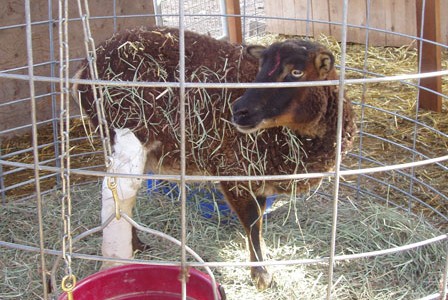
As you can see in this picture, we put Venus in a ring of sheep panel we use as a substitute for our “jugs” when we cannot easily move a new lamb and ewe or for any other reason we need a small catchpen for a short time.  It is not secured to the walls; we literally roll it around as needed.  By dumb luck, it turned out to be just what Venus needed.

venus_032907-002.jpg 

For a couple of hours she lay inert, even when we put yummy grain under her nose.  Then to our great relief, she must have decided it was “safe,” because she heaved herself up and actually got on her feet.  I couldn’t believe it.  She looked utterly perplexed.  What were the strange sensations in her legs?  What was that awful thing on her back right leg?  No longer, apparently, a charging coyote, because she did not try to fling off the cast as she had before.  But then she saw the water bucket and something clicked.  She stumbled over and drank, and drank, and drank.  Clearly she had gotten severely dehydrated.

Next she managed to drag herself to the edge of the circular pen, leaned into the side of the ring just a little, and lurched in circles around the perimeter, exploring her new world and trying out the leg in the cast.  It was remarkable to watch what is reputed to be one of the dumbest animals create her own rehab program.  Even more amazing was the size of the pile she deposited once she had taken her constitutional.  No wonder she had been listless!  No wonder our doctors tell us to drink 10 glasses of water each day! 

It’s now Thursday and Venus is doing quite well.  She is thin, but still pregnant.  And she is curious about the new lambs on the outside of her confinement ring.  No telling what tomorrow will bring, but

For now …
 

A pregnant Soay ewe with a broken leg – what to do?

Sunday, March 25th, 2007

Just when we thought we could relax and wait for lambing to begin, Steve came back to the house looking agitated and clearly worried. He discovered one of our pregnant ewes, Venus, in dire straits in the Maternity Ward. Here’s his report:

 ”When I first saw Venus out of the corner of my eye, I thought one of our ewes had lost her mind, standing on three legs, holding her back right leg straight behind her and shaking it furiously. Not until she paused momentarily did I see that her leg was broken between the hock and the dewclaw. When she shook her leg, her foot twirled around at a 180-degree angle, rather like a swivel club. This was not right. What to do.”

Once Steve was able to enclose Venus in the shelter, we quickly assessed whether we should try to save her, realizing the odds were not great of managing to keep her safely pregnant long enough to deliver, yet keenly aware of the likely expense of treatment. We will never know for sure what path we would have taken had she been an ordinary ewe, but Venus is carrying a genetically valuable lamb so we elected to try to save her.

These are hard questions, somewhat to our surprise. Soay are utterly endearing and we love having them, but when you start talking about x-rays and casts and more than 10 or 15 minutes of a vet’s time, the expense can swamp the value of the animal and then some. If we had only a few Soay, we might seek intensive vet care for every problem, but with over 100 sheep, we really have to be somewhat businesslike about prioritizing when and how much to spend on husbandry.

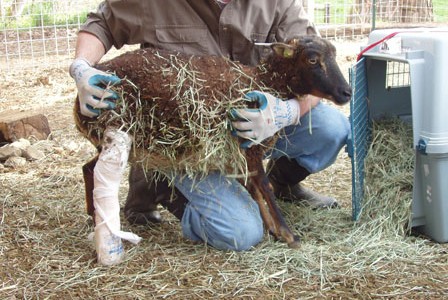
Off to the vet went Steve with Venus in a dog crate, the Soay shepherd’s one-animal “trailer.” An x-ray revealed a clean transverse break in the middle of her metatarsal bone. Back he came with Venus in a full-leg cast, complete with an artificial “hoof” made by daubing some quick-hardening epoxy-like stuff on the tip of the cast, complete with the two points characteristic of a real hoof. So far so good. But immediately upon landing back in the Maternity Ward, Venus began to flail again and banged the cast against anything she could find. Steve fashioned a small enclosure, about 4 x 5 feet, within the shelter using bales of straw. He gave her a bucket of water, some hay, and left her to heal. Here is the first recovery room.

venus_1_leg032307-001.jpg 

As near as we can tell, Venus interpreted the pain in her leg, and perhaps the weight of the cast as well, as a predator attack. From the outset, she had tried to shake off what had “grabbed” her. Whatever her nightmares were, she managed to work the cast off overnight and we found her the next morning still in her little recovery room, but with her leg once again unset. The cast was intact but thrown off to the side of the enclosure. Either she had shaken it off, or wedged it somehow, giving her purchase, and pulled it off. It was back to the vet for another cast, this one under “warranty,” thank goodness. The vet sawed the cast in half, re-cemented it, applied it somewhat tighter than before, and sent her home with pain medication but no sedative since she is pregnant.

Steve’s nothing if not a quick learner, so as we drove to the vet the second time, he talked through a better confinement arrangement. Clearly it needed to be much smaller, about the size of the dog crate or even narrower if possible, to prevent Venus from having any room to swing her leg and kick off the cast again. The dog crate had two drawbacks, instability and the air vents on the sides, which could catch the artificial “hoof” points. But Steve remembered a piece of our Shaul panel system we use only occasionally, 2-foot wide contraptions called “alley supports” that form each end of a makeshift “lane” for moving animals between pens. Why not make the sheep world’s shortest lane?

And that’s exactly what he did. Using two 5-foot panels and the two alley supports, he got the enclosure down to about 2 x 5 feet. A single straw bale tipped on end brought the length down to just over three feet. A single scrap of 4 x 4 inch “horse” panel cut to size formed the “gate.” Three scraps of plywood covered the three sides of Shaul panels so there would be no slots where the cast could catch. Here’s what the new outpatient facility looks like.

venus_2_leg032307-002.jpg

All that remained was to get Venus out of the truck, out of the crate, and into the recovery room. The whole barnyard was concerned. Here’s Isaac, our Anatolian shepherd puppy, following the gurney (a.k.a. garden cart with dog crate – nice fit, eh?) into the Maternity Ward.

 venus_5_leg032307-005.jpg

Here’s Venus with her cast. Woebegone, isn’t she?

venus_7_leg032307-007.jpg

Here’s Venus in her little stall.

venus_11_leg032307-011.jpg

And finally, here’s Llucy, ever the faithful guardian llama, checking on Venus to make sure her pillows have been fluffed and her bedpan, uh, make that water bucket, is in place.

 venus_13_leg032307-013.jpg

It’s 48 hours later and the evening lamb check, which of course now includes Venus, confirmed that she made it through another day without kicking off the cast. We are hopeful. Stay tuned.

For now . . .

A Soay by any other name

Saturday, March 24th, 2007

If dipping navels and trimming hoofs are the spinach and carrots of shepherding Soay (as in, “eat your vegetables, dear”), the choice of a naming theme for our Soay is the dessert cart.  Naming themes are about as close as most Soay shepherds get to unmitigated frivolity.  They are fun to come up with, fun to implement, and practical to boot. 

Why use naming themes?

At Saltmarsh Ranch, we use naming themes as a three-way sort:

  • What year was the animal born
  • Where does it fit in the birth order for that year
  • Is the lamb a British or American Soay

For example, we remember Cleopatra was born in 2005 because that’s the year we used Shakespeare names for our lambs.   When we see Cardamom and Thyme side by side, we know just by name that Cardamom is about 4 weeks older than Thyme, and we also know they are American Soay.  Let me go back to the beginning and walk through the process.

Has anyone used the theme I am considering?

Maybe, but only you can decide whether you like it so much you will use it anyway.  We picked up a number of good suggestions for themes, and eliminated some, by looking through the Open Flockbook Project database to see what topics/themes other breeders had used.  I urge you to peruse the Flockboook or better yet the Gallery (see links in the right hand column) if you are wondering whether a naming theme has been used already. 

How to come up with a theme and avoid themer’s block

Each of our themes came to us largely unbidden and sometimes from unlikely sources.  This is not rocket science, of course, and the only stumbling blocks are twins. 

Shakespeare.  Our first lambing year we had recently moved to our farm in southern Oregon and discovered nearby the truly outstanding Oregon Shakespeare Festival in Ashland.  What choice did we have but to use Shakespeare names?  Everything went along smoothly (Romeo, then Juliet) until we got to our first set of twins – oops.  Twins are a little hard to come by in Shakespeare, especially male/female.  When our first set arrived, without thinking we named them Antony and Cleopatra.  Yes, yes, I know the implications of brother/sister relationships, but we’re talking names here, not sex ed.  And they are adorable, aren’t they, shown here as lambs about 2 months old?

Antony & Cleopatra

By the end of 2005 lambing we were mentally exhausted from trying to remember the Shakespeare characters, but by golly we had a theme and we stuck to it.  We even got to name our first reddish lamb Rosalind.  Who could resist this little beauty?

Rosalind

Mothers-in-law.  I told you themes come from unlikely places, didn’t I?  Nothing would do our first year but that Steve’s mother would visit from Tucson to enjoy lambing with us.  In the course of watching one of our Shakespearian characters hit the ground (Duncan, if memory serves), she came up with what would become our theme for the following spring — herbs and spices.  Here she and Steve hang over the side of the shelter watching Duncan arrive. 

blw_sw_visit_019.jpg

Organizing your spice shelf.  Take my word for it, the ovine variety is easier than the culinary version.  I simply looked up the Penzey and Spice House websites and shamelessly raided them for an alphabetical list of spices.  When lambing actually started, we found ourselves faced with momentous decisions.  Should we use Caraway and Cinnamon for twins and then Dill for the next single, or use Caraway and Cardamom for twins and save Cinnamon for the next single?  

At one point we got lucky.  Right when we reached “L” in the alphabet, our first 2006 black lamb arrived and the perfect name was waiting for him.  Meet Licorice.

licorice_11wks_002.jpg

Of course there were names we really wanted to use, leading to strategic decisions like whether to use Sage and Saffron and risk never getting to Tarragon, my favorite spice, or skip the “S’s” and risk running out of names entirely before the last lamb appeared. 

What about names for the 2006 British Soay?

By the time lambing rolled around in 2006, we had acquired a few British ewes and rams, allowing us to double our naming fun by choosing one theme for the British and a different theme for the Americans.  We already had our American theme, thanks to Steve’s mom. Other breeders had long since cornered the market on Scottish names (recall Soay hail from the St. Kilda archipelago off the northwest coast of Scotland).  But Cornwall is where my mother’s family hails from and it seemed close enough to Scotland to lend a patina of authenticity to our fledgling flock of British Soay.  Not to mention that Steve’s family was one up on me with his mother’s idea of herbs and spices and I am nothing if not competitive.

All it took was a detailed map of Cornwall and one of those draftsman’s compasses, the thing-a-ma-jig that holds a stubby pencil and lets you make circles around any point.  Starting with Tolcarne, my family’s rural homestead, we worked our way out to Helston, where the family burial plot is located near the church, the little hamlet of Wendron, and on to enchanting place names like Gweek and Porkellis and Keverne.  When a pretty little reddish tan ewe appeared, we were lucky enough to have saved Rosudgeon for her:

Rosudgeon

Enough of history.  What are the themes for 2007?

Now lambing is upon us and once again we need names, lots of names.  To balance the geographic marital scorecard, we will use place names from the southwest U.S., where Steve was born and raised, for our American lambs.  At a minimum, it gives us a chance to name our first 2007 set of twins Truth and Consequences.  I could not possibly do justice to the story of how Truth or Consequences, New Mexico got its name.  For that you will need to visit the Chamber of Commerce website and click on Ralph Edwards’ picture.  I am not making this up.

The surprise appearance of my new friend Anne a month ago presented us with a golden opportunity for our 2007 British lamb theme.  You will recall she lives in Yorkshire, England, so why not use Yorkshire place names?  After all, it’s sheep country; it’s where Anne lives; it’s beautiful; it’s a place my family and Steve know well after all the years of chatter about James Herriot.  I asked Anne for help in gathering Yorkshire place names and sure enough, by return e-mail she sent me a starter list of names from A through G, plus a link to a dandy website.  When next you visit us here at Saltmarsh Ranch, you may have the pleasure of making acquaintance with Soay sheep named Askrigg, Appletreewick, or Chopgate.   

Here’s what Anne has to say about the Yorkshire Dales. I think you will agree with me it is a good choice for our 2007 British lambs:

“Sheep were the mainstay of the economy here in the middle ages. The monks were big shepherds and the abbeys grew rich on wool.  Near where I live there are several abbeys all dissolved and demolished by Henry VIII namely Rievaulx, Fountains, Jervaulx, Mount Grace, Byland, Bolton and Kirkham where only ruins remain. The monks had “lay brothers” who were really non-religious men who were used, just for their keep at the abbey with no religious duties, to tend the flocks. It built up the wealth of the abbeys and made the king jealous of their power and so brought about their destruction.”

Where can I learn more about naming themes?

We might never have thought about naming themes had it not been for a terrific article by our friend Kathie Miller in the Soay Sheep Society Newsletter, easily accessible now on the Soay Sheep Breeders website. 

Meanwhile, let me know what you decide to use for your Soay naming theme this year.  I promise I will not use your theme.  After all, as our 2005 ewe Juliet might say, a rose by any other name is still Rosalind, Rosudgeon, or Roswell. 

For now …  

What do Soay sheep have to do with global warming and climate change?

Sunday, March 18th, 2007

Apparently a lot, but you sure couldn’t prove it by looking out in our fields.  As near as I can tell, the only impact weather has on our flock is that when it gets cold, the sheep tuck their feet under and hunker down in the pasture.  In the summer, the sheep drink a lot more water and hang out under whatever shade they can find.  But global warming?  Until this week I would have said anyone talking about Soay sheep and climate change in the same breath needs a weekend in the city to clear her head. 

Not so, according to the media in London, both an article in the London Times (kindly brought to my attention by my new friend Anne in Yorkshire) and on the BBC website.  On first reading, the media seemed to be saying our sheep should be getting smaller because more small animals should survive the warmer winters and that means they should all get smaller.  Are you with me?  Researchers in the U.K. have been out on the St. Kilda archipelago off the northwest coast of Scotland observing the wild Soay flock on Hirta island, annually collecting data since long before global warming was recognized.  Little did they know how useful all that fundamental data would turn out to be!   If you have kept up with your Soay history, you will recall the Soay on Hirta are a closed flock subject to awful winters, making them ideal subjects for studying climate change.   Their little island is a natural laboratory where the combination of animal size and comparative level of available grass (which of course varies with the weather) can be used to make predictions about flock and individual sheep size.  Every August the ecologists visit, measure, tag, and count as many of the Soay as they can catch, usually about half the flock.  They do not have to account for predators; there are none on Hirta.  Nor are there humans to affect the Soay’s health.  They do not migrate, unlike their distant relatives the deer.  Their existence boils down to how much grass the climate allows to grow on Hirta.   

Despite my natural wariness of all things scientific, curiosity took over.  I read the article in the London Times (Times article) and I read the material from the BBC (BBC article) and immediately concluded in my “what good will it do” manner that smaller animals would mean less hay would mean less expense.  Not exactly.  You also will recall I am married to a scientist, and bless his heart if he didn’t look up the new research article in the journal Science that provoked the media coverage to see if they got it right.  Turns out the researchers have done a nice job of taking data over many years and they are in fact in a position to study trends in the Soay population on Hirta, but they were very circumspect in the article and did not make the bold pronouncements about shrinking size that were suggested in the press.  To be sure, once the researchers got outside their meticulous and rather cautious conclusions in the Science article about what size has to do with ability to reproduce, they gave the media interviewers a little more to chew on, namely the business about smaller sizes and who breeds better and survives better.

All of which sounds just ducky if you are both able to and interested in translating the complexities of research articles, and if you are, I urge you to look up the article in the March 16 issue of Science.  You will be a more informed person and you almost certainly will have a new conversation-stopper for your next cocktail party.  But you will not learn much about how to care for your own Soay.  The data from the wild Hirta Soay has nothing to do with domestic “kept” Soay.  Soay in our pastures are not getting smaller or larger due to climate change and neither are your Soay.  Why?  Because we feed them.  Nobody brings hay for Hirta Soay. 

Don’t get me wrong.  I am simply delighted to see Soay sheep getting this much press.  That our sheep’s cousins on their tiny island may be contributing to a better understanding of a pretty scary scenario for our planet should make all of us who own Soay mighty proud.  If nothing else, next time your friends scoff at the little rascals in your field, you might ask them when they last saw their angus bull or cocker spaniel featured in the media as the breed of choice for studying anything, much less the hottest environmental issue of the day.

For now …

Anti-tetanus vaccinations for Soay sheep: An ounce of prevention

Sunday, March 11th, 2007

Actually, it’s not an ounce, rather 2 cc’s, but “cc” doesn’t roll off the tongue quite as well, does it?

If by any chance you do not vaccinate your Soay against clostridial diseases, you should start now. This is one of the few areas where I cannot help nagging. The sight of an animal in the throes of tetanus is truly ugly and heart-wrenching, and easily preventable.

You can read about chilling vaccine, shaking it often, the nitty gritty of the actual vaccine on more technical sites. What you will not find on the pharmaceutical pages is how to make the process shepherd-friendly. Read on.

Scheduling. We follow conventional wisdom from other breeders and aim to vaccinate about 30 days in advance of lambing. On this schedule, the ewes’ immunity level is freshly boosted and their colostrum at the maximum level of antibodies for the newborn lambs. Plus, having a set calendar allows us to pretend our lives are in order, the same sort of harmless illusion of control we get by changing batteries on the smoke alarms each year when Daylight Savings Time kicks in.

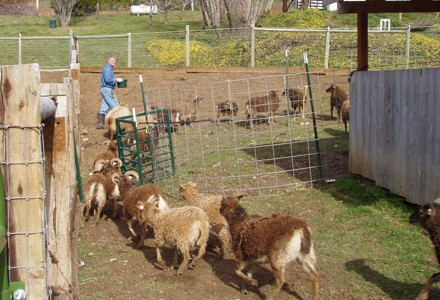
Catching. Use your trusty grain bucket, the Soay shepherd’s best friend (well, maybe second-best after blue gloves), to get the ewes off the pasture and into catchpens. In case you doubt the effectiveness of a strategically-placed bucket of grain, have a look at Steve last Sunday doing his imitation of the Pied Piper.

grain_bucket.jpg

Confinement. Tranquility is the goal here. The last thing you want is for general panic to set in; therein lies both madness and broken horns. Aim for the smallest possible enclosure.  We used to put all our girls into our 8 x 12-foot shelters and even they were too spacious. This time around we processed 5-7 ewes at a time in an enclosure no bigger than 5 x 4 feet made from our trusty Shaul panels, just room for the person giving the vaccinations. Since I was the paperwork processor and Steve was the hands-on guy, I will let him describe what he did.

“Once I get the ewes in a small space, I stand still among them, then calmly reach out and touch one of them, on her horn if possible, or around her neck. If they can’t go anywhere, they will accept my touch without undue alarm. What I want to avoid is anything that will start a chase. If they cannot run, they accept their fate.”

Seating the ewe. Working one standing ewe is enough to convince any sane shepherd that converting the ewe from a four-footed animal to a sitting duck is the only way to go when vaccinating. As the observer, it seems to me the key is to keep the ewe from lurching her head and arching her back, triggering flailing behavior. Once again, I will let Steve describe how it works for the person on the front line:

“The easiest way to get access to the vaccination site on the ewe’s chest area, right behind her foreleg, is to get her sitting on her butt or, better yet, slightly off to one side on her left ‘cheek.’  I have watched shearers do this and of course they make it look easy, especially that no-good rascal in Thornbirds. Unlike the big clumsy Suffolks, Soay are quick and adept at remaining upright.  But I have the advantage, their small size.  I just lift the ewe up until her back legs are dangling, then quickly drop her while moving slightly backwards so her hooves will point forward and she’ll land on her bum. For me it is most comfortable to let her left side rest against the inside of my left leg.”

Author’s note: where is the video camera when I need it?  Does anyone know how to post videos on a blog? Hrmph.

Injection-site lumps. Some sheep, perhaps one in ten, seem prone to develop marble-sized abscesses at the injection site. This is nothing to worry about except they look icky and you will fret about them no matter what I say.  It seems to help avoid the lumps if you are adept enough at giving injections that the needle lies almost flat between the skin and the body wall. Try not to go straight in like a “puncture.” Once you have given the shot, immediately rub the injection site for a couple of seconds, shmooshing the vaccine away from the hole.

Marking the finished ewes. By all means mark your ewes as you work them. It is the simplest way to be sure you have not missed anybody. We use the “All-Weather Paintstik Livestock Marker” made by LA-CO Industries, should be available at your local farm supplies store. One marker will last way beyond your Soay-raising lifetime if you do not leave it in your pocket and run it through the washing machine - yuk.  The slash of color on the ewes’ noses gives them a whimsical look right out of the circus clown tent, but it wears off in a few days, and who cares if they look like pregnant Bozos, anyway? Here is our fetching little tan ewe, Lime, with her pink forehead right after her vaccination last Sunday.

tan_lamb.jpg

Extra credits. In the non-essential but useful category, we always bring along a ewe list to make sure everyone is present and accounted for. Almost without fail, we see something to make a note about, an issue needing attention or presenting a “new development” worthy of discussion over adult beverages after chores. Just this morning, in fact, I was downloading pictures to the OFP Gallery (see link over there on the right) and needed to confirm whether Millie is polled or scurred. Sure enough, there in the folder of old vaccination and worming lists was a grubby note I scratched next to Millie’s name the first time we worked her in late 2004: “tiny buttons.”

A closing note on dosages. We use Covexin-8. Its label calls for an initial dose of 5cc, with boosters thereafter at 2cc. On the advice of our veterinarian, we use 2cc right from the beginning on our lambs. Five ccs seems just way too much for a 10-week old Soay lamb.

Oh yes, did you remember to set your clocks ahead last night?

For now …

Lambing Cards, the Ovine Hybrid of Baseball Cards and Scorecards

Saturday, March 3rd, 2007

For generations before the internet replaced paper, boys happily frittered away countless hours on baseball cards, memorizing statistics and honing their negotiation skills.  At the same time, if they were lucky, they were introduced by their grandfathers, as Steve was, to the insanely arcane world of scorecards, meticulously recording the details of a game with their stubby little pencils and even stubbier little fingers.  No wonder Steve came up with the idea of lambing cards.
 
Like their baseball predecessors, lambing cards are both a luxury and a necessity.  You do not need them to produce healthy, marketable Soay.  But once you try them, you cannot get along without them.  And they are a lot easier to master than scorecards.  

The lambing card is nothing more than a 3 x 5 card with pre-printed information about each dam/sire breeding pair and blank spaces for the shepherd to capture the vital statistics for the ewe’s one or two lambs right after it/they arrive. 
 
You may ask, why bother with cards, why not simply annotate a list of your Soay as lambing proceeds?   We once used a spreadsheet on a clipboard and it was okay, but the clipboard had a nasty habit of falling off ledges into the muck and it was a total mess by midway through lambing.  Plus, finding our way across an 11-inch line of small type to be sure we record data for the correct ewe is exasperating, even if we remember to bring our reading glasses.  With cards, once we know which ewe lambed, we grab her card, stick it in the Lamb Kit, and we’re set to go. Besides, it is fun to shuffle through the deck in the evenings as we chatter about lambs born and yet unborn.
 
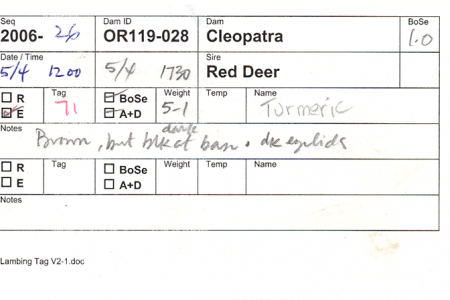
Every picture still tells a story even if Rod Stewart does not, so before I get any further wound up about lambing cards, let me show you what one looks like.  Here is our card for Cleopatra and her first lamb, Turmeric, in 2006:

lambcard3.png 

A few notes on a few items.  The first box, Seq 2006-  tracks the order in which the ewes give birth.  Cleopatra was our 26th ewe to lamb in 2006.

OR119-028 is Cleo’s ear tag number.  We always double check the ewe’s tag once we get her in the jug with her lamb(s).     

BoSe in the upper right hand corner reminds us to give the ewe her shot of selenium and vitamin E supplement, 1.5cc for big ewes, 1.0cc for gimmers.

Date/time of course records when the lamb arrived.  We use the adjacent blank box to record the date and time we first work the lamb.  That way, we can decide whether there’s enough of a time lag to warrant adjusting the lamb’s birth weight for a later-acquired belly-full of milk. 

Tag.  If you look closely at a lamb’s ears (sheep, not botanical), you know how small they are, too delicate to support a full-sized eartag.  To avoid lamb mixups, we install little plastic temporary eartags on our newborns. 

Notes – our catchall.  Looking over the 2006 cards, it seems we cared most about fleece and whether a lamb was light or dark phase.  Typical are Steve’s comments about Turmeric, roughly translated as ”Brown [fleece], but dark/black at base. Dark eyelids.” 

Twins.  Luckily, Steve designed our card to accommodate the possibility of multiple births.  Last year we needed this option for eight pairs of twins, whew! 

Have I persuaded you of the benefits of lambing cards?  If so, the key is to make them before lambing starts.  Their utility lies in having them ready to grab and go.   You can design them on the computer (Mailmerge on Microsoft Word works just fine), by hand, or on your trusty old Selectric typewriter.  One size does not fit all.  Your custom-designed card will mirror your operation and will include the information important to you. 

Oh yes, if you happen to own a Roger Clemens rookie card you’d like to trade for a tan Soay ewe with great horns, give us a call — collect.

For now …