Archive for the 'Genetics' Category

Identifying Soay sheep as “light phase” — a photographic primer

Saturday, February 13th, 2010

Few issues vex new Soay sheep owners as much as the quandary about whether one of their animals is “tan” or “light phase.”  I recently stumbled across a digital “stack” of photos of our light phase Soay taken over the last several years.  Posting several of them here, with minimal commentary, may help train your eyes to know whether a light-fleeced Soay is also genetically light phase.  If I had a newer version of the software, I could arrange the photos more artfully, but at least you can scroll through these pictures and get a feeling for the look of a light phase Soay.

Let’s start with a couple of examples to get you oriented.  The telltale signs to watch for first-off are the pale skin next to the eyes, almost translucent, and the equally pale lips.

080715-039a.jpg

This light phase ram, Hershey, also had extremely light fleece.  But note the fleece of the ram in the foreground of the picture.  He clearly is a dark phase animal, yet his dark fleece has bleached to almost as light as Hershey’s fleece.  Later in this pictorial tutorial I’ll show you how to use fleece to help decide whether an animal is light phase.  For now, let’s stick to the eyes and lips.

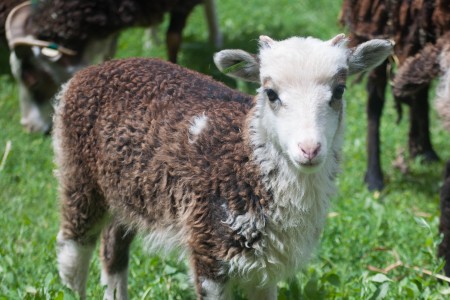
Although the next lamb shown has luxurious reddish fleece, much darker than Hershey’s fleece shown above, you can tell the lamb is light phase by her telltale pale lips and eye margins.

090509-031a.jpg

and a closeup shot of the same lamb’s face:

090509-031b.jpg

Red Deer, shown next, also was a light phase ram.  Look at his pale lips and eye margins.

gseiii-055a.jpg

Same ram, closeup to give you a better idea of what to look for around the eyelids and lips.

gseiii-055c.jpg

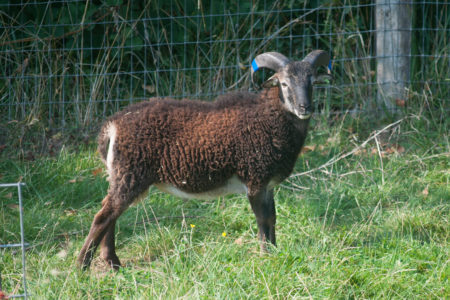
Time for compare and contrast.  The next picture shows a dark phase Soay ram with fairly light fleece (sun-bleached tips), but definitely not a light phase.  Notice how dark the skin is around his eyes, sort of like the horrible black eyeliner women wore in the 60s.   Dark, often nearly black, skin right next to the eyes is the most immediately noticeable difference between the relatively uncommon light phase Soay and the predominant dark phase Soay.

080715-022a.jpg

Many Soay sheep carry the recessive gene for light phase, but they are not themselves light phase animals.  They can produce light phase lambs when bred to a light phase animal.  Every lamb from this breeding has a 50% chance of being light phase because it has to get one gene for light phase from its light phase parent, and it has a 1-in-2 chance of getting its other parent’s light phase gene.  The carrier also can produce a light phase lamb when bred to another light phase carrier, but the chances of the lamb being light phase will be only 1-in-4.

The next two pictures show two of the most beautiful ewes to grace our pastures, Nell and Sandpiper.  They both carry — but do not express — the recessive gene for light phase.  For purposes of this post, the important fact is that neither Nell nor Sandpiper is a light phase ewe, and you can see that they are not light phase when you look at … what?  Their eye margins and their lips.  First, the two of them posing to show off their lovely light colored fleece.

nellandiris-005a.jpg

And now the giveaway closeup.  Look at the dark “eyeliner” and lips:

nellandiris-005b.jpg

The difference between light phase and dark phase also shows up dramatically in lambs.  The next picture shows twin lambs, one light phase (on the left) and the other dark phase (on the right).  As you can see, both of them have light fleece.  In fact, the dark phase lamb had lighter fleece at the time this picture was taken.

090511-009a.jpg

The more chocolate-y fleece of the light phase lamb is typical.  We have been fooled, at first glance, by lambs we assumed were dark phase because they had medium brown fleece, but their eyelids and lips gave them away as light phase, and their fleece lightened as they grew older.

The next two photos show the light phase lamb, and then the dark phase lamb, up close.  You should be able to see a distinct difference in their eyelids and lips.  Here’s the light phase lamb.

090511-009b.jpg

and here’s the dark phase lamb.

090511-009c.jpg

A third characteristic shared by all light phase Soay (besides eyelids and lips) is pale skin right under the tail.  Two years ago one of our first AI lambs, light phase Arzie, struck a lovely pose for the camera, showing her pale eyelids and lips,

080407-024a.jpg

and then without warning she turned around to display the pale skin under her tail — talk about lucky timing for the photographer!

080407-022b.jpg

Caveat: Although many dark phase Soay sheep have dark, nearly black, skin under their tails, an awfully lot of them have the same pale skin back there as light phase sheep. Truth to tell, I might have left out this “distinguishing” characteristic altogether if little Arzie had not flashed her bum for me without having to be picked up and put through the indignity of a posed photo of her back end.

Yet another hint in distinguishing light phase from dark phase is provided by the roots of the fleece.  In light phase sheep, the fleece will be light or medium brown all the way to the skin, even if the tips are noticeably lighter from sun bleaching.

gseiii-058a.jpg

In dark phase sheep, even if the fleece is bleached quite light, as in this “frosty” Soay, the roots will be really dark brown and appear black.  Here’s an example:

090429-003a.jpg

Okay, are you ready for the quiz?  First up is Fennel.  Look at her gorgeous fleece.  Light phase or dark phase?

ewes070825-120a.jpg

Would you like a closeup to help you decide?

ewes070825-120b.jpg

A:  Dark phase.

How about this sweet little lamb - light or dark phase?

newtanbaby-010a.jpg

A:  Light phase.

In closing, I have a confession to make.   Despite Steve’s heroic efforts to persuade me that the most important aspect of our breeding program is our strict rotational conservation breeding in which we do not choose matings by the handsomeness of the parents or by what color fleece they have, I remain a total sap when it comes to light phase Soay.  For me, there is nothing more endearing than the pale lips, winsome fawn-like eyes, and creamy light reddish fleece of the light phase lambs.  Hooray for recessive genes!

For now …

Soay sheep genetics for beginners

Wednesday, February 6th, 2008

I have a confession to make:  it is not always easy being married to a professional geneticist.  To be sure, it was fun to watch Steve put the Open Flockbook Project together and it is heart-warming to get e-mails from breeders who are able to put together authentic conservation breeding groups or find the Soay they want to buy using the online database.  The downside is that well-meaning Soay breeders ask me questions all the time, assuming Mrs. Flockmeister also understands genetics, and let me tell you, Mendelian genetics is hard to fake.  My years as a trial lawyer and piano player taught me a lot about bluffing and I suppose I should be grateful for the opportunity to keep these skills from rusting.  But I am embarrassed to say I did not pay attention in biology class in high school and I started out this Soay sheep caper knowing zero about recessives and gametes and double helices.

And so it was out of self-defense that I recently went on the web looking for places to read about the genetics of inheritance in order to understand why it is that Grace gave us a light-phase ram lamb and Celadon surprised me her first year with a black lamb.  I know, I can always ask Steve, and how lucky I am to have this resource right in my own home.   Don’t get me wrong.  It is great being able to ask the professor without waiting for office hours.  But after six decades of this life business, my powers of retention are shot, and I am too proud to ask Steve to explain what a chromosome is for the umpteenth time.   

Finding good sources of information was easier than I thought it would be.  I was not interested in a book so heavy it would serve better as a doorstop, nor one that consisted of nothing more than stick figures and cartoon balloons above dividing cells.  I have read Genetics for Dummies and its section on patterns of inheritance does not take you very far.  What I wanted was something I could work my way through in the mornings over a cup of coffee and without the distractions of chores or piano practicing.  There doubtless are dozens of similar sites, but three I found without much effort helped me and I hope they will help you, too.  They should give you enough background and knowledge of the jargon to make you more comfortable about what’s going on with color and horns and other characteristics of your Soay, without falling into the black hole of academic genetics that swallowed up Steve decades ago.

Morgan, a multimedia tutorial from Rutgers University, covers the basic principles of  genetics.   Each chapter has ten distinct parts you can work through at your own pace and then test yourself with their short quiz to see if you “get it.”  

Dr. Steven Carr, Department of Biology, Memorial University in Newfoundland, Canada, has put together a dandy one-page chart of Mendelian rules summarizing the definitions and basic rules of inheritance.  It is a little intimidating at first because cramming so much information onto one page makes it pretty dense to read, but if you work your way carefully through the chart and the definitions, you will end up smarter at the end of the page than when you started.  It is a good place to look back at for a refresher when someone starts yattering about “double heterozygotes” just when you are trying to finish cooking dinner. 

The American Mathematical Society has put together a detailed but not fatally technical summary of molecular biology and genetics.  It is a good “next step” after the first two sources.  You will need to read it when you are rested, as the typeface is maddeningly small and they wasted no time on the niceties of page layout, but it is rich in content and provides an overall context for the narrower issues of horn shape and fleece color we all face with our Soay sheep. 

It may be that simply living in the same house with a geneticist for over 36 years has skewed my notions of beginning genetics, so I would appreciate if you let me know whether you find these sources useful.  In any case, I promise there will not be a quiz next week, or any time soon.     

For now …