Archive for April, 2007

Jugging revisited

Monday, April 23rd, 2007

A number of regular and usually supportive readers, including my brother Jim, have expressed skepticism here and elsewhere about the notion of “jugging” and where it fits in the greater scheme of things.  One observer questioned the very existence of jugging, suggesting in polite tones that perhaps I made the whole thing up as a literary foil.

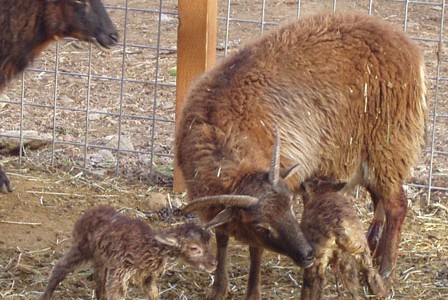
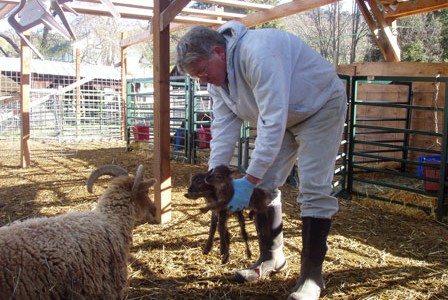
Make up jugging?  I don’t have enough imagination.  But in the interests of family harmony and to dispel any lingering doubts, here is an actual jugging dance featuring Gala and her twin lambs, Darrowby and Thirsk, a few days ago.  After a suitable musical introduction, let’s say 8 bars with a trumpet fanfare and a drum roll, Steve begins the dance by donning his blue gloves, picking up the lamb(s) and inching his way backwards towards Gala’s assigned recovery room — her jug de jour.  

jugginggala041307-009a.jpg

Steve tries to keep the lambs no more than about a foot from Gala’s nose, to be sure the olfactory link is not broken.

jugginggala041307-011a.jpg

Even at this early stage, it is apparent Gala’s lambs are not light phase (tan) as she is, but aren’t they cute?

jugginggala041307-013a.jpg

Almost all our ewes hesitate at the gate into the jug, torn between following their lambs and the fear of being “trapped.” 

jugginggala041307-015a.jpg

The lambs always – no exceptions — win out!

jugginggala041307-022a.jpg

With the gate shut and the sun shining, Gala can go back to the business of cleaning and feeding her little brood in relative tranquility.

Technical note:  The photos have not been subjected to PhotoShop (not that I’m against PhotoShopping, but I couldn’t have improved on this set even with Adobe’s help).

Naming note:  We waited patiently as our RBST/British lambs arrived one by one, saving Darrowby and Thirsk, the literary and literal names of James Heriott’s town, for a particularly nice-looking set of twins.  Now I can write to my new friend Anne, who I have ignored for several weeks, to report on the litany of lambs with melodious names from Yorkshire:  Appleby, Bainbridge, Boltby, Borrowby, Chopdate, Follifoot, and the list goes on, each temporarily housed in a jug and each welcome at Saltmarsh Ranch.

 For now … 


Twin Lambs: the Multi-tasking Soay Ewe in Action

Saturday, April 14th, 2007

Quite by accident, I found myself a couple of days ago in the Maternity Ward with my camera just as Sandpiper started to lamb. Our first year as shepherds I dutifully photographed every birth, but no more. A person can get worked up about a still shot of an amniotic-sac-covered lamb just so many times in her life. But soon after Sandpiper’s first lamb arrived, it became clear another one was on the way, so I started clicking, and I am glad I did. Here is Sandpiper nudging her first lamb back towards her udder for the all-important initial meal of colostrum.

sandpiper040307-001-a.jpg

Not much news there; any self-respecting ewe will clean off her lamb and get it eating as soon as possible so it will stay warm and thrive.

But look again at Sandpiper’s back end. See those little black and white things sticking out of her vagina? Those are lamb #2’s front hooves on their way out of the birth canal. Is Sandpiper paying the slightest bit of attention? Nope, she’s too busy taking care of lamb #1.  

Next picture, less of lamb #2 shows here, probably between contractions, but Sandpiper seemingly takes no notice in any case, no matter what her body tells her is about to happen — again. She is still busy with lamb #1 and determined to get him jump-started before she turns her attention to her second lamb.

sandpiper040307-002-a.jpg

In the next photo, still no lamb #2, so Sandpiper has just enough time to get lamb #1 feeding.

sandpiper040307-004-a.jpg

Actually, even though lamb #2’s hooves are back out in the next picture, Sandpiper stays on task and finishes licking the membranes off lamb #1.

sandpiper040307-005-a.jpg

And it’s a good thing Sandpiper stayed focused, because by the time I could take the next picture, the second lamb was on the ground. Lamb #2 is the yucky-looking slimy black mass in this picture.

sandpiper040307-007-a.jpg

Now, finally, Sandpiper is satisfied that lamb #1 can fend for himself for a few minutes, and she turns her attention to lamb #2 and starts the cleaning-licking-nudging process all over again.

sandpiper040307-009-a.jpg

Just a few minutes later, the little family of three is all cleaned up and ready to go.

sandpiper040307-011-a.jpg

As you know from reading my last post about lamb games, lamb #2 (Cascabel) actually wandered off about this time and Llucy had to fetch him back. In this picture, you see Cascabel turning away from Sandpiper and getting ready to strike out on his own.

sandpiper040307-013-a.jpg

Why he did that we will never know. We do not see this kind of wandering very often in a newborn. The ewes each have a unique gurgly-meowing-baa sound that only the “right” lamb responds to, and the lambs each have a slightly different baa sound as well. Whatever possessed Cascabel to go exploring, with Llucy’s help he was reunited with his mother and all was well and remains well. But let me tell you, once Sandpiper finished her double lambing, she chowed into the hay like there was no tomorrow. There is tomorrow, however, and it will come soon enough for the pregnant ewes who have yet to show off their multi-tasking skills.

 For now …

Let the [Soay Lamb] Games Begin!

Monday, April 9th, 2007


Having now dithered for a full two weeks trying to figure out a way to introduce our lambs, I have given up on the notion of an orderly, grown-up recitation of the lambs as they arrive, complete with mini-pedigree and a clever phrase about each one.  My downfall was watching the little woolies cavorting about in the Maternity Ward.

Duh – how about sharing some of that fun instead of yammering about lineage?  You would prefer that?  So would I, at least until Steve finds out and makes me go back to serious heritage questions. 

For three years straight the lambs have shown us by example precisely when the lambs are ready for their first taste of freedom from tagging along after mama every waking moment.  Imitating the big girls, they jump into the portable hay wagon (a.k.a. garden cart) and play with the hay, pretending to eat with all the earnestness they can muster.  Sometimes the game ends when too many of them move to one end of the cart, upending it with a great flurry of mock-horrified lambs.  Here’s the squad crowding in, all of them only 3 or 4 days old.

lambwagon040407-002a.jpg

Meanwhile, one would think that a day-old lamb would be content with her mother’s milk, but not our Borrowby.  Does she call to mind the old adage, ”the grass is always greener”?  I shudder to think what she’ll do when she gets old enough to go after real grass.   

gigtwins040407-004a.jpg

I sense a theme developing.  Here is Bowie checking out the buffet line in our Shaul feeders.

bowie032907-004a.jpg

Mind you, the lambs do not really eat solid food for some days yet, but by golly they are going to have their chewing and sniffing skills honed when the time comes.

Our first lambing year I was surprised to see the lambs engaging in what looked for all the world to be teething.  Hadn’t even thought about it, but no harm done.  Even if I had stocked up on those hard rubber gadgets human babies use when the Ryecrisp runs out, they would have gone to waste.  As Catalina demonstrates, the lambs much prefer the edges of the portable hay wagon.

catalinawagon040407-003a.jpg

Not all the lamb activities are food-oriented, although it seems that way most of the time.  Here is little Bisbee looking up at Llucy, pretty clearly thinking to herself, “you are an awfully big sheep.  Will I be that tall when I grow up?”

bisbeellucy032907-003a.jpg

Someone asked us the other day if there is a measurable difference in the sizes of Soay.  Catalina again assists with a demonstration.  She is the biggest lamb we have ever had, weighing in at a hefty seven and a half pounds right after birth.  Contrast that with Arivaca, the smaller lamb in this picture, who weighed only five and a half pounds after his first feeding.  Even Arivaca is large compared to our average lamb weight, which is comfortably under five pounds.  And besides that, Arivaca is four days older than Catalina.  With the steep growth curve these lambs experience in their first three or four weeks, the difference in size is even more pronounced.   

catalinaarivacawagona.jpg

There is always a game of King-of-the-Mountain going on in the Maternity Ward. Who knows which of the little ruffians are in this picture, but they are mighty grateful to Steve for arranging a “safe” place for them to test their climbing skills.  Of course, part of the game is to fall off and scramble back up for more.

lambhaystack040407-012a.jpg

In the midst of all this folderol, long-suffering Llucy was trying her darnedest to help get Sandpiper’s second twin, Cascabel, back to his mama.   Sandpiper had done a spectacular job of getting the two lambs out and cleaned off, but then Cascabel simply wandered away.  In this picture, Sandpiper is quite a ways off to the right with her first lamb, Calabasas.

llucymidwifesandpiper040307.jpg

Appearances to the contrary, we do try for a modicum of scruffy gentility here at Saltmarsh Ranch, including in the Maternity Ward.  Nothing captures this goal better than watching Amado and Arivaca out for an afternoon promenade with their mom, Willow. 

amadoarivaca032907-005a.jpg

Are you persuaded that decorum reigns on a Soay farm?  Don’t be.  Tranquility, like fame, is fleeting.  Within minutes of a peaceful walk, all of the lambs are likely to congregate and take off like Kentucky Derby contestants.  As Steve put it when he saw the next picture, you cannot remain grouchy in a lamb pen.  Involuntary belly laughs are the order of the day.  Here is the first lap at Saltmarsh Downs.

racinglambs040407-001a.jpg

Not surprisingly, as fast as the little juvenile delinquents organize a game, they collapse for brief naps.  I’ll close this post with an endearing little lamb asleep under the hay feeder.

lambsplaying040207-004a.jpg

May your lambing be this much fun and then some.

For now …

Working a Soay Lamb – the Lambing Kit in Action

Wednesday, April 4th, 2007

Now comes the fun part, working with our lambs instead of endlessly talking about them!

I already used up the “every picture tells a story” line, so let’s just say one of our cooperative new lambs and my trusty digital camera will show you how we work our newborns.   Remember the Lambing Kit?  As soon as our first lamb arrived, the L.K. swung into action.

These pictures star Amado, a twin American ram born last week.  Ready?  Here we go.

Setting the stage:  Steve sits down on the folding camp stool in a small enclosure, picks up Amado, and waits a couple of minutes while mama ewe Willow gets accustomed to sharing her lamb.  The goal is to do everything calmly.  As soon as Steve upends Amado, we learn he is a ram.  I run the portable database (i.e., the lamb card), entering what “lambing” it is, date and estimated time of birth, date of working, gender, etc.

A little KY or vaseline on the thermometer

working2a.jpg

and voilá - in goes the thermometer.  Do you think the look on Amado’s face suggests he knows what’s coming?  Yuk.

working3a.jpg

As I mentioned in an earlier post, you need not take a healthy lamb’s temperature.  We do it because we are numbers nuts and also to confirm what the lower end of our “healthy” range is so we will have an indicator of when we have a lamb in trouble.  Amado’s temperature was 102.5 F; he clearly had gorged himself  before we worked him about 9 hours after he was born.

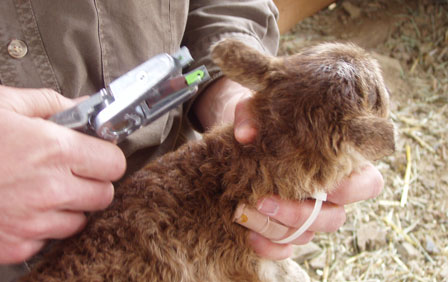
Next Steve puts in the baby eartag, two little bitty pieces of green plastic stamped with a number and applied with a task-specific tool that looks like a paper punch.  We get these tags from a supplier in the U.K. and they are really useful.  They allow us to identify our lambs immediately, preventing any possibility of mixup.  If you are the keeper of the Open Flockbook Project, as Steve is, it simply will not do to mix up lambs.   The little white strap around Steve’s fingers is neither a lamb tether nor a designer collar; it holds the arms of the applicator together in the Lamb Kit to prevent iodine spills and general chaos.

working6a.jpg

By informal convention, Soay rams have adult Scrapie eartags in their right ears, so Amado’s baby tag goes in his left ear and will stay there even after we install his adult tag (right) when he gets his first tetanus shot at 8 to 10 weeks.  More on ear tags and the federal Scrapie programs in a later post. 

working7a.jpg

I forgot to take a picture of Amado getting his BoSe and vitamin shots, but that’s the next step in the process.

Then into the sling goes the lamb for weighing.   The scale above is a Rapala fish scale, 50-pound capacity, and the sling below it probably came from Jeffers.  I plan to talk about lamb and adult weights in a later post, so for now let’s just say it is a completely optional step in the process.  If you are new to Soay, let me put Amado’s weight in perspective.  He weighed 4 pounds 11 ounces at the age of 9 hours.  That’s a half gallon of milk and change.  When people brag about their easily-handled Soay, they mean it.  These sheep are small. 

working4b.jpg

The only part that sometimes upsets the lamb is The Dipping Of The Cord.  Remember the “ahem” caution I gave you in the iodine posting earlier?  As you can see, with ram lambs your aim has to be good:  Steve’s middle finger points to the umbilical cord, his ring finger points to the little guy’s tiny pink penis.

working8a.jpg

We take one final precaution before we turn the lamb(s) and ewe loose to do a ceremonial turn around the Maternity Ward.  Also not a mandatory procedure, but certainly sound husbandry, we give a shot of BoSe to the new mama for good measure, just in case she became selenium deficient with her in utero lamb filching it from her.  Pressing the ewe to your chest as Steve is doing in this picture eliminates the need to plop the ewe on her rear, the conventional way of working a sheep, when her vulva and her udder are still very tender and vulnerable.

working9a.jpg

Here is Amado reuniting with Willow in a fun bunch of fresh straw we had put out for Venus (remember Venus, she of the broken leg?).

working10a.jpg

And to complete the storybook, here are Amado and his twin brother Arivaca headed up to the feeder so mom can get refueled before refueling the twins.

working11a.jpg

See why we use eartags to identify our lambs?  Can you tell Amado and Arivaca apart?  We can’t unless we pick them up and check their numbers. 

For now …