Archive for May, 2007

Break A Leg: Venus lambs successfully, and how!

Thursday, May 24th, 2007

Neither traditional dictionaries nor any of the numerous websites that trace the history of “Break A Leg” have seen fit to include lambing in their list of definitions, or Soay lambing as a possible source for the expression.  They obviously haven’t been reading this blog.

Breaking a leg sure brought Venus good luck.  Last year, with her leg intact, she delivered a pair of mouflon boys.  While they were very cute and grew up to be very handsome, they were still not the black Soay we were hoping for from Venus, who in Steve’s genetics jargon is an obligate carrier for self-coloration.  Translation:  her mother was black.

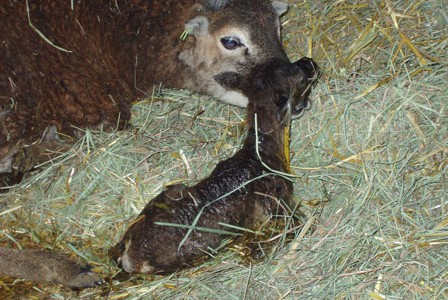
But give this ewe a broken leg to contend with and boy does she ever rise to the occasion.  She not only produced a black lamb last week, but a huge healthy one at that, the biggest lamb we’ve ever had at a stunning 7 pounds 9 ounces (more than 3 times the size of Otley, for example).  I don’t know how many of you out there have had a broken leg, much less given birth with a splint on one leg, but I find it downright impressive that Venus managed her delivery, cleaned and completely dried off the lamb and fed him, all without our even knowing it had happened.   Here’s the happy pair, Venus and Tolleson, shortly after Steve jugged them [Side note:  I’m sorry I missed the jugging dance, with Steve stumbling backwards and Venus lurching forward].

venuslamb051407-003a.jpg

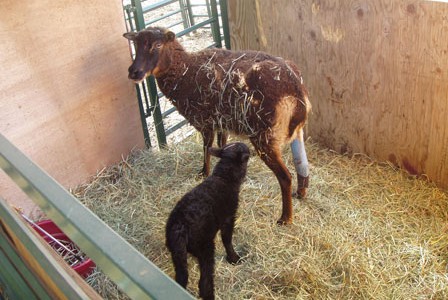
By the next day, young Tolleson was wandering around the jug and Venus was behaving as though lambing with an immobile leg is the most natural thing in the world for any half-capable Soay ewe.  Look at the size of this lamb.  Most one-day-olds have to strain just to reach the ewe’s udder, for heaven’s sake.

venuslamb051507-002a.jpg

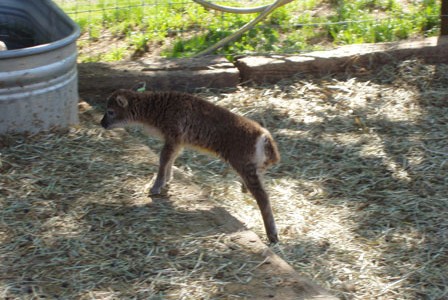
It’s a good thing Tolleson is so big and robust, because we realized we needed to get Venus out and walking around as soon as possible after more than two months in spaces no bigger than 5 feet by 5 feet.  For the last week she and Tolleson have had the run of a corridor about 25 feet long and 5 feet wide adjacent to the jugs.  In this picture, Venus is doing laps at a most respectable clip, with Tolleson jogging along beside her.

venuslamb051807-002a.jpg

We have no notion what we will do if we ever have another animal with a broken leg.  At this point, we are simply relieved Venus came through all of this alive and healthy and her lamb is alive and thriving.  Maybe when we get the lambs vaccinated and weaned and turned out to pasture, I will contact Wikipedia and suggest they modify their interminable lists of definitions and sources for “break a leg” to include “may ewe have a successful lambing.” 

But for now … 


Otley Update

Tuesday, May 15th, 2007

When last we met here, Otley was a 3-day old, unusually small lamb who already had seen the world and was none too pleased with it.  As you will recall, Otley not only arrived at less than two and a half pounds after her mother struggled mightily to deliver her, she also ran away from home at the age of 3 hours, changed her mind when she encountered giants and ghosts in the outside world, and announced in a loud voice to all who would listen that she was sorry and would never do it again.  So much for the peace and tranquility of sheep-raising.

Fast forward two weeks.  I was out photographing the latest arrivals, nearly all rams to my dismay, when off to the side I spied a little bitty lamb scrambling up the edge of the “high” platform in the feeding area of the Maternity Ward.

otley051007-003a.jpg

Guess who was out exploring again?  Mind you, Otley and her mom, Tolcarne, long since were kicked out of their jug to make room for new arrivals, so this time Otley’s wanderings were at least sanctioned.  On the other hand, making her way to the hay feeders was a futile gesture, since she will not be ready to eat solid food for awhile yet.  Did that stop her?  Not our little Otley.  Soon she stood behind the row of ravenous ewes who were refueling before the next round of nursing started up. 
otley051007-006-a.jpg

In the good old days, any self-respecting drug store featured a variety of dairy products at the soda fountain, but I suspect none provided the array of options Otley thought were hers for the picking.  I was not able to capture in still photography her several efforts at poaching off someone else’s mother, but suffice to say she soon figured out she was not invited to anyone’s “house” (except Tolcarne, of course) for lunch and she resigned herself to a mid-day snooze.  Otley is the little lamb to the right of her larger and more experienced cousins, none of whom, it appears, had succeeded in pilfering someone else’s sack lunch either. 

otley051007a.jpg

And last but not least, for those of you who thought I was making it up when I said the miniature Otley could make a lot of racket from the first minute she hit the ground, put away your skepticism.  Here she is letting the world know – again – that she is a force to be reckoned with.  Move over, Nora, Madonna, Dolly, Eartha, and all the other great throaty chanteuses.  Otley intends to claim her rightful place in the singers’ pantheon, thank you very much.

otley051007-001a.jpg

For now …   
 

Mama’s Got a Brand New Bag: First-time Soay Mothers

Tuesday, May 1st, 2007

Some of the indications that a Soay ewe is about to lamb are seen only in an experienced ewe.  If she is going to twin, she usually looks like a propane tank.  Even if carrying only a single lamb, an older ewe will develop saddlebags and a waddle.  The yearling ewes (”gimmers”) who are lambing for the first time exhibit more subtle signs of approaching labor, oftentimes surprising us when a lamb appears.  They never have a big soft bag for several days or even several weeks before the lamb arrives, as do their matronly colleagues.  In our experience, gimmers do not bag up until a few hours (at most) before they drop their lambs, and even then, their bags are hard to spot.    

Leave it to Tolcarne (who happens to be the first British ewe born here) to lead by personal example and remind us shepherds of our limitations in the lamb forecasting department.  It was not a dark and stormy night, quite the opposite.  Friday afternoon was a peaceful time in the Maternity Ward, with nothing but the sound of 50 ewes eating for two and the muted thunder of 120 little hooves doing laps and wind sprints to break the silence.        

Without warning, out of the corner of his eye Steve noticed The Kick, a tell-tale sign of a ewe in labor.  We had not even been certain Tolcarne was pregnant.  She had no poochy belly and no bag, but there she was, lying on her side, vigorously kicking straight out horizontally, not at all the langorous stretching they do all the time, pregnant or not.  I have never been able to capture The Kick on camera, but I promise you, when first you see a ewe executing The Kick, you will recognize it as something new, something different.  It is unlike any of the other gestures in the Soay repertoire.

Most ewes proceeding through labor get up and down a number of times in a restless Birth Dance.  But not so Tolcarne.   In obvious discomfort, she just lay there grunting and whimpering, frightened and in pain.  Steve managed to nudge her into a jug, concerned about her immaturity and inexperience and wanting her in a relatively clean, dry place with no distractions.  And in fact, she did have an uncommonly hard time getting her lamb out, to the point that Steve took the nearly unprecedented step of intervening, gently rolling back the skin of her vulva just enough to ease it over the top of the lamb’s skull.  Unlike the body of the lamb, which can be squeezed out and is quite malleable, its skull and front feet, which come out together, do not give at all.  Anyway, once Steve helped get the lamb’s head moving, the rest of the package plopped right out in a few seconds.

We were startled.  Given how much exertion it took Tolcarne to give birth, we could not believe how small her lamb actually was.  And Tolcarne had so exhausted herself that she lay immobile for a long 5 minutes.  This is most unusual for our ewes, who either birth standing up or immediately get up, licking and gurgling, and get right to work on the lamb.

Fortunately for the lamb, Steve had rubbed her nose just enough while she was coming out to break the membranes, allowing our miniature Soay creature to start bellowing like a miniature Soay bull or, more accurately, a miniature mezzo soprano.  Gilbert and Sullivan, here we come!  At first we worried that we had a preemie on our hands, with the attendant lung problems, in particular the possibility that her lungs, which are collapsed in utero, would not convert to “balloon mode,” as must all babies right at birth.  To our relief, we concluded a preemie with lung problems could not possibly make this much racket.  It was a very encouraging sign and just plain funny in an otherwise somewhat tense situation.

Tolcarne, on the other hand, was not as impressed as we were with her squalling, slimy bundle of joy.  Her life had just taken a dramatic, irreversible, and from the look on her face, not entirely welcome turn:  “This is not the career path I had in mind.” 

tolcarnelambs042707-004-a.jpg

Other than dipping the cord in iodine, we elected to leave Tolcarne alone for the post-birth cleaning and first meal.  Steve does not like to “work” lambs with gloves on and it seemed too soon to handle the tiny lamb with bare hands.  By this time Tolcarne had roused herself and was starting to get down to business, so we decided it was safe to leave the two of them alone for their ancient, instinctive rituals.  

tolcarnelambs042707-010-a.jpg

Back to the house we went for our own dinner (Note to self:  do a blog posting on the realities of human meal planning during lambing).  Turns out we need not have worried about this little lamb’s resourcefulness.  When we returned to the Maternity Ward to work her it was dark.  All forty-plus lambs, having found their mothers, had with one exception turned in for the night.  You can guess who the holdout was.  Once again she was bellowing, but this time from amidst the general population of bedded-down ewe-lamb pairs.  Somehow she had managed to crawl out of the jug through the bars of a Shaul panel and had marched right out into the fray, where I found her surrounded by – in relative terms – elephants and dinosaurs.  No baby Mozart this lamb; she was in full Wagnerian coloratura, waking everyone up with her high notes.  

tolcarnelambs042707-015-a.jpg

Back to the jug she went.  Up went cardboard, plywood, anything we could find to secure the four sides of the jug.  We were not about to lose a precious little British ewe lamb to sleep-walking.

Working her started uneventfully enough — Good temperature (102.4), easy tagging, injections without undue wiggling.  Then came the weigh-in.  Even carrying her back to the jug could not have prepared me for seeing a mere 2 pounds 6 ounces register on the scale, almost a full pound less than the smallest lamb we have ever had, and at least two pounds smaller than average.  Where did all that lung power come from?  How could she possibly have had the strength to start a cross-country trek at the age of two hours? 

Now it is three days later and little Otley (named for a small town in Yorkshire) is to all appearances doing just fine.  She has not managed to get out of her cardboard-lined nursery again and she gets up and feeds regularly.  Little mama’s brand new bag also is functioning just fine, thank you. 

tolcarnelambs042707-016-a.jpg

We remain concerned that Otley’s small size may present problems over the next few weeks, but at this point, she is every bit as robust as her larger cousins.

Meanwhile Tolcarne has, to our great relief, concluded that motherhood may compare favorably with a career outside the home after all.  And besides, with Otley’s musical talents, she may yet support her mother in Tolcarne’s dotage.   

For now …