Archive for August, 2007

Perhaps the greatest initial investment a Soay keeper needs make is decent fencing to keep the little darlings home and safe.  Alas, the aesthetics of a run of taught, newly-installed wire fence fastened neatly to precisely aligned, precisely vertical fence posts is of no concern to the rams, especially during rut.  They bash away without shame when they are trying to court the ladies on the other side of the fence.  Let it be said, in fairness to the rams, that ewes also engage in this most unattractive behavior, with more persistence if less power.  Ordinarily they do not actually broach the fence, but clips come loose, unsightly bulges develop, and the bottom of the fence raises up to the point that stupid lambs will get their necks caught reaching underneath.  All most annoying to an otherwise agreeable shepherd.

Consider the options.  You can sell the sheep and take up some other hobby.  Or you can always just eat them.  Less drastic, if expensive and back-breaking, you can replace the trashed fence entirely with a stout board fence of 2-by-8’s bolted to railroad sleepers.  Better yet, make use of the fact that a sheep will not bash what he, or she, cannot see.  That is, provide a View Block.

A View Block is just that – something, anything that keeps a sheep on one side of your fence from seeing, and trying to get at, what is on the other.  There are any number of strategies.  A friend of ours came by a great stack of used plywood sheets some years ago.  Every autumn she lugs the whole lot to the fences separating her various breeding groups and ties the pieces together end on end with scraps of baling twine from last year’s hay bales.  Economical to be sure, but only if you have a source of free plywood and a strong back you are willing to sacrifice to the cause. 

Last year about this time, just as the rams were gearing up for their annual testosterone-driven display of head-butting, we stumbled on a less strenuous and for us more practical alternative.  Steve was out one day laying black landscape cloth along one of our fences to keep grass and weeds from shorting out the electric “scare” wire.  A gust of wind blew a loose flap of the cloth up against the fence, blocking our view.  Eureka!  If it blocked our view, it also would block the animals’ view. 

For readers not familiar with this stuff called “landscape cloth,” here is a modest description.  It is generally black, somewhat the texture of thin felt except made from a woven synthetic fabric, water permeable, UV-resistant so it lasts a long time, and mechanically strong so it does not stretch – all desirable characteristics.  At our farm store it comes in 3, 4, 6, and 12-foot widths, the 4-foot size being just right for our fences.  It is sold in 100 or 200 meter rolls (go figure).  Landscape cloth usually goes under a gravel lane or walkway to keep weeds from growing up through the rocks, or under the mulch layers of flower beds much tidier than the ones found on our farm.  (We like to think of its new use as keeping our ram or ewe “weeds” from getting through the cloth to the other pasture.).

Steve folds the cloth over the top of the fence, leaving a 4-inch flap (somewhat akin to a selvage if you’re a tailor or seamstress) on the other side, and secures it with cable ties, the doodads electricians use for bundling wires.   Here’s a picture of one of our View Blocks with the flap folded over and held down by cable ties. 

viewblock-001a.jpg

Any scraps of wire or twine also will do to secure the cloth.  Using a 10-penny nail to poke a hole through the main sheet of cloth and the flap, as close to the top wire as possible to provide a snug closure, we zip up a cable tie every 2 feet or so across the top length of fence.  The goal is to keep the cloth flat against the fence and tightened down so the wind cannot allow any flapping or billowing pieces to get started and eventually tear off.  Here’s a closeup of the cable tie securely anchored.
 
viewblock-003a.jpg

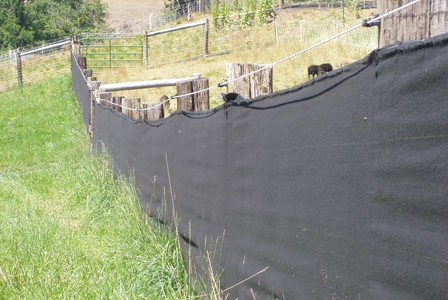
Our first fence outfitted this way was equipped with a stout flat board – a batter board actually – about 15 inches above the ground that we originally installed against the actions of a particularly determined ram.  After securing the top edge of the cloth with cable ties, Steve simply nailed the bottom edge of the cloth to the board with wide-headed roofing nails.  Although we fretted the winds would pull the cloth through the nails, we got through breeding season last year with no mangled fences and nary an attempt at bashing through the cloth. It has been nearly a year and so far the View Blocks are intact and ready for another rut, which is fast upon us.   Here is the full expanse of our most needed View Block from last year.  It kept Warwick, who had been favored with over 20 ewes in his own pasture, from bashing through to get at the additional ten or so ewes who were being courted by Jerry on the other side of the fence.  Good grief.

viewblock-007a.jpg

In the Soay world at least, good fences do indeed make good neighbors.  Warwick and Jerry finished their appointed tasks without a single dustup, and who knows whether the splendid bunch of really good-looking lambs that ensued was thanks in part to the fact that their daddies were not distracted by the possibilities just beyond the fence.      

The other method we tried came about when Steve noticed a pair of ornery ewes, known troublemakers, deep into an extended dispute back and forth along a 150-foot fence, making a mess of the whole length of it.  Indifferent to the source or explanation of such unappealing female behavior, Steve quickly threw up a cloth View Block.  This fence was not fitted with battering boards, so he used cable ties both top and bottom.  It worked for awhile, until the ewes were moved to another location.  But over the winter, the bottom edge of the cloth tore loose, creating an undulating but ineffective length of fluttering black cloth still attached at the fence top.  Here it is in all its useless glory.

viewblock-004a.jpg

The Engineering Department is at work on a solution.

As for our friend the plywood queen, we are pleased to report she has become a landscape cloth convert.  She reports that poultry wire clips also work quite nicely to hold the cloth to the fence.

Here’s [not] looking at you, kid.

For now …

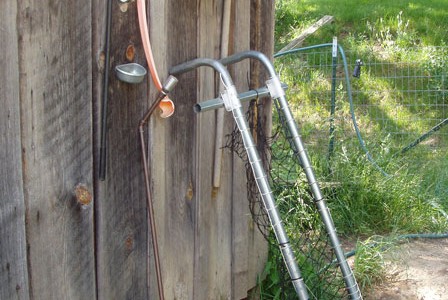
When you are putting together your Soay flock business plan, remember you do not need to include haircuts and perms in the expense column.  For the most part, Soay will shed their fleece without your help.  But you do need to pay for someone to trim your animals’ hooves or, better yet, learn how to do it yourself.

If you have kept up with your reading here, you already know about the Sheep Chair we use at the Saltmarsh Beauty Parlor.  So now the ram or ewe is strapped in and ready.  You lift up the first hoof, only to be greeted by an irregular-shaped black thing that looks like a partly-melted piece of black plastic embedded with hay shards and grass bits and suffused with the ubiquitous sheep poop.  Gaak!  Where to begin?  What to do?

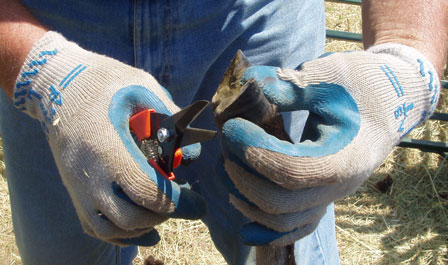
Off-hand, I cannot think of anything related to Soay husbandry that depends more on trial and error, or benefits more from a little practice, than hoof-trimming.  Unless your animals are on gravel 24/7 year-round, their hooves really must be trimmed or the animals will go lame or get impacted or infected hooves.  At a minimum, they will be uncomfortable.  There is good news on two fronts:  the learning curve is steep and fast, and you can find quite a few well-illustrated guides in the sheep literature.  Our current favorite, including photos, is at www.fiascofarm.com.  Let me just briefly introduce you to trimming and then send you off to the experts.  Here is Steve as he starts one hoof:

workrams-014-a.jpg

No two hooves are alike, so I cannot give you a formula or a rule based on inches or centimeters about what to cut off.  But the goals are always the same.  First, try to end up with the bottom of the hoof flat and the two halves trimmed so that together they form a nice flat platform for the sheep to stand on.  We do not want our sheep listing off to one side or favoring one leg over another because of grossly uneven hooves.  Remember run-down heels in the bad old days of high-heeled women’s city shoes?  Ouch!  We want to avoid the ovine equivalent of that curse.

Second, try to leave no flaps of horny material on the sides, or an overly thick heel pad, to get impacted or sore.  If you achieve either of these goals, you usually will have achieved the other one, too. 

In the next picture, Steve takes off a protruding edge.  On some animals, the “heel” portion also will have grown too thick and must be trimmed off.  The flaps are easy to spot; judging the thickness of the heel really does take practice, so err on the side of taking less off at first.
workrams-015-a.jpg

Here is a close-up to show you how a small trimmer operates with more finesse than the bigger pair designed for Suffolks and other hulks.

workrams-016-a.jpg

In the next picture, Steve works on the edge closest to him and the fresh edge looks shiny, appearing almost white with the sun glinting off the new surface.  Notice the surface of that part of the hoof is now more or less level, with no offending flaps.

workrams-017-a.jpg

The last photo shows a pair of hooves with all edges and the heel pads in need of trimming.  Steve has taken off some of the edges on the animal’s right hoof (on your left, of course), where it is shiny, but there is more work to be done.  The hooves are not so overgrown as to cause limping at this point, but another year of growth without trimming probably would cause problems.

workrams-019-a.jpg

Just as your pedicurist needs to judge how much cuticle or heel callus to trim off, my resident Soay pedicurist (Mr. Steven to his valued customers) needed to learn how far to trim without drawing blood.  He still misses sometimes, and the sheep register their displeasure by sauntering right past the “tips” jar without breaking stride or even turning their heads. 

Maybe next year we will experiment with the latest shades of hoof polish or even massages, but for now …