Archive for February, 2008

Ram horn growth: another harbinger of spring

Saturday, February 23rd, 2008

When last we met to discuss signs of spring, the topic was chicken eggs.  It’s about time to re-direct attention to Soay sheep, don’t you think?

Every year along about January or early February, our previous spring’s ram lambs — what I refer to loosely as our “yearlings” – begin an impressive growth spurt which by the end of summer will take them nearly to their final adult size and shape.  In addition to their overall body size, I am thinking in terms of two male anatomies, only one of which — their horns — can I discuss in this family-oriented blog.  The Principal Scientist here at Saltmarsh Ranch tells me growth hormone is behind the overall increase in body size, but the presence of adequate levels of testosterone is required for horn elongation.  The timing intrigues us.  Just like everything else, these little guys hunkered down in the coldest, darkest days of winter in December and stopped growing.  Even though nothing else seems to be growing in January and February, now that the days are longer, brighter and warmer, something remarkable has been triggered in the yearling rams’ physiologies.

Our trusty veterinary medicine tomes and sheep husbandry books occasionally remark on the circumstance that horn growth is correlated with length of days.  And so I assume (and am trying to track this down with an outside expert), once the winter solstice has happened in late December, the combination of increased daylight, hormones, and perhaps melatonin, produces the surge in horn growth. 

It is now the third week of February and we have just finished a 2-week stint of 55-60 degree weather, sunny, very little rain, a beautiful spring teaser.  And let me tell you, our little guys’ horns are fairly popping out of their heads.  I love watching them in their pasture, so full of themselves, strutting their stuff, playing pretend-head-butting, and generally looking like a fraternity pledge class parading in front of the sorority house.  Sadly for them, the pregnant ewes in the adjacent pasture could not be less interested.

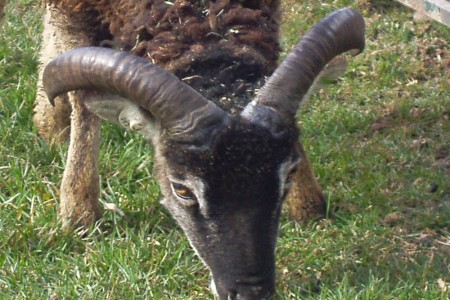
Yearling rams continue to experience horn elongation each late winter/early spring for about five or six years, but the spike in their first full spring is the most dramatic.  Let me show you a few examples. 

How to interpret the photos:  new growth occurs at the base of the horn, right next to the skull.  That is all you need to know to see what is going on.  Although we did crop these photos, all taken on February 20, 2008, we did not alter them in any other way with PhotoShop or any other software or developing “tricks.”

Here is Saltmarsh Grassington, a handsome little light phase (tan) British Soay sheep, son of Greener Pastures Jerry Lee Lewis and USA0001 Kiger, born April 10, 2007. 

080220-052_edited-1-thb.jpg

See the gnarly dark stuff on his horns right next to his head?  That is his new growth.  In other respects he still looks great and I am pleased to report that he is slated to breed one of these years.  With the bright afternoon sunlight on his horns, you can really see the contrast between the old and the new.  None of the new growth was visible in early January when last we made a mental note of it.    

Next comes Saltmarsh Stillington, also a British Soay ram, son of Blue Mountain Warwick and Saltmarsh Keverne, born a full month later, on May 11, 2007. 

080220-068_edited-1-thb.jpg

Stillington’s overall horn size is less than Grassington’s at this point, but the new horn growth on Stillington actually looks more substantial than Grassington’s.  It could be the angle, and I am not of a mind to disturb the young stud muffins to do precise measurements.  

Last but by no means least, Saltmarsh Eloy, an American/British ram named for a town in Arizona, same sire as Stillington (Warwick) and his mother is Saltmarsh Nutmeg.  Eloy was born about a week before Grassington, on April 5, 2007.  Look at the horns on this little fellow! 

080220-005_edited-1-thb1.jpg

Eloy has about the same amount of new horn growth as Grassington, but perhaps because Eloy’s horns were darker to begin with, the contrast between the “older” part of his horns and his current growth spurt is not so great.  Eloy sure looks like he will have Warwick’s wonderfully wide and stout horns, doesn’t he?

If I succeed in finding an authority who can explain the interplay of factors contributing to the unusually robust horn growth in January and February, I will share what I learn with you.  Meanwhile, what I do know is that when we see our yearling rams start to put on their first burst of horn growth, spring — and lambing — is just around the corner. 

 For now . . .


Soay sheep genetics for beginners

Wednesday, February 6th, 2008

I have a confession to make:  it is not always easy being married to a professional geneticist.  To be sure, it was fun to watch Steve put the Open Flockbook Project together and it is heart-warming to get e-mails from breeders who are able to put together authentic conservation breeding groups or find the Soay they want to buy using the online database.  The downside is that well-meaning Soay breeders ask me questions all the time, assuming Mrs. Flockmeister also understands genetics, and let me tell you, Mendelian genetics is hard to fake.  My years as a trial lawyer and piano player taught me a lot about bluffing and I suppose I should be grateful for the opportunity to keep these skills from rusting.  But I am embarrassed to say I did not pay attention in biology class in high school and I started out this Soay sheep caper knowing zero about recessives and gametes and double helices.

And so it was out of self-defense that I recently went on the web looking for places to read about the genetics of inheritance in order to understand why it is that Grace gave us a light-phase ram lamb and Celadon surprised me her first year with a black lamb.  I know, I can always ask Steve, and how lucky I am to have this resource right in my own home.   Don’t get me wrong.  It is great being able to ask the professor without waiting for office hours.  But after six decades of this life business, my powers of retention are shot, and I am too proud to ask Steve to explain what a chromosome is for the umpteenth time.   

Finding good sources of information was easier than I thought it would be.  I was not interested in a book so heavy it would serve better as a doorstop, nor one that consisted of nothing more than stick figures and cartoon balloons above dividing cells.  I have read Genetics for Dummies and its section on patterns of inheritance does not take you very far.  What I wanted was something I could work my way through in the mornings over a cup of coffee and without the distractions of chores or piano practicing.  There doubtless are dozens of similar sites, but three I found without much effort helped me and I hope they will help you, too.  They should give you enough background and knowledge of the jargon to make you more comfortable about what’s going on with color and horns and other characteristics of your Soay, without falling into the black hole of academic genetics that swallowed up Steve decades ago.

Morgan, a multimedia tutorial from Rutgers University, covers the basic principles of  genetics.   Each chapter has ten distinct parts you can work through at your own pace and then test yourself with their short quiz to see if you “get it.”  

Dr. Steven Carr, Department of Biology, Memorial University in Newfoundland, Canada, has put together a dandy one-page chart of Mendelian rules summarizing the definitions and basic rules of inheritance.  It is a little intimidating at first because cramming so much information onto one page makes it pretty dense to read, but if you work your way carefully through the chart and the definitions, you will end up smarter at the end of the page than when you started.  It is a good place to look back at for a refresher when someone starts yattering about “double heterozygotes” just when you are trying to finish cooking dinner. 

The American Mathematical Society has put together a detailed but not fatally technical summary of molecular biology and genetics.  It is a good “next step” after the first two sources.  You will need to read it when you are rested, as the typeface is maddeningly small and they wasted no time on the niceties of page layout, but it is rich in content and provides an overall context for the narrower issues of horn shape and fleece color we all face with our Soay sheep. 

It may be that simply living in the same house with a geneticist for over 36 years has skewed my notions of beginning genetics, so I would appreciate if you let me know whether you find these sources useful.  In any case, I promise there will not be a quiz next week, or any time soon.     

For now …