Archive for March, 2008

Soay Ewes-in-Waiting: a Study in Tranquility

Sunday, March 23rd, 2008

Anyone learning about Soay sheep for the first time and who embarks on a literature search commonly will encounter numerous references to the Soay ewes’ legendary ability to lamb easily.  In fact, if you find an article about Soay sheep that does not remark about how easy lambing is, I would be surprised.

The good news: it’s not just easy at lambing time.  During the final weeks leading up to lambing, the pregnant ewes loll about, sleep, eat then ruminate, and generally do a pretty darned good imitation of furry blimps.  We hear no demands for trips to town to stock up on chocolate chip praline meringue ice cream, no extra manicures, and no natural birthing classes.  If we give our girls plenty of good quality grass hay to eat, and an occasional scoop or two of COB (a mix of corn, oats, and barley with a smidgeon of molasses thrown in for good measure, should be readily available at your local feed/farm store), they quietly gestate and then effortlessly (on our part, not theirs) produce irresistible lambs.

Pictures tell the story.  Look at our pregnant girls yesterday afternoon out in the sun of an early spring day.  Lambing has not started here yet, to our dismay, but as you can see, it cannot be far away. 

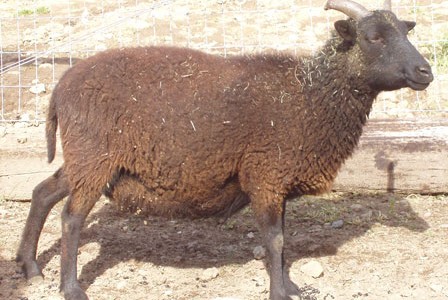
Carolina is one of our original ewes.  We did not breed her last year, which explains her thick, rather unkempt fleece.  In our experience, ewes that do not lamb often do not shed their fleece that year.  When Carolina does cast her fleece this spring, it should be quite a spectacle.

080322pregnantewes-020a.jpg

Next comes one of our British ewes, Catalaya, lying in the barren wasteland that is our young lamb playground.  We long ago despaired of keeping grass in this area, what with all those little rambunctious hooves racing around pounding it to pulp.  We are hopeful that Catalaya is carrying twins, but we know better than to count on it.

080322pregnantewes-027a.jpg

Portia gave us black twins last year.  This year we bred her to our one-of-a-kind tan ram Fenugreek, he of the gorgeous fleece.  We can hardly wait to see what their offspring look(s) like.

080322pregnantewes-018a.jpg

I cannot resist sharing a picture of Holly, a nearly-polled, beautiful ewe we bred for the first time this year.  She is so regal when she moves through our pastures –check out her other pictures on the OFP Gallery – that it is hard to believe this big lumpy thing is really our lovely Holly.

080322pregnantewes-045a.jpg
 

Finally, pictorial evidence that pregnant Soay ewes are a tranquil lot who will lower your human blood pressure if you spend a little time wandering quietly among them in the week or two before they lamb.  I took this last picture in the late afternoon, shortly before the second hay feeding of the day, when all was peaceful here at Saltmarsh Ranch.  I know our British ewe Sequoia is up there on the left because I recognize her white-spotted face, but I did not want to disturb the matrons’ sleep by getting close enough to confirm who the other three are, especially the one facing away from me.

080322pregnantewes-059a.jpg

Whether or not I have convinced you that pre-lambing is a special time on the Soay calendar, at least taking the photos for this post kept me from going crazy yesterday waiting for our lambs to start arriving.

For now …
 

Horn growth update — what about the gimmers?

Sunday, March 9th, 2008

Several readers brought me up short by chastising me for unfairly omitting the yearling ewes (gimmers) from my report on the late-winter spurt of ram horn growth.  I was tempted to ignore their criticisms, so certain was I that only rams could possibly exhibit dramatic horn growth.  But then good manners and a little nagging voice in my head prevailed, and it was back to the pastures to corner and photograph the girls.

Lo and behold – the yearling ewes also experience the burst of horn growth, albeit proportional to their overall horn size.  Here are three of our yearling ewes. starting with our British gimmer Darrowby, who you will recall is named for James Herriott’s fictional town in Yorkshire: 

080301aigim-006xhb.jpg

I decided not to interrupt the yearling rams’ strutting and preening so that I could actually measure their horn growth against Darrowby’s, but I dare say her horns have grown every bit as much as the boys’ horns.  As with the rams, her new horn material is somewhat lumpy and gnarly-looking right now, and quite a bit larger in circumference than her first-year, “baby” horns.

Ewe lamb Leyburn, also British, shows a similarly robust pattern of growth:

080301aigim-032xhb.jpg

Compare Leyburn’s horn growth to that of her half brother Grassington (both offspring of Jerry Lee Lewis), shown in my original — and obviously incomplete — posting about horn growth a couple of weeks ago.  If anything, Leyburn has more new horn material.  No wonder people were crabbing about the omission of the girls!

My third example of ewe horn growth is our farm website covergirl, Ellerbeck, she of the assymetrical white nose spot, which I just realized I cropped off in this picture.  Sorry about that.   

080301aigim-009xhb.jpg

Ellerbeck’s new horn material is visually more interesting than the boys’ horns because of her partially white horn.  The portion of her new stuff that eventually will be white illustrates through its pink cast just how “alive” the new horn material really is, with blood and soft tissue at work creating what will harden into a good sturdy horn. 

With hopes that my friends from the good old days of feminist activism will forgive me . . .


Soay ram lambs: Whether to wether, when, and how

Sunday, March 2nd, 2008

Absent a big win in the gender lottery, we end lambing season with more ram lambs than we need or can sell.  When the lambs are about 8-14 weeks old, we convert some rams to wethers, i.e., we castrate them.
 
Why castrate at all, rather than leave things be?

I can think of at least four reasons, all tied in to marketing Soay sheep: 
 
1.  Wethers make flexible, good-natured companions.  No sheep likes to be alone, even an independent, no-commitments ram.  Worse, keeping a ram in solitary invites his bad behavior, especially bashing structures and fences.  In a one-ram breeding flock, providing a companion wether avoids some of these problems.   When the ram moves in with the breeding ewes, the wether can toddle right along and not have to be alone for several weeks.  Similarly, in a two-ram situation, the wether stays behind with the reserve ram while the lucky one visits the ewes. Wethers can live with their intact ram buddies or with the ewes, wherever makes most sense for pasture or personality management.  We also use our senior wether, Troon, as a 24/7 attendant when we have an injured ewe or ram in recovery isolation.

2.  All-wether flocks provide a low-cost alternative when you have customers who want to avoid sex (in their Soay) — so they can test whether they really want to have sheep at all without the added management issues in lambing, or when an all-ram flock is a poor choice, e.g., because they have small children.  Customers focusing on fleece often keep wethers for their simplicity – the only characteristic the owner cares about is the quality of the wool.  For example, here are two of our teenage rams, both self-colored dark (”black”) born in May 2007, pictured in February 2008 at age 9 months.  

080220yrlngrams-009_edited.jpg 

Ventana (L) is intact.  Reddington (R) was wethered at about 8 weeks.  Reddington’s thick black fleece suffered not a bit for his having been castrated.

3.  Butchering flexibility.  Unlike rams, wethers can be butchered year-round.  To avoid the strong taste of ram meat during rut, which our occasional meat customers generally do not like, we must butcher our yearling rams no later than June or early July, before they start accumulating hormones and related chemicals in their muscles.  Wether meat has excellent mild flavor that does not change with the seasons.    

The timing constraints for ram butchering create a related problem.  Soay need to grow for at least a year, and preferably 18 months, in order to yield 20-25 pounds of cut and wrapped meat.  Any less time and the revenue/cost balance goes south.  Remember free grass vs. expensive hay?  We want as many of those 18 months as possible to be on grass, both for economics and for flavor.  We cannot avoid one winter’s worth of hay for our male lambs, be they rams or wethers, but we sure do not want to add the cost of a second winter to the butchering balance sheet. 

Here’s the catch:  if we butcher our intact ram yearlings in June, they will be barely past one year old; they will miss the whole long summer of growth on free grass; and they won’t yield much meat.  The only way to keep growing them until they are 18 months old is to feed them a second winter’s worth of hay and butcher them the next April after rut ends and the “rut” taste wears off.  By constrast, we can leave the yearling wethers on grass until October, when they are about 19-20 months old, and then butcher them just before the grass runs out. 

4.  More and better meat.  We believe, based on unscientific observation, that wethers put on more weight than rams of equal age, probably because while the rams are running around jousting, the wethers just sit, ruminate, and grow.   Here are Amado and Calabasas, born on March 25 and April 3, 2007, respectively, photographed in late  February 2008 at the age of about 11 months.

080220yrlngrams-026_edited.jpg 

Intact tan Amado over on the left is noticeably smaller than his wethered buddy Calabasas, who pretty clearly was lounging around while Amado wasted a lot of energy showing off for the pregnant ewes next door.

So why not wether all the excess ram lambs and be done with it?

There are at least two reasons not to castrate, one economic and one aesthetic.  Rams generally sell for more than wethers, and animals on the hoof sell for more than the net revenue after butchering, even if you do it yourself.  So we consult tea leaves about how many rams we might be able to peddle over the winter, and wether the rest.  The other disadvantage is that the wethers’ horn growth slows to a relative snail’s pace for the rest of their lives, so they will no longer have the signature Soay ram look – big handsome curled horns.

The wethers’ horn growth varies a lot from animal to animal, as you can see in the pictures, and some will end up with okay horns, but never even close to their intact friends.  Intact Eloy (L) and wethered Douglas, born one day apart in April 2007 and shown here in February 2008, make the point.  After less than a year, Eloy is distinctly smaller, but his horn growth far outpaces Douglas’ horns.

080220yrlngrams-004_edited.jpg

This is the first time we have looked carefully at the differences in our yearling rams and yearling wethers.  We were so struck with the size and horn differences in less than one year that we decided to see whether the disparities persist over time.

Two years ago, our “herbs and spices” year, we had several sets of twins and, as usual, extra rams.  Our friend Angela Percival up near Portland wanted an “estate” flock — no breeding ewes — and she bought our wethers Lemon (twin of our tan ewe Lime) and Curry (twin of our intact ram Cumin).  Let’s take a look at Cumin and Curry to see how the intact ram compares to his wethered twin after almost two years.  Here they are as baby rams at about 8 weeks, before we neutered Curry.   

venuscumincurry-002xhb.jpg

Curry is the darker lamb in front with a small white spot on top of his head.  Cumin, much lighter, had a large white spot and a fetching little white button on his nose from day one.  They were about as endearing a pair of lambs as we’ve ever had.

Now let’s see how they and their horns have grown since then.  We do not have the luxury of putting them side by side any more since we live several hours away from Angela, but we sure can compare their horns.  Here is Cumin, still an intact ram, pictured in February 2008 at the age of 22 months:

080226miscsheep-011xhb.jpg

Not only does he have an excellent rack for his age, his expression still is rather whimiscal with that little white spot on his nose, his white head, and his partially white horns.

Curry, the wethered twin, also has remained a very handsome Soay sheep, with his coat still darker and much deeper mahogany than Cumin’s, and the tell-tale shorter horns of a wether.  This picture was taken in May 2007 when he was 13 months old.  Notice how nicely proportioned Curry is; his horns do not look “funny” or “odd.”  They actually match his body size quite nicely, don’t you think?

img_3238xhb.jpg

To us, Curry is a walking advertisement for the benefits of having some mellow wethers as part of your flock.

What wethering methods work on Soay rams? 

The elastratorRubber bands made especially for castrating small livestock are readily available at your local farm store.  They are not your basic bundle-the-pencils bands, so do not try to economize with a home remedy here.  Banding is nearly free (100 bands for about two dollars) once you acquire the ten-dollar applicator.  Doing the dastardly deed is straightforward:  stretch the band on the applicator and slip it over the lamb’s testicles.  The band cuts off the blood supply. 

One drawback:  banding only works during a narrow window when the lamb is about 8-14 weeks old, after the testicles descend, and before they get too big for the band to slip over, i.e., when they are not much bigger than a grape.     

Health concerns:  It is important that the ram lamb have a sufficient level of tetanus antibodies at the time he is castrated.  Other than that, when we band our little guys, they appear confused and uncomfortable at first, but within a hour they are up playing with their buddies as though nothing had happened.  In a few days you can check your work – you should feel two hard little peas in the scrotum; after a month or so the scrotum will fall off and you may find it in the pasture.  The wethers continue to grow and thrive over the rest of the summer and winter and we can continue to offer them for sale on the hoof, or schedule the trip to the butcher any time of year.

As you probably can tell, banding is our method of choice. 

The burdizzo allows you to wait until the ram lambs get more horn growth, or until you have a better estimate on how many intact rams you can sell.   Let me state right upfront that we have no experience with this method so I am relying on published descriptions and anecdotes from fellow shepherds.  The burdizzo basically crushes the spermatic cords and the testicles atrophy.  But you need a lot of precision, placing the tool accurately and squeezing hard enough to crush the cords without severing the skin and creating an open wound.  The burdizzo tool sells for about $35 and up.   The same caution about tetanus applies.  Breeders who are comfortable performing the procedure prefer it because they can let their ram lambs develop for a longer period of time before making the irrevocable decision to wether them.  

The knifeAlthough cutting off the testicles allows complete flexibility in timing and avoids the precision required for the burdizzo, you will either have to remove them yourself, creating an open wound, or have your veterinarian perform full-blown surgery.  Vet-performed surgery may be your only choice other than euthanasia if an adult ram is injured to the point that the other rams turn on him.

Which ram lambs to wether?

Here again, it depends on the owner’s goals.  We designate our American/British lambs for ramhood vs. wetherdom based on their soundness and conformation, fleece color and probable final horn shape, and requests from customers for particular characteristics.  We select which British ram lambs to keep intact based strictly on the needs of our conservation breeding program and which ram lambs will be the best genetic match for the ewes selected for our customers’ starter flocks. 

End note:  I must say this has not been my favorite topic.  If only we would get that elusive lopsided gender split so we would have just the right number of ram lambs to sell.  As the Cubs fans would say, wait until next year.

For now . . .