Archive for October, 2008

Big Barn, Small Sheep

Tuesday, October 21st, 2008

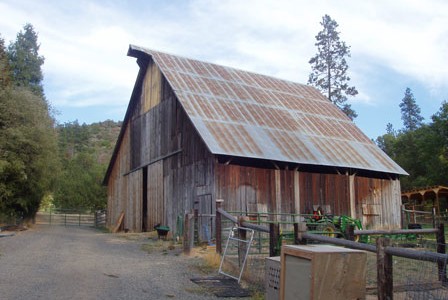
By the time we discovered Soay sheep, we already lived on a farm with a huge old dairy barn.  At first, it seemed a waste to raise animals too small to take full advantage of our cavernous barn.  But we soon realized that little sheep can co-exist quite nicely with a very tall, very wide structure.

 081015barn009a.jpg

We should all look so good well past our hundredth birthdays.  There is quite a story to the restoration of this handsome structure, but that’s for another day.  Back to the utility of a big barn for raising Soay sheep.

As our flock grew and grew and grew, we were glad we had ready-made storage for the many tons of hay it takes to feed all those hungry mouths in winter.

 081015barn011a.jpg

I’m sorry I do not have a camera with a lens sufficient to capture the haystack top to bottom, but at least you can see how to make use of the tall center section of an old dairy barn.

If you have a barn, it will come in handy for both housing and working your Soay sheep.  Although legendary for their hardiness, if the truth be known our sheep like getting out of the heavy rain and occasional snow here in Southern Oregon.  In our climate, sheep also need protection from the sun during the hot, dry summer months.  Barns also can function as predator control.  Sheep trained to follow you into a barn each night are safe from coyotes, cougars, and whatever other animals lurk about hoping for rack of Soay on their menu. 

When it comes time for annual tetanus vaccinations, hoof trims, or periodic worming, having a barn will give you both an enclosed small space (for example, the old milking stalls) to actually work the animals, plus a secure place to store your supplies:  a camp stool for you, a sheep chair for particularly large rams, extra “hog” panels for nudging your flock into the work area, and almost any old discarded cabinet-like affair for storing the little stuff.

What if you do not have a barn?  Pretend.  Treat a small shelter as a barn.  A square roofed shelter with even two enclosed sides (made of old plywood, for example) can double as your working and sun protection area.  Here’s an example.  Even though the sheep (and baby llama Hank) are grazing a section of pasture some distance from the shelter, Steve has left a path for the animals to reach the shelter, where they can get out from under the sun, have access to their mineral feeder, and find water (the tank is barely visible in front of the shelter, left side).

080710-001a.jpg 

If you give the shelter four high sides and just one door and your flock is small, the shelter can serve as night protection as well.  Voilá!  You’ve got yourself a reasonable facsimile of a barn.   True, the shelter will not give you the same warm, fuzzy feeling as a barn redolent of new-mown hay, but then again, the shelter will cost a whole lot less and will not take up as much valuable pasture space, either.

Author’s note:  This post began life as a 10-minute exercise in “just getting started” at a recent farm writers’ workshop sponsored by Oregon State University.  You never know where you are going to find blog material.
 
For now …

Getting started with Soay sheep: Mineral

Thursday, October 9th, 2008

Remember when you were growing up and your mom or dad nagged at you to take your daily mineral-fortified vitamin pill?  Here is good news.  You never have to nag your sheep about mineral; you just have to keep their mineral feeder full and I promise they will eat enough to keep them healthy.

You say you did not take your vitamins and you turned out just fine anyway?  How nice for you.  The same cannot be said for your Soay sheep.  Pastured animals — cows, goats, sheep, horses — need mineral.  Why?  Because they cannot range and graze far and wide to find naturally occurring outcrops of mineral-rich rocky deposits where they can lick up the mineral nutrients they need, just like their ancestors did.

So what is this “mineral” that you must provide to your sheep?  Mainly it is salt, plain old sodium chloride, common salt.  But other things are added, too.  What gets added, and in what proportions, depends on the kind of animal and on the part of the country you live in.  This brings me to two particularly critical components of sheep mineral that I want to talk about next.

First, copper.  Sheep need copper, just like other farm mammals do.  But sheep have adapted to life in regions where levels of naturally occurring copper are very low, and they did this by becoming very efficient at taking up and retaining the copper.  So all the copper they need in their mineral these days is a very low dose – a trace, if you will.  Mineral formulated for other animals (e.g., cattle) has much higher levels of coppe.  If you give this relatively copper-rich formula to your Soay sheep, they will not be able to handle the copper load and it will accumulate in their bodies to toxic levels.

Second, selenium.  In the Pacific Northwest where we are, and in some other areas of the U.S., there is very little selenium in the soil and thus very little in the grass.  Apparently the selenium leached out during pre-historic rains or the glaciers or some such geology-related episode.  Selenium is an essential nutrient for animals and humans alike.  Sheep in particular do poorly without it and are at risk for something called white muscle disease.  So sheep mineral in our area also includes selenium, and you should watch for it if you live in a selenium-deficient area.  Your county extension service or your large-animal vet can help you with this one.  

Bottom lines?  If you are not already providing mineral for your sheep, please go to your farm store tomorrow, get yourself a bag of mineral, and be sure it is mineral formulated for sheep.  Sheep mineral comes granulated, not in block form.  If someone tries to sell you a mineral block for your sheep, thank them politely for their time and walk away.  Why?   If the mineral is in a block, it is not formulated for sheep.  How do I know that?  Because  sheep will try to eat the block and break their teeth, and the manufacturers know that.

Mineral is suprisingly expensive, so you want to minimize waste.  Unfortunately, there are as many ways mineral can be wasted as there are wily sheep.  Mineral gets dumped on the ground, by either clumsy you or a clumsy ewe tipping over a tray of it.  Or, hmm, how to say this delicately.  Sheep have an annoying habit of backing up to mineral feeders, water tanks, and just about anything you would like to keep relatively clean, and either peeing or pooping in them.  I am not making this up.  Or the mineral gets naturally rained on and you cannot break it back apart.  See what I mean about how easy it is to waste pricey mineral?

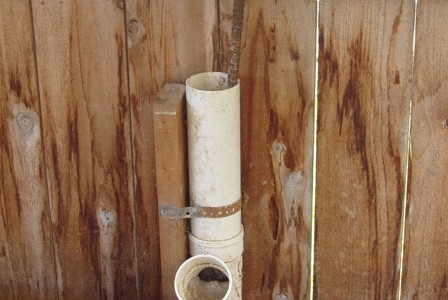
You will need a container of some sort in which to put the mineral and a place to put it where the sheep – but not the rain, snow, or irrigation sprinklers – can get at it 24/7.  First, the container.  We probably are not the only breeders who tried to cut corners at first and simply put out trays or buckets we already had lying around the barn.  Big mistake.  Sheep tip them over, ruining all the mineral that was in the buckets, or they use the trays as their personal latrine.  In short order, the chagrined shepherd changes to a better design.  We know of two that are in common usage.  For several years, we made and used a white tubular getup that resembles the pipe configuration that leads into or out of a toilet or a sink.  Here is a picture of such an arrangement:

080820mineralfeeders4a.JPG

At first blush, this setup seems ideal.  Steve made several of these dispensers and used them more or less happily for awhile.  In theory, the sheep come and lick at the mineral in the short angled part of the apparatus and more granular mineral then drops down to the opening, like those self-feeders for dogs or cats marketed in pet stores.  This design does have the advantage of not providing a big target for the sheep’s back end, so the white PVC contraption stays pretty clean.  The problem is, it also has an annoying habit of clogging up, even if you stick a piece of rebar in it to stir the pot, as shown.  We have turned perfectly respectable mineral feeders of this design into tubes of cement-like material that defies all efforts to break it apart (the PVC breaks before the mineral does), either because we forgot to cover the top of the mineral feeder when we irrigated, or simply because the mineral eventually attracts moisture and hardens up “naturally.”  The pipe thing simply will not reliably keep the mineral flowing over the long haul.

The best alternative we have found, although by no means perfect, is a squarish green plastic container sold in any farm or feed store, and which hangs over the fence or a 2×4 or can be nailed to the wall of a shed or barn.  Here is a picture:

080820mineralfeeders-002a.jpg

True, there is a larger area for the sheep to use as a toilet, but that same larger area means that if you forget and irrigate the feeder and it hardens, you can simply turn it over into a metal bucket, knock out the mineral block, and break it back apart with your trusty sledgehammer.  Or, you can place it where it will not get wet and then keep it only partly full so that what sits in the feeder for several days does not accumulate moisture and harden up.  Steve has managed to jerry-rig our square green mineral feeders in a corner of each shelter with just enough board in front to allow the sheep to crane their necks and reach the mineral but not enough to allow them to back up to the feeder, a big plus in the sanitation department.  Having the feeder wedged in the corner also means the rams cannot bash it apart when they get randy in the fall.  The next picture shows how the feeder is tucked behind a sturdy board and secured to the existing batter boards so it will not tip over or get soiled or dislodged.

080820mineralfeeders-003a.jpg

Other breeders who use these feeders simply nail them to the walls of their barns or sheds high enough so the sheep cannot back up to them. I know this may sound like a lot of work, but it is not as time-consuming as I probably have made it seem, and besides, you will need a mineral feeder until you quit keeping sheep, so you may as well make one now that will last as long as your shepherding life.  The best news is that once you figure out what will work in your particular setup, all you have to do is remember to keep a supply of mineral in the feeder.  We fill old half-gallon milk containers with mineral and leave one of them hooked to a shelter beam wherever our sheep are pasturing so we don’t have to make a special trip back to the barn whenever  a green mineral feeder is empty.    However you set up your mineral feeder, you will immediately see why it is so important.  Your Soay somehow know they need mineral.  They will rush to the feeder whenever you fill it and lick to their hearts’ content.  Life should be so easy for us humans, eh?

For now …


Flushing Soay ewes: A correction

Sunday, October 5th, 2008

Well I’m embarrassed.  When I put together the chart of grain amounts we feed our ewes to enhance twinning, I included amounts in both ounces and cups, most likely because I am wasting a brain cell remembering an old ditty from home ec class about measuring the dense ingredients (butter, for example) in baking:  “a pint’s a pound the world ’round.”

Not so with livestock grains; the equivalency does not work.

The sheep books I have read, and the chief shepherd here at Saltmarsh Ranch, measure in ounces.  For those of you who relied on the cup measures in my posting last month about flushing, I apologize.  You will find a corrected chart in the original post.

Hanging my head for now …