Archive for December, 2008

Soay sheep on the menu: an introduction

Thursday, December 25th, 2008

As promised, it is time to share recipes that showcase the mild-flavored, lean taste of Soay meat.  Let me set the stage.

When we decided to start eating Soay sheep meat, I cheerfully headed off to the bookstore and the kitchen stores to get myself a couple of good lamb cookbooks.  To my dismay, there were none — zero.  Being the good capitalistic American that I am, I can only conclude there is no market for lamb cookbooks.  Whether their demise is attributed to a shift away from red meat generally, or the fact that imported Australian lamb is too pricey, or to memories of all those awful, tough muttony meals we were served at “hot lunch” in the school cafeteria growing up, the sad fact is the lamb cookbook appears to have gone the way of the buggy whip.

Now here’s something I have not shared with my readers before:  I used to be a librarian.  Whatever else you can say about librarians, they never take “I can’t find it” for an answer.  Out here in the country, we are a little short on used bookstores, but a quick e-trip to the used book sections of the on-line bookstores turned up three “classic” lamb cookbooks that looked promising:   The Southern Heritage Beef, Veal & Lamb Cookbook, The Great Lamb Cookbook published by the Australian Women’s Weekly, and Madame Benoit’s Lamb Cookbook.  You may remember Madame Benoit as the author of the opening essay on our farm website about the joys of living in the country and raising sheep.  Madame Benoit was the Julia Childs of Canada and equally famous in her own country.  In fact, if you Google her, you’ll find an entertainingly old-fashioned video clip of one of her early cooking shows on TV.  Julia did not have a monopoly on this art form, even back in its rudimentary form in the 1950s.

But I digress.  The problem with the old lamb cookbooks is too many of the recipes call for layers of lard slathered on the roasts before cooking, or lots of bacon tucked in slits of the shanks, and any number of other fat-focused ingredients and methods for cooking the lamb.  I can only assume the lamb Madame Benoit and the other authors had at their disposal was tough, stringy, and dry.   Back to the drawing board.  Time to gather my own set of Soay recipes.

Before we moved out here in 2004, I had the accidental good fortune to come upon one of my all-time favorite recipes for lamb:  Lamb Shanks Reynolds Wrap.  It is just the right recipe to start this collection — tasty and almost embarrassingly easy.  L.S.R.W. came into my life one day when I was standing in the butcher shop near my home in the suburbs of Chicago ordering who knows what, and next to me a pleasant-looking woman asked for “lamb shanks, cracked” in an authoritative voice.  Having never even once cooked lamb at that point, I don’t know whether I was more surprised to hear about lamb “shanks” for the first time, or that the description of them as “cracked” came out of the mouth of such a sweet little senior citizen.  At least I had the presence of mind to ask her what she was going to do with them.  To my delight now, I also wrote down what she said and then had the continuing good luck to find that scrap of paper again when we moved out here and began having Soay sheep on our menu.  Here then, is the recipe, just as originally reported to me at Zier’s Meats in Illinois:

Lamb Shanks Reynolds Wrap

From now on, you will find lamb recipes every week or so in a printer-friendly setting on our farm website.  Look for “Soay sheep on the menu.”

Bon appetit!

To Eat or Not to Eat, That is the Question for Soay Sheep Owners

Monday, December 22nd, 2008

Just as there are widely varying opinions about when to put breeding groups together, whether to breed a spring ewe lamb her first year, how to manage weaning and at what age, so too are there widely divergent views on whether to eat animals from your flock.

The good news, of course, is that the decision is entirely up to you.  We know breeders who have enjoyed having Soay sheep in their pastures for years and have never even considered eating them.  We also have colleagues who raise Soay sheep exclusively for their meat.  Actually, some of the middle grounders have the most interesting and sometimes complex rationales and policies, e.g., drawing the line at animals with or without names, eating only animals from other breeders’ flocks, and so forth.

For those of you who are thinking about whether to butcher some of your Soay sheep, here are a few statistics and tips we have picked up over the three years we have taken animals to the butcher.   It is only fair to let you know up front where we stand on the issue of eating our own animals, since our views doubtless color what I’m saying here.  It took us a couple of years to feel comfortable with and want to eat sheep from our own fields.  Once we tried rack of Soay, however, we became enthusiastic consumers, primarily because we like knowing what is in the food we eat (or more importantly, what is not) and we like eating locally-grown food.  We also have friends who eagerly purchase their annual lamb quota from us for the same reasons.

Where to butcher.  As with many other aspects of raising Soay sheep, butchering issues can be addressed in several different ways.  First off, you will need to decide whether to butcher yourself, have a butcher come to your farm, or deliver your animals to the butcher in town.  One of the lines we draw is not butchering ourselves, can’t do it, not interested in altering our mindset to accommodate that.  It is our understanding that folks who do their own butchering end up with somewhat more meat because they are pickier about getting it all.  And of course they have no butcher costs.

How much meat will I get from a Soay sheep?  Quite a bit.  But not surprisingly, not anywhere near as much as you would get from the big hulking Suffolks and their ilk.  Let me walk you through some numbers we have accumulated (remember the Chief Shepherd here at Saltmarsh Ranch is a data geek).

An opening caveat.  Because Soay are spring lambers and they are so much smaller than domestic sheep, you really need to wait until they are at least a year old to butcher them.  That means keeping them over a winter and that means buying hay.  We take our animals to the butcher in the fall when they are a year and a half old, after they have had a full summer of free food in the pasture and before they start eating their second winter of pricey hay.

We do not have the occasion or facilities to weigh our full-grown sheep, so the best I can give you in terms of weights is hanging (post-kill, pre-cut and wrap) weight versus the weight of the packaged meat.  I have reliable data (no gaps) for the hanging weights and packaged weights of eight butchered Soay sheep, all between the ages of one and three, with a mix of ewes, wethers, and a couple of rams.  All of these animals were either American or American/British Soay, commonly assumed to be somewhat larger than full-blood British Soay).  Based on our own experience to date, we expect to get about 22-23 pounds of packaged meat per animal, including the bones (for making yummy soups).  The average hanging weight is 36-37 pounds, and our best guess is that the live animals weighed between 50 and 65 pounds.  The only time we have gotten more than 30 pounds of meat was from a very large, intact 3-year old American ram and he came in at a whopping 39 pounds of meat.  Don’t count on this happening unless you are purposely breeding for large size.

What kind of cuts should I ask for?  One of my all-time favorite lamb recipes uses shanks, so we always ask for the shanks intact and “cracked” to allow the marrow to cook – either cook away if you want leaner meat, or cook into the stew if that is how you are using the shanks.  Unless you are really nimble with your grill, you will regret having the butcher make individual Soay lamb chops — they are simply too small and will quickly turn into hockey pucks when exposed to heat.  Ask your butcher to leave the racks intact (there should be four packages of these at about a pound or so each) and remove the “chime” bone so that once you cook the rack, you can cut it apart into what amounts to individual lamb chops.  I will share a couple of great recipes for rack of Soay with you shortly.  As for roasts, our recommendation is to ask for the two leg of lamb roasts, but have what would otherwise be shoulder and other roasts cut into stew meat or ground meat or both.  Only the leg roasts of Soay are easily capable of carving into the lovely slices you can array on your serving platter.  Both we and our customers have struggled to carve any of the other roasts.  The leg roasts will be about 3-3.5 pounds each, plenty for a family or dinner party of eight with a good meaty bone left over for making soup.

What about the strong flavor of ram meat?  At our house, we usually draw the line at eating intact rams because of their strong flavor and because we have the luxury of having ewes and wethers as a source of lamb meat.  On the other hand, we have a loyal, annual customer who gladly takes a ram if one is available, favoring the stronger flavor.  When we butcher intact rams, we only do so in the spring (June) before rut sets in.  As long as the ram is not more than two years old, the meat will still be acceptable with spring butchering.  We also have customers who purchase whole live rams for celebratory barbeques on the spit and they rave about the flavor and clean lean flavor.  For the first time this year, we were approached by a man who could only afford to buy a couple of our oldest rams and wethers for very little cash outlay.  He understood that they would be gamey and tough, but planned to turn them into highly spiced sausage as an economical way to feed his family with the comfort of knowing the animal had lived on untreated pasture grass and hay.  In short, there apparently are as many ways to approach eating sheep as any other food source.  It all depends on what you are looking for.

Is there any way to get the lean, “sweet” flavor of Soay in a larger animal?  The answer is a qualified “yes.”  Each year we have between one and four lambs born of Soay fathers and one of our Shetland/Icelandic ewes.  A brief diversion about the “Shetlandic” ewes.  They were the result of a fence-jumping ram at Jen Bailey’s farm and we got them originally for their fleece (my mom’s a spinner/weaver).  Not until later did the import of their coat color genetics sink in with my resident geneticist:  both of the ewes are self-colored light phase (”chocolate”) animals, so we can use them to test whether one of our rams carries either light phase or self-coloration or both.  The ewes dutifully produce twins each year, bless their little hearts, with the result that we have a ready-made supply of meat animals each year as well.  In fact, it is the predictable supply of these cross-breds that accounts for how few full Soay we have butchered over the last few years.

If we compare the hanging weights and packaged weights from our Soay yearlings with our “Soaylandic” yearlings, there is about a 10% increase in the hanging weight and also the packaged weight of the cross-breds.  For us, it is nice to have a way to turn our breeding “experiments” into a source of food or a small amount of revenue from meat customers.  Otherwise, the size differential does not seem worth the effort to keep big non-Soay animals in your flock.  Our two Shetlandic ewes are pushy at the trough and generally a nuisance, but Steve loves their genes so we keep cranking out meat lambs from them each year.

The other way to get somewhat more meat from your Soay sheep is to keep them until they are 3 or 4 years old.  The older Soay we have butchered weighed 10-15% more hanging and packaged, especially the 3-year old ram.  If you are lucky enough to live where you have free pasture grass all year round, holding the sheep to a larger size and age makes economic sense.  If you have to feed hay in the winter, the numbers turn bad with the second season of hay.

How should I cook my Soay meat?  Ah, the fun part begins!  This post has gotten long enough, but I promise to return shortly with the first of many tasty recipes.

Bon appetit!

Diagnosing lameness in Soay sheep

Wednesday, December 17th, 2008

Yesterday one of our neighbors knocked on our door, distressed that a pregnant Suffolk ewe on his nearby farm had become lame about four days earlier and, instead of getting better, she has declined to the point of not eating.  The neighbor was hoping our experience with Soay sheep would carry over into helping him diagnose his sick ewe.  We did the best we could to help him narrow the possible causes and evaluate whether to send for the vet.  I share this with you because we would use the same thought process were the sheep a Soay ewe rather than a big hulking Suffolk.

Symptoms:  pregnant, lame in front right and back right legs, ate and drank adequately for the first three days of lameness but then stopped eating and drinking water.

Steve and the neighbor talked through all of the following:

1.  The ewe did not show signs of scours or other intestinal issues (no yucky stools dribbling down her back end, to be precise), so no need for ProBios.
2.  The neighbor vaccinates his ewes annually for tetanus so that’s not it.

3.  The fact that the two right-side legs were lame seemed to rule out a rock-in-hoof cause and also probably ruled out spinal injuries.  We have had two Soay sheep who bashed so hard into fences or gates in unavoidable fright that they apparently did injure their spinal cords, but the symptoms in both cases were a single dragging rear foot that eventually healed just fine.

4.  There has been no change in feed source (grass, hay, and grain) for the last several weeks.

5.  Probably not an internal infection because no sign of fever or generalized overheating, no panting, no flailing.

6.  But … our neighbor is not diligent about putting mineral out for the sheep, so the ewes are either getting no selenium, or they are pilfering mineral from the black angus who share the pasture.  If they are getting no selenium, that’s a good bet for a diagnosis, especially in pregnant ewes.  Our ewes gobble down their mineral in the weeks before lambing.  If the neighbor’s sheep are eating the cattle’s mineral, they almost certainly are getting copper, which is in virtually all cattle mineral and which is highly toxic to sheep.

This particular ewe regularly delivers two big healthy lambs destined for market, so we’re guessing the neighbor will spring for a visit to the vet for a professional diagnosis.  Given the dangers of selenium deficiency and copper poisoning, we sure are hoping the vet finds something else, less serious, that is causing the ewe to decline so alarmingly.

Reminder to Soay breeders, especially in the weeks before lambing:  be sure your animals have round-the-clock access to mineral specifically designed for sheep.

For now . . .

Soay sheep deserve Christmas stockings, too

Monday, December 8th, 2008

No sooner had I filed the post on how to make Christmas stockings for the shepherd on your Christmas list than a hue and cry arose from the pasture.  The Soay are outraged that our no-count guardian dogs (from the sheep’s perspective, not ours) get Christmas feed bags and the sheep don’t.  I tried to explain to them that they can eat merely by lowering their heads into the grass or the hay feeder, but to no avail.  They are not about to be upstaged by those smelly dogs.

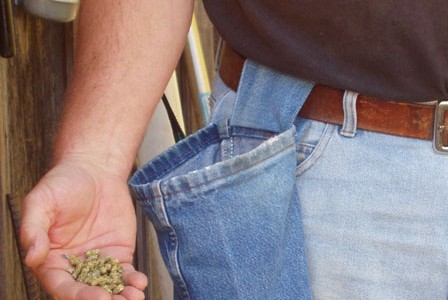
So in the interests of pastoral serenity, I gave in and made the sheep their own stocking, and you can, too, very easily.  This is one Christmas stocking that does not require counted cross-stitch, a lifetime supply of knitting needles, or even a pattern.  And actually, it is quite a bit easier to make than the dogs’ feed bags.  All you need is the most rudimentary sewing skill, a penny’s worth of electricity, and a half hour of spare time.   Like the shepherd’s “stockings,” this new one is nothing more than a bag made from part of one leg of an old pair of jeans, with an attached loop to fit over your belt, perfect for carrying grain treats out to the flock, your year-long gift.  Steve models:

080928denimbags-001a.jpg

Find an old discarded pair of jeans.  This pair, which in my opinion still has a lot of wear left in it, was donated by our summer ranch hand, Shawn Olsen.  Cut off one leg about 16 inches up from the bottom hem, keeping the hem intact.  The bottom hem is going to become the opening of the bag.  Turn the jeans leg inside out and sew the open end shut.

081120grainbags-001a.jpg

Now cut off another piece of the leg about 4 inches wide and 10 inches long.  Hem each of the long sides.  You can leave them unhemmed but they will fray and you’ll never win the Martha Stewart prize for artistry.  Attach one end of the hemmed strip to the still-existing hem of the pant-leg-turned-bag.

081120grainbags-003b.jpg

Hook the strip under your belt and adjust its length so that when the loose end is sewn to the bag, you will be able to slip the bag on and off your belt easily.  Sew the other end of the flap to the same edge of the bag opening (what used to be the jeans hem) so that you can easily reach your hand into the bag of grain.

081120grainbags-004a.jpg

Finally, go out and enjoy walking among your flock, feeding them as much or as little as you like, with no fear of the grain bucket tipping over.

080928denimbagsa.jpg

Oh yes, we do not recommend feeding coal to your Soay sheep, even if they misbehave.

Happy holidays!