Archive for January, 2009

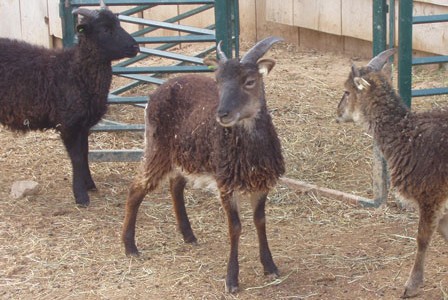
Not quite, but we know it won’t be long, because our Soay rams are calming down and everyone’s horns — ewes and rams alike — have started growing again.

We put our breeding groups together later this year so we are just now thinking about returning the rams to the Bull Pen.  I must say it’s not a chore I look forward to because the “reunion” between the breeding rams and their celibate brethren is always unpleasant to watch, what with all the bashing and general ill humor.  But I’m hoping the overall air of tranquility out in the breeding areas, and even in the Bull Pen where the unlucky bachelors have been duking it out for two months, means that by waiting to breed later in the year, we will have less chaos when we break down the breeding groups next week.

Ordinarily, I would use the occasion to write about this chore, but not this year.  It seems Steve has taken a notion to writing his own stuff, and darned if he didn’t take my “Ram Class Reunion” post idea right out from under my nose and put it on our farm website.  You can read what he has to say about safely reuniting rams by clicking here.

Another sure sign that spring is on the way is the spurt in horn growth, a subject I managed to write about last year before you-know-who could trump me.  It almost hurts to look at new horn growth on a Soay sheep exhibiting white spotting on the head.  Because the absence of pigment extends up into the horns, the new growth is translucent and the active new red blood vessels feeding the new horn growth fairly gleam in the sun.  It’s a time of year when we are relieved to observe the winding down of aggressive behavior, what with the soft new horn growth right next to the animals’ heads.  Although a broken horn usually is merely an aesthetic nuisance rather than a genuine health issue, the Soay sheep’s graceful horns, and the fact that Soay ewes have horns, is one of the hallmarks of the breed and it always seem a shame when a horn breaks off.

One way I know spring is almost here is that Steve shuts himself in his office and goes into a frenzy of updating our websites, hoping against hope to get it all done before lambing starts.  This winter his efforts have focused, at least so far, on a series of short essays he has wanted to write for a long time, each having to do with one of the discrete aspects of lambing:  managing ewes in late gestation, assembling the right supplies to have on hand before the lambs arrive, and actually working the new lambs.  When we first started raising Soay sheep, reading other more experienced breeders’ websites and talking with them about how they manage their flocks was invaluable.  We hope our experiences also will help newcomers to Soay sheep.  Equally important, we hope putting our experiences out there for everyone else to use and/or take shots at will contribute to the ongoing robust dialogue among Soay breeders that benefits all of us, no matter how long we’ve been at it.

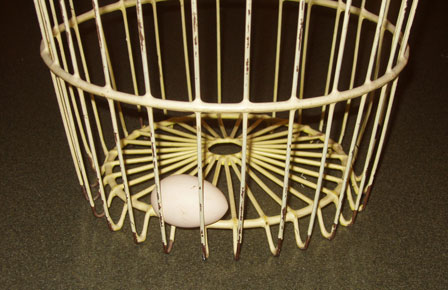
And finally, the annual egg update.  Last year we got our first oval harbinger of spring on January 5.  As you can imagine, I have been watching the nests in the henhouse like a hawk (oh, sorry) for the last two weeks.  And sure enough, the first little bitty egg arrived this morning.  Better two weeks later than never.  At least until I decide what to do with just one precious homegrown egg, it will occupy the place of honor in my grandmother’s egg basket.

p1010006b.jpg

Time to go load up the tractor with a pallet of hay for the Bull Pen and count the weeks until the boys can live on new grass.

For now …

Several readers have commented on the notion of “normal” Soay sheep temperature mentioned in the recent post about using temperature to diagnose problems in Soay sheep, specifically, whether there is any difference for Soay sheep because of their small size.
As all Soay breeders know, a lot of lore about the bigger varieties of sheep – the hulking Suffolks and others — must be adjusted when speaking of the hardy, but diminutive Soay.  What about body temperature?  Is there a size-correlated difference, or a difference perhaps based on the Soay’s primitive status?  Or no difference at all?

The sheep books suggest that sheep generally have normal temperatures in the range of 101 or 102 up to 104F, and that anything higher than 104F indicates a problem.  These numbers provide a benchmark for figuring out whether Soay sheep are different.

We take the temperature of every Soay lamb born live on our farm within hours after birth, well over a hundred lambs so far.  We also had the opportunity last fall to record the temperatures of 33 adults, yearlings, and 6-month old weaned lambs during the vet inspections required to ship them interstate.  The results confirm that at least on our farm, the normal range of temperature for newborn Soay lambs and for older lambs and adults is not significantly different than for other varieties of sheep.  For all but the data geeks, you may stop reading now.  For the numerically curious, here’s a summary of the data.  We will be pleased to share the animal-by-animal numbers with anyone who still hasn’t gotten enough of numbers.

Although the “average” Soay temperature is about the same as the normal temperatures reported in the books about the big commercial sheep, there is a small, but noticeable decrease in average temperature from newborn to older lamb to adult.  So far, we have not had occasion to worry about or even take into account these small differences, but just in case any of you can use the information, here’s the data.

Newborn lamb temperatures:

102.7 the mean temperature of 107 Soay lambs born in 2007 and 2008
102.7 the median temperature of the same group
99.3 – 104.3 the range of temperatures in this group

We have had just two lambs with temperatures at or above 104 shortly after birth, a big North American Soay twin ram lamb who came it at a steamy 104.3 and obviously had been hard at his mother’s bag, and one of our AI ram lambs from last year, a big single named Emmett who showed the same single-mindedness about eating.  Neither of these boys was in any way sickly or running a fever; they simply had digestive systems that were at full throttle.

Of these same 107 lambs, 13 had temperatures below 102 within a couple of hours of birth.  Those lambs were the subject of the recent post that provoked the questions about “normal” in Soay sheep.

Older sheep (adult and teenager) temperatures

The 33 animals in our flock that were inspected last fall for interstate transport had a median temperature of 102.4 and a mean temperature of 102.3.  Sorted by gender and by variety (North American vs. full British), the results were virtually identical.  At first blush, it seemed that our “adults” have normal temperatures about .3 degrees lower than our newborns.

But when we cut the “adult” data by age, it became apparent that the average Soay sheep temperature does not settle down completely until the animals are at least a year old.  Here’s what I mean.  The 14 adults born between 2003 and 2007 had a median temperature of 102.1 and a mean temperature of 102.0, more than half a degree below the average newborn lamb temperature.  But the 19 animals born in 2008, inspected when they were between 5 and 6 months of age, had a median temperature of 102.5 and a mean temperature of 102.6, closer to a newborn’s average temperature, even though the older lambs had been weaned and eating exclusively grass (with a much lower caloric value than their mothers’ milk) for at least 6 weeks and, for some of them, 8-10 weeks.

In summary, then, based on 140 of our animals, the differences look like this, with mean first and median second:

Newborn Soay lamb    Older, weaned Soay lamb    Adult Soay

(107 animals)                (19 animals)                          (14 animals)
102.7/102.7                 102.6/102.5                          102.0/102.1

With this number of data points, the small differential in temperature among the cohorts, and experimental protocol flaws I probably have not even thought of, I cannot make any definitive statements about what it all means.  And even if I tried, Steve would fuss, stickler for detail and cautious analyst that he is.  Nonetheless, as we assemble a larger and larger collection of data about Soay sheep on our farm, we will be watching for trends and anomalies just in case something pops up that might make a difference in our approach to Soay husbandry — or that is just plain fun to wonder about.

For now …