Archive for January, 2010

The historical puzzle of Soay sheep in North America – a missing piece found

Wednesday, January 20th, 2010

One of the rewards of managing the Open Flockbook Project — documenting the ancestry of all known Soay sheep in North America — is tracking down missing parts of the family tree. We are pleased to report that one of the pieces has been rediscovered, a flock in Arkansas descending from a flock in Georgia, via Nantucket Island. A few days ago I interviewed the shepherd of this flock, Bill Lilly; here is his Soay story, mostly in his own words.

Bill and his wife Linda’s Soay adventure began in the mid-1990s, when they learned about Soay sheep through magazine articles and “literature.” At the time, they already owned about 140 registered Jacob and Shetland sheep. Nevertheless, Linda loved what she learned about Soay and wanted to get a breeding pair. Bill recalls that they had contact with an organization associated with rare breeds, but the only Soay they could locate were Bruce Poor’s flock on Nantucket Island off the coast of Massachusetts. Note: Bill understood that Bruce’s Soay came from Georgia, which must be a reference to Robert and MaryEllen Johnson’s important early flock of Pine Cone Valley Soay.

Thanks to Linda’s persistence, in about 1997 she and Bill acquired their foundation Soay ewe and ram from Bruce. They flew to Nantucket, put the two sheep in crates and flew them back to Hyannis, then drove the pair in a rental car to Boston, where they air freighted the animals to Little Rock, and finally drove them home in their pickup truck to Fayetteville. Note: and I thought Steve and I were heroes when we roused ourselves in the middle of the night to airfreight two rams from our nearby airport just 23 miles away!

Bruce told the Lillys they were getting his “prized animals” and that he had taken their ram to “the best hotels in Boston” as a pet [!]. The ram, who Bruce had named Ewelysses [I am not making this up], was about one year old when the Lillys bought him. The ewe, also a year old at the time, was named Ewephoria. Both lived long and productive lives at the Lillys’ farm; Ewephoria died just recently at the ripe old age of 14.

Linda and Bill paid Bruce $1200 for each animal, and the airfare was about $800 per animal. Wow!

From day one, Bill and Linda kept their Soay separated from their Jacob and Shetland flocks. Their farm is divided into paddocks for that purpose and also for pasture rotation. Over the years, Bill and Linda kept their Soay as a wild flock for several reasons. Early on, they tried to house the Soay rams apart from the ewes and set up distinct breeding groups, as they did with their registered Jacobs and Shetlands, but it did not work because of lack of space within the Soay area of their farm for breeding pens. Because they were unable to find any organization that was registering Soay sheep at the time, keeping track of parentage within their Soay flock was not a priority. They also believed that running a wild flock more closely resembled how animals naturally breed in the wild, such as on Hirta, the Soay ancestral home.

None of the Lillys’ Soay sheep have eartags, and they of course have no pedigrees other than as direct descendants of Ewelysses and Ewephoria.  At the beginning, Bill and Linda tried to give every animal a name, but gave up after six or eight lambs. The inability to locate a conservancy that was interested in Soay sheep was particularly disappointing to Linda, who served for several years on the board of the Jacob sheep organization. Note: you can still find references online to some of their Jacob sheep, flock prefix “Lillywold” in pedigrees.

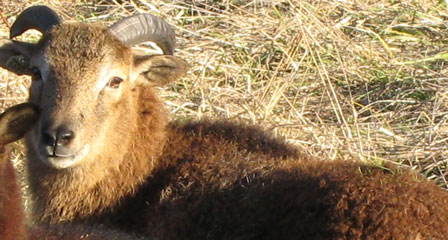
As for the characteristics of the Lillys’ flock, there are no black Soay and no light phase Soay. The rams are mostly “dark brown.” There are no polled or scurred animals; all have full horns. Bill and Linda did not trim their Soay rams’ horns, although they do have to trim their Jacobs’ horns. They always waited and sure enough, every Soay ram’s horns turned back out.

Not surprisingly, the Lillys’ Soay flock grew most rapidly during the last few years, reaching its final size of 52 animals. Bill and Linda never sold any of their Soay, although a few died. Their plan was to get a “reasonable” sized flock before they started selling. Sadly, Linda just died during the Christmas holidays, and Bill has sold their flock locally.

We are grateful to Bill for sharing the story of their Soay sheep. The Soay world is the richer because the Lillys went to the expense and trouble to bring their beloved breeding pair back to Arkansas and to maintain their flock over the last decade and more. Thank you, Bill and Linda!

For now . . .

The “Greening” of Soay Sheep

Wednesday, January 6th, 2010

One of the joys of raising rare little sheep is the seemingly endless stream of “can you believe this?” stories.  Just before the holidays, we received an e-mail from a fellow breeder, Mike Reid from northern Oregon, with the latest.  Mike tells the story first-hand:

I don’t know what to make of it, but it has rained so much up here that Tandy, a spring lamb who is the largest of our batch, looks like a Chia Pet with sprouting green seeds on her back and neck. We left seed heads on the orchard pasture for extra feed for the sheep and she rubbed seeds into her coat….we’ll try to get pictures when the sun comes out again.

The discussion was fun at the time…”Is green a Soay color? Because Tandy has got some green on her back rear….” “Wait, there is more on her neck!” “What the devil is going on?” “She’s sprouting!”

So we can claim being the breeder of the first green Soay? (Hey, have to have fun with it…maybe she’s our St. Patrick Soay.).

I’ve heard of self-feeders for dogs and cats, but a self-feeding Soay sheep?

Alas, by the time Mike found time to photograph the portable pasture, most of the grass was gone.  He explains:

We think others have picked up on Tandy’s “problem” as there was less grass to take pictures of than we remembered from before. So while she might be self feeding, snacks are picked off by others who DON’T have to crane their necks.

For your winter amusement, here is the closest thing to a green Soay sheep my resident geneticist has ever heard of:

069a.jpg

Just think, if several of Mike’s Soay grew their own sod, they could engage in their own variation of “pasture rotation.”
For now …