Archive for the 'Bummer lamb' Category

The mystery of slow-growing Soay sheep lambs

Thursday, November 27th, 2008

When I started this blog, it was my intention to write only about subjects on which Steve and I felt we had a basic grasp of the research or professional writing about the problem confronting us.  This time, I am stumped and so is Steve, and we can rely only on our own observations of a number of our Soay sheep.  The topic:  lambs who do not reach sexual maturity in time for fall breeding, and who frankly evoke an image of “runts.”  Let me explain.

During the last three lambing seasons, we have had over 170 Soay lambs born on our farm, and three or four of the ram lambs, and a couple of the ewe lambs, have failed to mature by fall.  We have been unable to find anything in the literature or on the web about why this happens or how we can prevent it.  We know it is not a case of breeding too late in the year, because the vast majority of our ram lambs go roaring through ovine puberty right on schedule in late summer, early fall and cannot wait to show their stuff, and show it they do! 

But occasionally a ram lamb does not butt heads, sniff other animals’ private parts, show dramatic horn growth or impressively-sized you-know-whats for his age.  Or a ewe lamb simply does not grow anywhere near as quickly or as much as the other ewe lambs and her horns do not grow, either. It is as though, if they do not reach a certain hormonal point by, say, September, their hormones go into arrest and they do not mature sexually until the next spring.  Let me say right up front that we have not figured out the biological explanation for this phenomenon, but we have found ways to address it successfully on our farm.

The first couple of times this happened, we assumed it was worms even though the little ones did not have dirty bums, and we dutifully treated them with Ivomex.  Nothing happened.  We also noticed that the apparently stunted ram lambs were much less asssertive about bellying up to the feeder once we took them off grass for the winter.  In one or two instances, we have moved a slow-growing ram or ewe lamb into a small pen with some other small sheep and supplemented them with grain until we felt it safe to return the small lambs to the general melee of the bull pen or the ewe pasture.  The nutrition boost at least keeps them growing generally so they will not fail to thrive, but does not provoke them into puberty and does not kick-start them into the kind of rapid growth we expect from our lambs for at least a full year.  Quite apart from their small size, they are clearly way to immature to breed.

In each case, thankfully, once the days began to lengthen in the winter, and especially when the dramatic increase in daylight started in March, the slow-growing lambs began catching up with an impressive growth spurt in all respects.  By their second fall, the rams were stomping their feet to get at the ewes and the ewes were ready to breed.

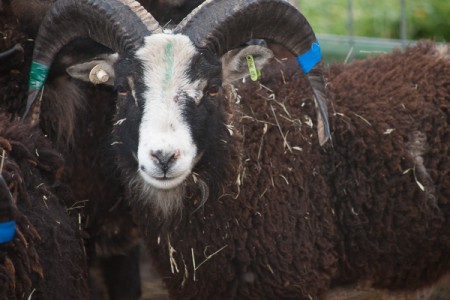
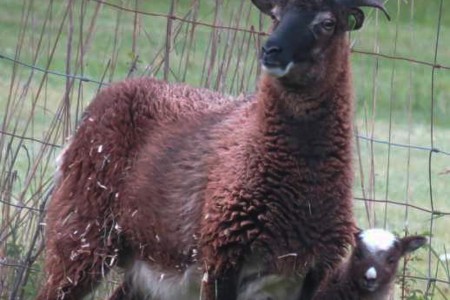
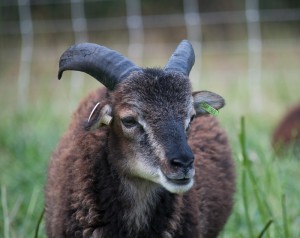
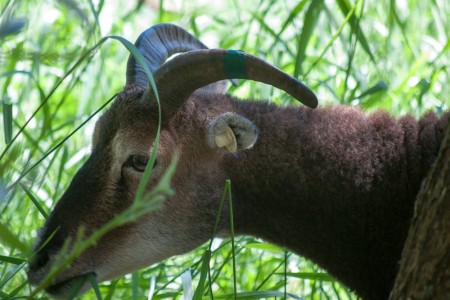
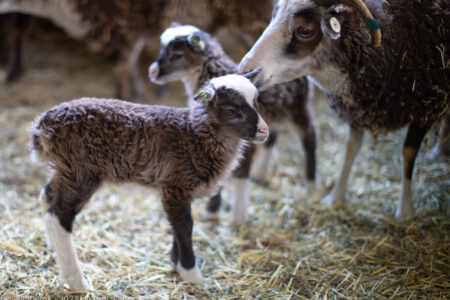
How do you know if you have one of these slow-growing Soay lambs?  Not surprisingly, they are unusually small (even more so than some lambs who have sexually matured quite nicely by fall), generally they have far less horn growth than their sexually mature pasture mates, and most conspicuously, they will not assert themselves at the feeder and none of the more mature ram lambs will butt heads with the slow-growing lamb. 

We do not want to lose even one healthy lamb, of course, so we devote enough time to watching our littlest lambs’ behavior to catch problems before the lambs give up and wither away.  In fact, this year we had the mixed fortune of having both a little ewe lamb — our cute bottle baby Patterdale — and a little ram lamb who needed to be sequestered for a few weeks because they simply were not keeping up in the big pen.

Since I have done all the talking about Patterdale in the past, I think I’ll let her pick up the story from here and explain the problem of being a slow-growing lamb and how to deal with it. 

Dear readers,

You are such nice people to keep reading Priscilla’s blog.  But she really talks too much, especially about me.  I wanted to be the one to talk this time so I can tell you how to help your sheep if you have a little lamb who grows too slowly, like I did. 

As you know, I arrived in less than ideal circumstances and frankly, it has been a struggle ever since to catch up.  Once Priscilla and Steve took me out to the Maternity Ward where I did not have to live in their kitchen in a dog cage, I was very happy.  Whenever Priscilla would ring the dinnerbell, I would let out a loud “whoopee” and come running for my bottle.  I loved being in the nursery with Sedgwick and Threlkeld and their moms because they had just been born so they were my size (I’m very small for my age, but I’m really smart).  I missed my own mom, of course, but since I never really knew who she was, I didn’t know who to look for so I was content just being in the same small area with my friends and their moms and they were very nice to me. 

When Steve let us all out onto the pasture grass in early July after the other lambs were weaned, I was even happier.  I love grass.  It is just my size.  I can put my head down, see the grass, and snarf it up whenever I am hungry and I get to behave just like the bigger lambs and their moms.  It is really nice to be on grass.  There is plenty of room for everyone to have her own space on the pasture. 

And that is why I was so sad when fall came and the grass ran out.  Steve puts a lot of hay out in the feeders for the ewe group — a whole bunch of big sheep who are not very sympathetic to us wee ones.  It’s not that easy for me to get my head up high enough to reach the hay and to make matters worse, those rude old ewes shove me out of the way all the time so they can have my share of the hay to themselves.  It’s not fair.

So I went out into the barren pasture by myself and kept trying to find enough grass to stay alive.  It got really cold out there way before winter was supposed to start.  I have a spunky personality for such a little sheep and I was trying so hard to be like the big girls that Steve and Priscilla didn’t realize how much trouble I was having.

We have a big dog named TJ who lives with the ewes and takes care of us so the coyotes don’t eat us for their dinner.  I really like TJ.  He’s really furry and sometimes he lets me lie down beside him when it’s extra cold outside.  He dug a big hole in the ewes’ winter pasture so he can have a place that feels like a bed to him.  One cold day Steve found me in TJ’s hole all by myself.  I didn’t understand that if TJ was not in his hole with me, it would be too cold to be there alone, but I was so tired from trying to find enough little grass nubs to fill my tummy that I just could not get up enough gumption to stand up any more and I figured I was done for. 

But Steve never gives up.  He took me back to the nursery in the Maternity Ward and put me in there with another little sheep — my buddy Sedgwick actually — who also was having trouble being with the big kids, especially for him because rams are supposed to be tough but he isn’t.  He’s just a nice little guy and I like being with him.  Now the two of us are living happily in the nursery together.  Sedgwick has not grown up yet, if you know what I mean, so it is okay for us to be together for now.  

Steve gives us our own grain

081109rams-007a.jpg

 and our very own customized hay feeder, a scrap of “hog” panel tilted up on the batter boards of the nursery.  I don’t know why shepherds call it a hog panel when it is so perfect for a little Soay sheep like me.

081109rams-010a.jpg

We can reach right up and get all the grass we want and there are no big ewes or rams to push us around.   I hope Steve will make more of these beginner feeders for the lambs next spring because they are a really fun way to practice eating hay without having to compete at the regular feeders.

I’m glad you were willing to listen to my story.  I have to ask you something, though.  Please watch out for your little Soay sheep who avoid the feeders after they have lived on grass for awhile.  It is scary to look up at those big feeders and at the same time be careful not to get stepped on or shoved by the grownup sheep.  It just seems easier to try to make it on the old grass in September but we can starve if you don’t pay attention to us and help us make it through until we grow some more.  And by the way, Steve says that even though I think I am precocious (it is the longest word I know), I really am not, and that I am both physically and psychologically immature.  I call it being scared. Me and Sedgwick are growing okay, I guess, but Steve says we have to eat a lot, and that is why I can’t go back to the winter pasture with the ewes until later.  I really need to pay attention to eating and besides, I don’t do very well with grownups yet.  But I am determined to become a big sheep so I can have lambs and Steve thinks I will grow up much faster when the seasons change in the spring and my body tells me it is time for one of those growth spurts you humans talk about in serious voices with your teenage children. Maybe you can come out and visit me in my new home, which is really my old home but I am much bigger now than when you saw pictures of me as a Soay bottle baby last summer.

Your friend, Patterdale

Even bummer lambs grow up, sigh

Friday, May 30th, 2008

I have such mixed feelings about Patterdale, our first and only bottle baby.  She seemed so vulnerable when she first arrived and then as she started to grow in our breakfast nook, yattering away to be sure we knew she was there and needed milk — all the time.   Both Steve and I had to resist the urge to smother her with attention, lest she get too attached to us.

We need not have worried.

These days, Patterdale hangs out with the friends she made in the Nursery when she first moved outdoors:  Sedgwick and his mom Yalo, and Milburn and his mom Catalaya.  We are relieved that she does not cling to us, or pay any attention to us at all, truth to tell, except when she wants milk.  Yalo and Catalaya will not let her nurse, of course, but Patterdale beds down with one or both of them nearby.  It is a surprisingly endearing family group scene for “just” sheep.

During the day, Patterdale is one of the crowd, exploring the hay feeders, running in and out of the creep feeder,

080506-080a.jpg

and generally learning the only skill — eating adult food — she will need until the Ancient Rituals — breeding and lambing — kick in.

But back to milk.  Notwithstanding her increasing independence, all it takes is a ring of the dinner bell hanging on a nail, or simply calling Patterdale’s name, and she comes racing over from whatever games or other mischief she’s gotten into with her lamb colleagues.

It is not very often I allow Steve to act as the official Saltmarsh Ranch photographer, mostly because he is somewhat of a perfectionist and I get impatient waiting for him to take the ideal picture.  But a few days ago he grabbed the camera as I was strolling down the gravel lane in the Maternity Ward to feed Patterdale.

080525-001a.jpg 

Does the old Al Jolson tune, “Me and My Shadow” come to mind?

When Patterdale first moved inside with us, we used a purchased lamb nursing bottle, but once she moved out to the Maternity Ward with her buddies, we needed something a bit bigger so as not to be running back and forth to the house all the time.  Enter a no-longer-needed-for-human-consumption Schweppes Diet Tonic bottle — just the ticket.

080525-005a.jpg

As you can see, there is no shortage of enthusiasm for eating in this little ewe lamb. 

I have to laugh at our naivete in this whole episode, especially our unwarranted fear that we would not be able to find Patterdale amidst the throng of lambs in the Maternity Ward.  We actually put a big swath of green marking crayon, the stuff we use to tell us which of our Soay have been vaccinated when we work the ewes or rams, on Patterdale’s head. 

080525-013a.jpg

Oh yes, the red nipple.  For such a mundane tool, it has an awfully fancy name, “Pritchard teat,” and it is widely available in farm stores.  Unfortunately, as you can see it is way too big, as is a lot of sheep-related equipment not made especially for the little Soay, lambs or adults.  So far we have not had any luck finding a reliable smaller nipple and we welcome any advice on where to find one.  The nursing/watering equipment for rabbits and such in the pet stores never seems to include a nipple and we cannot imagine the Soay taking a liking to one of those stainless steel “straws” that little rabbits are supposed to lick on for liquid intake.

I haven’t decided whether to submit this next picture to the American Dairy Board or whoever it is that puts out the ads featuring celebrities with milk mustaches, but if life gets boring around here, I may just give it a whirl.

080525-017a.jpg

Meanwhile, as endearing as Patterdale is, on balance I will be relieved when her rumen is fully operational so she can live exclusively on hay and grass and we can commit the Schweppes bottle to the recycling bin.

For now …

Bummer Lamb Update: More Lessons Learned

Tuesday, April 29th, 2008

When last we met Patterdale, she was just a few days old, traumatized by her mother’s rejection, confused by her wanderings in the Maternity Ward, wishing she could have continued as Tolcarne’s adoptee, and a bit uncertain about her prospects in the makeshift pen in our breakfast nook.  Not to mention the nearly hourly strife of going nose-to-nose with a border collie through the wire dog crate.  Weighing a mere 2 pounds 4 ounces at birth, she had a long way to go.

What a difference a week makes!  This morning as I was feeding her, I realized we should weigh the little darling to see if she ihas made any progress.  To our great surprise and delight, she has put on nearly 2 full pounds in just 12 days, to a whopping 4 pounds 3 ounces.  Not only that, she is no longer fazed by Molly’s border-collie intensity (see Molly back there quietly observing the proceedings?), and she has decided every Soay lamb should have a kindergarten chair as her personal gym equipment.  Have a look:

 080429-005a.jpg  

A few minutes ago, I turned the chair sideways and she actually jumped right over the seat.  Time to get her out in the nursery, that’s for sure!

So what have we learned thus far?  Patience.  Now there’s a newsflash, patience with a baby.  But a particular kind of patience – not feeding too much.  Patterdale never actually scoured, thankfully, but she did not pass the … hmm … how to say this, the ”solid waste products” test.  She has been slow to pass this second test of potty training despite her best efforts.  Fortunately, Steve had squirreled away for just such an occasion a bag of an energy supplement with electrolytes by the grand name of “ARREST,” to be used for “scouring calves, pigs, foals, lambs and kids.”  As near as I can tell, it is the ovine equivalent of Gatorade or one of the other energy drinks.

In any case, it works just dandy.  We mixed up an empty water bottle of the stuff per the dilution directions.  The first day we used equal parts of the supplement and milk replacer, reducing Patterdale’s total milk intake.  The next day we used one part supplement to 3 parts milk, again substituting the supplement for part of the milk.  By the third day, Patterdale was tired of reduced milk rations and let us know in no uncertain terms.  She may be only the temporarily-adopted sister of Otley the Noisy, but by golly they have the same robust vocal cords even if they are not biologically related.

One caution about electrolyte supplements for scouring:  do store the mixture in the refrigerator.  Unlike milk replacer, which can sit out at room temperature without spoiling, at least for a day, the electrolyte mixture will start to ferment at room temperature.  What we do not need around here is a tipsy lamb; she and her ilk are not exactly rocket scientists stone-sober, after all.  Besides, I don’t know about you, but an exploding plastic bottle of sugary solution in my kitchen is not my idea of a good time.

Patterdale, you’ve come a long way, baby.

For now …

A Bummer Soay Lamb: Lessons Learned

Wednesday, April 23rd, 2008

It was a dark and stormy morning last Thursday.  I was in town and Steve was running the lambing operation solo.  Delighted to find Fulmar with a big (5 lbs, 4 oz) ewe lamb in the area reserved for pregnant ewes, he jugged them and then went about the normal routine of quieting the din in the Maternity Ward proper with several flakes of fresh hay and a little beet pulp for the nursing mothers.

And then all the wheels came off.  There, amidst the nursing moms and their big three-week old lambs, was a little bitty brown thing with no distinctive markings and no ear tag – a newborn lamb.  But whose? And where was the mother?  Someone was where she did not belong.  Either the mother had panicked, jumped out of the adjacent lambing area, and lambed instead with the 3 dozen mothers and 4 dozen lambs in the comparatively chaotic main part of the Maternity Ward and lost her lamb there.  Or, the lamb had been born in the lambing area but then crawled out.  But which ewe and where was she?  Was Steve really going to have to lift up 3 dozen tails to see which ewe besides Fulmar had lambed overnight? 

Step one:  count noses in the pregnant ewe area.  Sure enough – one short.  The most likely candidate to have had a really little lamb was Gweek, and Steve did not see her.  Thinking he would find her by carrying the little lamb around the Maternity Ward sort of like a sniffing dog at the airport looking for drugs in luggage, Steve was hoping the lamb’s mother would smell her “work” and follow along to a jug.  Lo and behold, that is exactly what happened.  When Steve picked up the lamb, all the ewes but one scurried away, and only the presumptive Gweek paid any attention to the little lamb in Steve’s blue-gloved hands.  She sniffed and gurgled at the baby and dutifully toddled along right into a jug, where she (the ewe) and the little lamb proceeded to nuzzle and slurp approvingly at each other, sounds that always reassure a shepherd that all is well.  Steve’s sigh of relief probably could have been heard far beyond the friendly confines of the Maternity Ward.  Only the ritualistic checking of the ewe’s ear tag remained (remember this is a lab scientist who used to keep meticulous records of several hundred of his tagged lab mice).  I can only imagine the sound of Steve’s jaw dropping open when he discovered that the little lamb’s “mother” was not Gweek at all, but rather Tolcarne, who already had a three-week old lamb!  And not just any lamb, but one with such distinctive markings that no mother with even minimal visual acuity could mistake her for someone else.  (Never mind the universally accepted common wisdom that any ewe worth her salt can recognize her lamb 100% of the time by smell alone).  Look at Tolcarne’s lamb Buttermere.  Does she look like a little bitty nondescript brown sheep?

 080422-047a.jpg

 What … on … earth … was … going … on?

See what I mean about wheels coming off?  Mind you, I was still in town at this point, calmly going about my non-sheep business, while all this was taking place.

Back to the pregnant ewe pen went Steve to find Gweek, who he persisted in believing was the lamb’s mother.  With no small amount of relief, Steve realized he had miscounted by one and all the pregnant ewes were in fact accounted for, including Gweek.  And that, faithful readers, left only one explanation: Fulmar had twinned, and the little one had wandered off.  A sense of deja vu crept crept into Steve’s consciousness.  The same thing happened to us last year with another little bitty lamb, Otley, who crawled out of the same kind of opening — the slot between the bars of a Shaul panel – only to be found lost and wandering around the Maternity Ward bellowing like a miniature hippo.  You would think we would learn, eh?   Would you be surprised to learn that as of this moment, there are no more slots for tiny lambs to crawl through?  Maybe.

But I digress.  Fortunately, this year’s little bitty lamb was warm and clearly had managed to get a meal off Fulmar or Tolcarne or somebody, so Steve caught the little one, took her temperature just to be sure, and put her in with Fulmar and the other twin while he pondered how he could possibly figure out whether the little one had gotten any colostrum from Fulmar during the night.  Fulmar, however, was not about to buy into the proposed new arrangement.  She wanted nothing to do with this unfamiliar creature and she proceeded to bash the poor unsuspecting little lamb against the plywood sides of the jug.  Ack!  We never want to lose a lamb, but especially not at a point where we are behind in the lamb gender lottery.

Armed with the knowledge that a ewe’s milk is always the first choice for a lamb and so is living with sheep rather than with people, Steve considered whether to try to graft the little one (since named Patterdale, which beats referring to her as “hey ewe”) onto Tolcarne on a permanent basis.  Even though Tolcarne seemed willing enough, it nonetheless seemed too risky, especially given the disparity in age between Tolcarne’s own lamb and the proposed adoptee, and also the fact that Steve had no idea whether Patterdale had gotten any colostrum.  And so, for the first time in our tenure as shepherds, we had ourselves a bottle baby. 

From then on, the process has taken on a certain regularity using well-established guidelines for dealing with bummer lambs.  Most importantly, we needed to get colostrum into Patterdale immediately.  She was approaching the 12-hour-old point after which her system would no longer absorb the critical antibodies that will protect her for several weeks until her own immune system kicks in.  Fortunately for her, in the rare cases we have lost a lamb, Steve has been diligent about milking out the ewe beginning right away and continuing for about a week, in order to have an ample supply of frozen milk for just such occasions.   In this case, Steve was able to strip some milk from Fulmar and boost Patterdale with another ewe’s frozen first milk as well.  Once Patterdale had her furnace running, Steve quickly dipped her navel, tagged her (at last!), and off to our house she went. 

Patterdale is pleased to report that her home-away-from-home, a wire dog crate lined with clean straw and a little fresh hay, and seated on the cement floor near our breakfast nook, was quite satisfactory for the first few days.

080418-001a.jpg

The crate continues to be her bedroom, but she spends her days in a “run” composed of a leftover set of wire puppy panels and lined with an old college dormitory bedspread in a lovely shade of ovine brown plaid.

080421-031a.jpg

Relying on our references of choice, Storey and Parker, we set up a feeding regime to meet the twin goals of getting Patterdale growing, but also avoiding scours by overfeeding.  She only weighed 2 pounds 4 ounces at birth (even smaller than the sainted Miss Otley), so the temptation to stuff her with ewes’ milk (never cows’ milk!) was strong.

Here’s a really short course in bottle feeding an animal the size of a very small Soay lamb, adaptable to your circumstances:  Day one, 2-4 ounces of colostrum if you have it, plus 1-2 ounces more of milk — no more.  Best to administer one ounce (that’s two tablespoons) at a time.  Days 2-6, between 6 and 12 ounces of milk total, depending on the lamb’s enthusiasm for eating.  Second week, 12 ounces or so per day.  If the lamb is getting milk but still hollers, it is probably thirsty.  Feed plain water in the bottle or heavily dilute some milk.  If the lamb starts to scour (diarrhea), cut back on milk but dilute it so the lamb will not dehydrate.  The warnings about scours in Storey and Parker are surprisingly strong.  One of them says bluntly that you can kill a bottle-fed lamb by overfeeding it, so err on the side of underfeeding it.

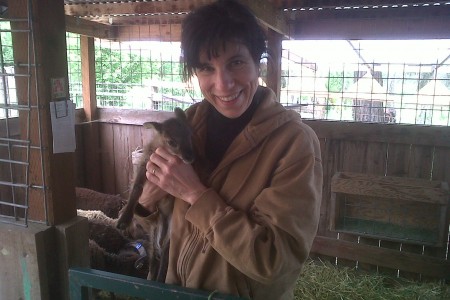
We have not yet faced the issue of when and how to re-unite Patterdale with her twin, mother, cousins and aunts in the Maternity Ward.  Not surprisingly, we have grown quite attached to our little house companion and Steve delights in sitting in her playpen on a chair scavenged from my kindergarten classroom back in rural Iowa that lets him get closer to her without having to sit his middle-aged carcass on a cement floor.  Molly, our border collie, sits remarkably quietly on the other side of the cage, enjoying the sight of a rescued lamb frolicking around the huge sandals belonging to the gentle giant.

 080421-034a.jpg

Just a minute, you may ask, haven’t you left out a critical part of this report?  What was going on with Tolcarne?  What on earth possessed her to adopt the little lost soul?  Almost never does a lamb successfully poach off a ewe who is not her mother.  Remember Otley, the lamb who wandered off last year?  Only readers with truly impressive memories will recall that Tolcarne is in fact Otley’s mother, so for Tolcarne, perhaps there was a sense of “been there, done that” this time.  Perhaps Tolcarne remembered her plight last year and was simply returning the favor. On the other hand, shepherds far more experienced than we are long have cautioned that, however altruistic sheep may appear, they are not rocket scientists.  Attributing both long-term memory and a social conscience to Tolcarne seems a bit of a stretch.  We simply will never know why she, of all the ewes, took Patterdale under her care.  I guess that’s the beauty of shepherding – never a dull moment.

For now …