Archive for the ‘Ear tags & numbers’ Category

Those of you who follow this blog or spend time on the main part of our farm website are familiar with pictures of sheep with little green ear tags — our lambs.

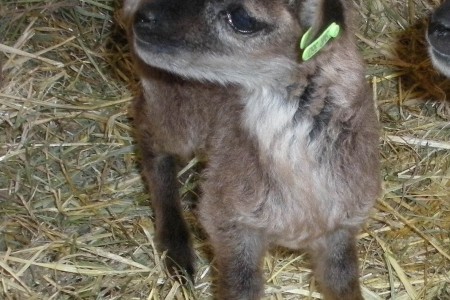
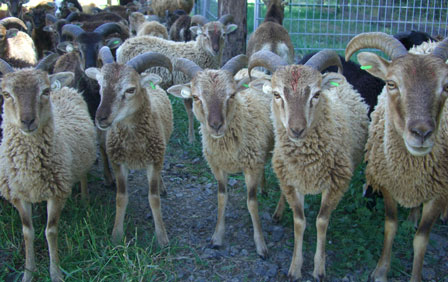
Curious British Soay lambs with green baby ear tags

Curious Saltmarsh Ranch Soay lambs with green baby ear tags

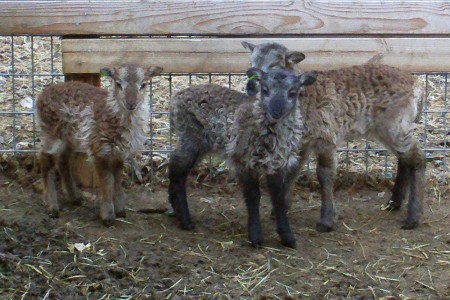
All of our lambs sport these cute little tags from Day 1.  The lambs pictured here are small enough that they almost certainly will find their way back to their mothers when they get hungry.  But imagine if they were weaned at this point and had no tags.  Unless the grey lamb with black legs were our only black-legged lamb, we would have no idea who she was [Note:  you can tell she's a ewe because her baby tag goes in her right ear; her adult tag will go in her left ear].  Similarly, as long as the gorgeous little tan ewe on the left is our only light phase ewe lamb, we can figure out who she is without an ear tag.  But throw in another light phase ewe lamb and who knows?

Why do we incur the additional cost of baby tags, and not simply rely on adult scrapie tags to identify our sheep?  There are several reasons.  For starters, the adult tags are too heavy to put in a Soay lamb’s ears until the animal is at least 8, and preferably 10-12, weeks old, but identification issues can start as early as birth.  We have a high rate of twinning in our British Soay flock — close to 50% in each of the last two years.  The twins often look identical, and baby tags are the only way to tell them apart.

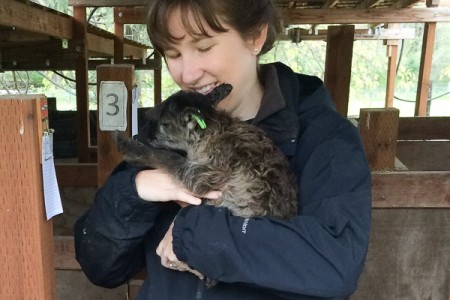
Cute little brown Soay lambs show off their green baby tags

Twin Soay ewe lambs Saltmarsh Coltishall & Saltmarsh Cromer show off their green baby tags

Much as we love to brag about the strong bonds between Soay mothers and their lambs, and even though we keep each ewe and lamb isolated in a jug for 2 or 3 days, once they are out of the jug there will be an occasional lamb who wanders off and before long tries to poach a meal from another ewe.  If all the lambs have ear tags within the first few hours after birth, and then a lamb gets separated from its mother, the odds of sorting out who’s who and getting the lamb back where it belongs in time to prevent rejection are much higher.

For anyone with more than 2 or 3 lambs, even keeping them sorted out when rounding up the lambs for working them — weighing their progress, giving them their first and second baby tetanus boosters  — gets iffy if they do not have tags.  If you separate the lambs briefly from their mothers in order to work the lambs, you may not know which lamb is which without tags.  If you round up the ewes and lambs together in a small enough area to catch them without stress, there is a good chance the lambs will not be right next to their mothers and you’ll have the same identification issues.

Mismatched lambs and mothers — no matter when or how it happens — means the lamb is basically without identification and cannot ethically be registered or sold as a Soay sheep with known parentage — its pedigree.  Not a good situation, but easily remedied with tags.

Dalton Minis are little bitty tags engineered by the folks at Dalton specifically for rabbits.  We decided to try them at Kathie Miller’s suggestion several years ago; she already used the blue Minis on her lambs.  The Minis are only 20mm long (about 3/4 inch, 5mm high  (just under 1/4 inch), and weigh almost nothing.   Here’s what they look like (photos courtesy of Dalton, all brand names either Dalton copyright or Dalton trademark):

Dalton Minitag

Dalton Minitag

For several years, the only problem we had with our Minis was that we ordered a big supply with gold lettering on green tags and our aging eyes could not read the numbers except up really close.  Plus the lambs are not thrilled about being rounded up every time we cannot read their tag numbers.  Our fault, and easily solved by ordering black lettering next time around.

Last year for the first time we had two or three Minis fall out.  We are not sure why this happened, but our working hypothesis is that the lambs developed mild ear infections from some microscopic beastie in the pasture, or the posts are just a smidgen too short for our bigger, more robust lambs these days.   Although we have lots of adult Soay who have successfully worn their Minis for years, it is the case that the  miniature tags are a very snug fit even in the lambs’ ears, and it is difficult to rotate them to prevent binding.  For whatever reason the infections happened, once the ear lobe was infected the ear tag hole got big enough for the tiny tag to fall right through.  Even though the Minis are light enough for our little lambs’ ears, they may be a bit too small for even our diminutive sheep.

Dalton makes two other products my resident researcher thought might work better and our consultants at Dalton recommended.  Here’s the Dalton Temptag:

Dalton Temptag

Dalton Temptag

The Temptag is fitted by hand (just pinch and it locks) and is 30mm long and 10mm wide.  We were tempted (!) to try it, but ultimately decided that its temporary characteristic — which large-scale commercial breeders apparently prefer — was not what we wanted, given the occasional loss of an adult tag later on – redundancy is just plain useful.  And we are skeptical about anything that creates a loop in our lambs’ ears — too many places for the loop to get caught and tear.

We ultimately decided to go with a third Dalton product for the first time this year – their Supersmall.  It is quite a bit longer, 32 mm, than the Mini and just a bit wider, 8mm, but still weighs almost nothing.  We know it will fit more freely in our robust lambs’ ears as babies and as adults, and we are hoping this will eliminate infections.  What we do not know is whether the “play” in the post will result in the tags getting caught more often.  If nothing else, the lettering will be larger and also black, a big plus for us.  Here’s the Supersmall:

Dalton Supersmall

Dalton Supersmall

As of this writing, Dalton tags still cannot be ordered online here in the U.S., but ordering them by email is as straightforward as using an online distributor.  We suggest you start by going to the main Dalton website in the U.K.  Look through their catalog to decide what tag you want, in what color and with what lettering.  Then you simply send an email to Pat Harwood at Dalton (pat h @ dalton . co . uk) and tell her what you want.  Pat is one of the most helpful people we have ever dealt with in any capacity, anywhere.  She will tell you what kind of applicator you need to order (if you decide on Minis or Supersmalls), give you instructions for your payment options (including PayPal), and when to expect your shipment.  Note:  I purposely spread out Pat’s email address in hopes of thwarting spam “harvesters.”  Just leave out all the spaces and you’ll be fine.

We order baby tag numbers (001, 002, 003) to match the number series on our USDA Scrapie adult tags – OR119 001, OR119 002, OR119 003 — so that our animals each have only one unique number.  It seems to us that having two different numbering systems, and thus two different numbers on each sheep, is just asking for confusion.  Dalton will make your tags with whatever numbering system you ask for.

What about other brands, including small tags available here in the U.S.?  Our first lambing year, before we knew about Dalton, we used the metal small animal tags Steve was familiar with from his lab years, but they are notorious for ripping out and causing all sorts of havoc with baby lambs’ ears.  Other than our problem with gold lettering and our curiosity about an even better  “fit,” we like Dalton so much we see no reason to switch brands.  But … we have heard rumors that at least one company in the U.S. now sells plastic tags small enough for newborn Soay lambs.   Premier advertises a 1″ x 1″ tag, not too long but way too wide for Soay lambs and probably too heavy.  A second Premier product has the same general shape (narrow) as the Dalton Supersmall but the Premier version is a full 1 and 1/2 inches long — too long for Soay, we fear, and also probably too heavy.  Allflex’s smallest tag is 2″ long and over an inch and a half wide.  But … we have not tried these products nor have we made an exhaustive search for other tags.  If you have had experience with a good brand that is small enough and light enough for Soay lamb ears, please send back a comment and let us know.  We are always open to new suggestions.  Until then, we eagerly await the arrival of the first lamb to sport its green, black-lettered, Supersmall eartag — lamb number OR119-351.

For now …

Answer?  Yes.

End of post?  Not quite.

In the world of pedigrees and registrations, identification is everything.  Paperwork listing a Soay sheep’s name and parentage is a great start and required for registration, but in the final analysis, ear tags (or tatoos or imbedded chips) are the only way to positively identify an animal, by linking its tag number to its paperwork.  If an owner has only one or two sheep, or only raises Soay for meat, ear tags are less important and many people would say unnecessary.  But the value of a Soay sheep to be registered or sold as breeding stock comes largely from its authenticity — is it really a Soay sheep? — and pedigree.  Without some form of positive identification, that value pretty much goes out the window.  Using tags even with a very small flock is good practice so the procedures are routine as the flock grows.

Here are a few hypothetical examples of why we believe ear tags are an essential component of accurate and ethical breeding and sales.

Mary’s mix-up. Mary buys four Soay adult ewes from Jim.   Three of them are brown with nice horns; the fourth is scurred with a white spot on the top of her head.   The paperwork consists of a bill of sale listing the four ewes’ names, birth dates, and parents.  The ewes do not have ear tags.  Although Mary has no prior experience with sheep or with fleece colors, she’s confident she will be able to tell her ewes apart after she leaves Jim’s farm.  Within a couple of weeks, she gets swamped at work and asks her teenage kids to do chores for her.  About a month later when her work schedule eases, she heads back out to check on the ewes.  To her dismay, the three brown ones look just alike and worse yet, she cannot remember which one had the white spot on her head.  Oh yes, and Jim has been transferred overseas and doesn’t do email, so even if he could describe enough distinctive traits to help her figure out who’s who, he is unavailable.

Tim’s lost tape. Tim is excited when his first three Soay ewes present him with two singles and a pair of twins, all rams (well okay, he is disappointed about no ewes, but it’s just an example), all brown.  For the first three or four weeks, the lambs stick close to their own mothers and since Tim has spent a lot of time walking amongst his ewes, he is confident about which lamb is which.  Then the lambs become less dependent on their moms and wander off during the day to explore the pastures.  Still no problem, they come back to nurse when their moms call.  Tim weans the lambs at about 12 weeks, but he has decided not to bother with baby ear tags and he has not had time to figure out how the scrapie identification program works.  No problem; he simply tapes his ram lambs’ horns in different colors until he has time to get adult scrapie tags.  The ram lambs look quite smart and rakish in their tape, and after a day of bawling for their  mothers, they settle in to enjoy the freedom to munch around in the pastures without having to come home to mother for supper. All goes as planned and in fact, the weaned ram lambs get along so well that Tim doesn’t have to do much with them for a few weeks other than be sure they have enough water and their mineral feeder is full.  But Tim’s heart sank when he came out one Saturday morning and found that the ram lambs had figured out make-believe headbutting and the color-coded tape for three of the boys was strewn about the pasture.  One ram could still be identified from the list of ewes and the color of tape on his horn.  The other three were no longer identifiable.

Jill’s juggling act. Jill prides herself on the uniform look of her flock.  For several years she has bred her American Soay for polling and for light brown fleece.  She chooses to let her ewes lamb in the field, more like what took place on St. Kilda for generations.  She  read online that all she needs is a pair of binoculars (boy, do I wish I had been the first one to think of that line!).  Although she elected not to disturb the natural scene in the field by going out and putting baby ear tags in each lamb’s ear, she is not worried about a lamb mix-up because the mothers have ID tags in their left ears.  These assumptions and adages are usually true, and lambing generally works out this way.  But then one morning Jill put down her binoculars and went out to have a closer look — she heard more than the normal amount of animal noise overnight.  To her consternation, two ewes (either in the field or perhaps they came into the barn for shelter) were spooked by something and caught their ears in a fence or on a door or a latch or a mineral feeder and their ear tags tore off.  Not only can Jill no longer tell the ewes apart, but now their lambs are also without identification.

None of these three examples matches precisely the circumstances we’ve heard about, but each is close enough for discomfort.  Far too often we have commiserated with buyers who realized too late that the paperwork they were given does not match the tags on their new Soay sheep and perhaps does not match the animal’s physical appearance (color, spotting), or worse yet, the sheep have no tags at all or have lost them.  Sellers are almost always available and cooperative to resolve the confusion in these cases, but sad to say it occasionally happens that a seller is not willing to help the buyer once the sheep have left the seller’s farm, or the seller simply disappears when his or her flock has been sold to unsuspecting buyers.

Stuff happens.  Those of us who breed British Soay need to be able to report accurately on the identity and parentage of our lambs in order to participate fairly in the RBST registration process.  All of us who sell Soay sheep — British or American — need to be able to look our buyers in the eye and tell them with confidence which animal is which.  Ear tags, and especially the use of both baby and adult tags, provide such assurance.  If the adult tag is lost, for example (and the official scrapie tags do break apart on occasion), the remaining baby tag provides a road map so the adult tag can be replaced.

One way to get tags for your adult Soay sheep is to participate in one of the US (or Canadian) scrapie programs.  The USDA provides free adult ear tags, and participating in either government’s program will allow you and your buyers to legitimately ship interstate.  The USDA tags come with your farm’s premises ID number  — an abbreviation for your state followed by a 3- or 4-digit number (ours is OR119).  A second number located on the other side of the tag is the unique number for each sheep (001, 002, 003, and so forth).

Here’s our ewe Wendron with her scrapie tag — OR119 057.

OR119-057 Saltmarsh Wendron

OR119-057 Saltmarsh Wendron

And here’s a closeup of her tag, to give you an idea of how the numbering is placed on this round scrapie tag:

Closeup of Wendron's USDA scrapie tag

Closeup of Wendron's USDA scrapie tag

Sheep sold to Canadian buyers must have USDA tags.  Veterinarians signing interstate transportation papers need to list the animals by name and identification number, and we cannot imagine an interstate transporter accepting sheep without ear tags or tatoos.  The last thing you want to have happen is to get part way home with your new Soay sheep and be turned back at the border of your home state because you lack proper documentation for your new animals.

If for some reason you choose not to participate in either the “voluntary” or “mandatory” scrapie program, you can get adult-size tags from your local feed store and put your own tag numbers on with the marking pen that should come with the tags.  Any kind of numbered tag is better than none!

Using adult tags solves most identity problems, unless one of two things happens:  lambs get mixed up before their ears are big enough to hold the heavier adult tags, or the adult animal loses its tag.  Between the number of instances in which our own sheep lost their adult ear tags, and the experiences we know about from other owners, we became convinced early on to use baby ear tags and also to leave them in the lambs’ ears even after they get their permanent adult tags at about 12 weeks.  The baby ear tags are a failsafe measure, to be sure we know which lamb is which so we can register them.  Using the little tags protects us from the awkward situation of realizing we can no longer identify a poor little sheep whose identification has gone astray.

Lamb tags small enough for Soay sheep are not commonly sold in the U.S., but fortunately there is at least one good source that is easy to find and use.  I’ll talk about it in my next post.

For now …