Posts tagged ‘british soay sheep’

Please welcome the smallest viable British Soay sheep ever born on our farm –OR119-360.  Is it any wonder we named him “Peanut”? Here he is the day he was born — all 1 pound 15 ounces of him:

tiny British Soay lamb at age ~6 hours

tiny British Soay lamb at age ~6 hours

[Note: click on any picture to see a bigger version] We may eventually give this little guy one of our “official” names, but you can see why his unofficial name fits him to a T.  He is almost a half pound smaller than any British lamb we’ve ever had. He had a scary beginning to life in the big world.  Steve had jugged his mother, Rivington, and her small ram lamb.  It was not until an hour or so later that Steve walked around the Maternity Ward making one last check for lambs and he heard a faint sound – like muted squalling — coming from under the accumulated hay on the floor.  Sure enough, Peanut had somehow burrowed his way into the hay and was lying there shivering and wondering how he had gotten lost – and his mother apparently had forgotten about him.

Thankfully, when Steve put Peanut in with Rivington and his twin brother, she immediately accepted Peanut.  Once Steve had taken his temperature (a frighteningly low 98.2F) and given him a slug of Baby Lamb Strength to quick-start his internal furnace, he knew exactly what he wanted and where to get it and headed right back to the udder.  One of the remarkable things about Peanut is his vigor – he’s been healthy, had all his parts fully formed, and ready to venture out into the world from the minute he got that first slug of colostrum.  In terms of health, there is nothing about him that is compromised because of his size.

But … his eartag is quite another matter.  Regular readers will recall  it was only a couple of months ago that I went on and on about how wonderful the Dalton Minis and Supersmalls are for the Soay breed — small enough for the Soay lambs to accommodate without dragging the ears down.  I need to go back and revise that post.  Even the nearly weightless Daltons are too heavy for a less-than-2-pound lamb’s ears:

Peanut's eartag is too heavy!

Peanut's eartag is too heavy!

Here courtesy of EweTube is a more animated look at Peanut’s floppy little tag:

Peanut shows off his new eartag

This movie requires Adobe Flash for playback.

I’ve struggled to find ways to demonstrate how small a less-than-2-pound lamb is (Peanut of course has no idea he’s small), but here’s a pretty good comparison – wee lamb investigating small adult female hand:

at age 5 days, Peanut is hand sized

at age 5 days, Peanut is hand sized

two-pound stud muffin Peanut

two-pound stud muffin Peanut

When Peanut was just six days old, I captured him with his twin, already posing for the camera:

curious miniature twin Soay lambs

curious miniature twin Soay lambs

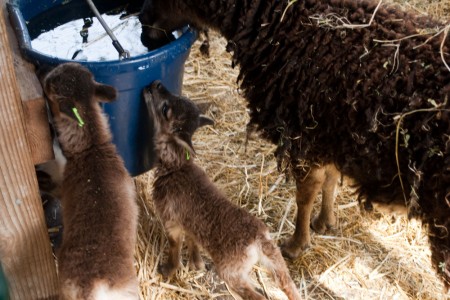
Doesn’t Peanut’s twin look positively huge by comparison?  He weighed only 3 pounds 3 ounces at birth, not exactly a giant.  The two of them are forever exploring their new world, thank goodness, and nothing seemed quite as interesting on their 9th day as the big water bucket, placed safely high, in the nursery:

small twins, big bucket

small twins, big bucket

That same day we put Peanut and his twin out in an open area with one of the other lambs from our first round, a stunning grey ram lamb we’ve named Chester.  Chester is only 8 days older than Peanut, but look at the size difference — Chester weighed in at 5 pounds 6 ounces at birth, almost 3 times as large as Peanut – whew!  Chester and Peanut, by the way, have become great buddies, as you can see.

The Three Amigos

The Three Amigos

Peanut's new buddy, Chester

Peanut's new buddy, Chester

Peanut continues to pose whenever he can.  To close this photographic journey into the land of the Soay Lilliputians, here are my  favorite pictures of Peanut … so far.

I am Peanut - hear me roar!

I am Peanut - hear me roar!

2-week old breeding ram Peanut

2-week old breeder-in-waiting

Peanut wants me to tell you that he is one of our line-cross British Soay ram lambs, so he is a candidate to breed for us in a couple of years.  He also wants you to know he is ready, willing, and able, and is asking for your support in the upcoming election!

Peanut at 3 and 1/2 weeks

Peanut at 3 and 1/2 weeks

For now …

In our first five years of breeding British Soay sheep (2006-2010), our lambs’ birth weights ranged from 6 pounds 12 ounces all the way down to 2 pounds 5 ounces – quite a large spread.  The largest lamb was almost three times as large as the smallest lamb, yet virtually all were healthy, and although the smallest ones have tended to remain small as adults, their lower birth weights do not seem to have adversely affected their ability to breed successfully as adults – ewes and rams alike.  For example, until a couple of weeks ago, Patterdale held the record for our smallest Brit lamb at 2 pounds 5 ounces, yet despite her small size and the fact that she was a bottle baby, she successfully lambed the first time we bred her and lambed without a hitch this year as well.

Because we have a large flock and we like to keep detailed and accurate records of data like birth weights, we often are asked by other breeders what an “average” Soay lamb “should” weigh.  Other breeders have asked us if there are significant differences between, for example, twin and single lamb birth weights, differences between conventionally bred Soay lambs and lambs bred by means of artificial insemination (AI), differences between ram lambs and ewe lambs, and so forth.  There is of course no single right answer to what lambs “should” weigh, but we are glad to share the data on our lambs if it will assist other breeders in assessing their own flocks.  Here goes!

Twins vs. single lambs

In three of our last four lambing years, the average weight for a single British Soay lamb was a full 13 ounces more than the average weight of our twins – no surprise there.  In fact, we would have been surprised if the gap had been much smaller, since even with this differential we know the ewes carrying twins resemble furry doublewides; they clearly are carrying more than a single lamb weight.  [based on weights for 65 singles and 40 sets of twins, all conventionally bred].

Lambs from British Soay ewes who are bred for the first time in the same year they are born vs. lambs from ewes at least a year old at the time they are bred

The first two years we had British Soay, we bred all our ewes, including those born that same spring when they were about 6-7 months old.  Although a number of those ewe lambs did not conceive, the ones who did produced offspring much smaller than what the older ewes produced.  The 8 singles from ewe lambs weighed on average 1 pound 5 ounces less than the singles born to older ewes in those two years (19 lambs).  That was a dramatic enough difference to persuade us we should quit breeding our ewe lambs and wait until their second autumn, when they are a year and a half old, to begin breeding them.  Besides giving us larger and more robust lambs, the delay allows the ewe lambs to fully mature and reach their final (or nearly final) adult size, which makes lambing easier for them.

Conventionally bred lambs vs. lambs bred using artificial insemination

The data sets for these weights are both small and not as susceptible to analysis as are some of the other comparisons, but here’s the data for what it is worth.  In 2008 and 2009 we had 21 lambs born using AI.  Of those 21, there were 3 sets of triplets, 5 sets of twins, and 3 singles (one triplet was stillborn, which accounts for the 22nd lamb).  We have no way to compare AI vs. conventional weights in the triplets, since triplets are extremely rare in British Soay in this country, at least so far.  The AI twins (5 sets) weighed on average 3-4 ounces more than our conventionally-bred twins (16 sets)  in those two years, not a significant difference and also a pretty small sample.  Our 3 single AI lambs outweighed their conventional counterparts (32 singles) by 5-6 ounces each, but the sample is even smaller.  The differential may be explainable by the fact that for our AI project, we purposely selected ewes that were twinners and in their prime, neither beginners nor ewes approaching senior status.  And even if Steve had not hand-picked which ewes to use for AI, he would not have expected to see much difference in any case, since lamb size most depends on the size and maturity of the mother and how many lambs she is carrying.  Whether or not the AI lambs and succeeding generations of their offspring turn out to be measurably larger than their conventionally bred counterparts will not be known until there are several generations of adult AI sheep and their adult offspring from which to glean enough data to have statistical significance.

Ram lambs vs. ewe lambs

Over the last three years (after we quit breeding our ewe lambs), our average single British ram lamb and our average single ewe lamb have either weighed the same or the ram lambs average only one or two ounces more.  For the same reasons we do not expect significant differences in the average weights of our AI vs. conventional lambs, we are not at all surprised that our ewe lambs and ram lambs are about the same size.  Again, it is the size of the mother and how many lambs she is carrying that are the principal determinants of the lamb’s birth weight. [55 singles and 40 sets of twins analyzed for this data].  Once the lambs head into puberty, the rams of course rocket ahead in weight and horn size.

Health issues affecting lamb weight

We know of two husbandry practices that have dramatically increased our lambs’ weight — ramping up the gestating ewes’ nutrition in the last month of their pregnancies, and treating both the pregnant ewes and the lambs with a preventative against coccidiosis and other cloistridial diseases, which can bring down very young lambs within a matter of a day or two — but are easily prevented.  See here for why this is so.

In 2007, we had a particularly rainy lambing season, minimal facilities that required our pregnant ewes to be in the wet mud much of the time, and no program to prevent a coccidia outbreak.  That year, our British single lambs averaged 4 pounds 12 ounces and our twins averaged 3 pounds 15 ounces.  Beginning in 2008, we had a completely covered area for our pregnant ewes (The Maternity Ward) with largely dry dirt “floor.” We began supplementing our pregnant ewes with either beet pulp or a little alfalfa hay.  And most importantly, we began adding coccidiostat to the pregnant ewes’ mineral and feeding medicated lamb/kid creep to our lambs until about a month after weaning.  In 2008, 2009, and 2010, our British single lambs averaged 5 pounds 2 ounces and our twins averaged 4 pounds 6 ounces, an increase of half a pound for the singles and almost a half pound for the twins.  If we needed evidence to confirm that heading off coccidia and boosting our ewes’ nutrition pays off, here it is.

Whew – I have fulfilled my responsibility to share weight data.  Now the fun part begins.  Lambing is winding down on our farm, but I can’t wait any longer to share a few pictures of our smallest viable lamb ever — a handsome and  robust ram who weighed in at only 1 pound 15 ounces.  We’ve named him Peanut, not too original but it fits him.  We  have already learned from him that even the miniature Dalton tags are a heavy burden for such a tiny creature, and more importantly, that great Soay things can come in very small packages.  Have a look!

For now …