Posts tagged ‘lamb creep feed’

In our first five years of breeding British Soay sheep (2006-2010), our lambs’ birth weights ranged from 6 pounds 12 ounces all the way down to 2 pounds 5 ounces – quite a large spread.  The largest lamb was almost three times as large as the smallest lamb, yet virtually all were healthy, and although the smallest ones have tended to remain small as adults, their lower birth weights do not seem to have adversely affected their ability to breed successfully as adults – ewes and rams alike.  For example, until a couple of weeks ago, Patterdale held the record for our smallest Brit lamb at 2 pounds 5 ounces, yet despite her small size and the fact that she was a bottle baby, she successfully lambed the first time we bred her and lambed without a hitch this year as well.

Because we have a large flock and we like to keep detailed and accurate records of data like birth weights, we often are asked by other breeders what an “average” Soay lamb “should” weigh.  Other breeders have asked us if there are significant differences between, for example, twin and single lamb birth weights, differences between conventionally bred Soay lambs and lambs bred by means of artificial insemination (AI), differences between ram lambs and ewe lambs, and so forth.  There is of course no single right answer to what lambs “should” weigh, but we are glad to share the data on our lambs if it will assist other breeders in assessing their own flocks.  Here goes!

Twins vs. single lambs

In three of our last four lambing years, the average weight for a single British Soay lamb was a full 13 ounces more than the average weight of our twins – no surprise there.  In fact, we would have been surprised if the gap had been much smaller, since even with this differential we know the ewes carrying twins resemble furry doublewides; they clearly are carrying more than a single lamb weight.  [based on weights for 65 singles and 40 sets of twins, all conventionally bred].

Lambs from British Soay ewes who are bred for the first time in the same year they are born vs. lambs from ewes at least a year old at the time they are bred

The first two years we had British Soay, we bred all our ewes, including those born that same spring when they were about 6-7 months old.  Although a number of those ewe lambs did not conceive, the ones who did produced offspring much smaller than what the older ewes produced.  The 8 singles from ewe lambs weighed on average 1 pound 5 ounces less than the singles born to older ewes in those two years (19 lambs).  That was a dramatic enough difference to persuade us we should quit breeding our ewe lambs and wait until their second autumn, when they are a year and a half old, to begin breeding them.  Besides giving us larger and more robust lambs, the delay allows the ewe lambs to fully mature and reach their final (or nearly final) adult size, which makes lambing easier for them.

Conventionally bred lambs vs. lambs bred using artificial insemination

The data sets for these weights are both small and not as susceptible to analysis as are some of the other comparisons, but here’s the data for what it is worth.  In 2008 and 2009 we had 21 lambs born using AI.  Of those 21, there were 3 sets of triplets, 5 sets of twins, and 3 singles (one triplet was stillborn, which accounts for the 22nd lamb).  We have no way to compare AI vs. conventional weights in the triplets, since triplets are extremely rare in British Soay in this country, at least so far.  The AI twins (5 sets) weighed on average 3-4 ounces more than our conventionally-bred twins (16 sets)  in those two years, not a significant difference and also a pretty small sample.  Our 3 single AI lambs outweighed their conventional counterparts (32 singles) by 5-6 ounces each, but the sample is even smaller.  The differential may be explainable by the fact that for our AI project, we purposely selected ewes that were twinners and in their prime, neither beginners nor ewes approaching senior status.  And even if Steve had not hand-picked which ewes to use for AI, he would not have expected to see much difference in any case, since lamb size most depends on the size and maturity of the mother and how many lambs she is carrying.  Whether or not the AI lambs and succeeding generations of their offspring turn out to be measurably larger than their conventionally bred counterparts will not be known until there are several generations of adult AI sheep and their adult offspring from which to glean enough data to have statistical significance.

Ram lambs vs. ewe lambs

Over the last three years (after we quit breeding our ewe lambs), our average single British ram lamb and our average single ewe lamb have either weighed the same or the ram lambs average only one or two ounces more.  For the same reasons we do not expect significant differences in the average weights of our AI vs. conventional lambs, we are not at all surprised that our ewe lambs and ram lambs are about the same size.  Again, it is the size of the mother and how many lambs she is carrying that are the principal determinants of the lamb’s birth weight. [55 singles and 40 sets of twins analyzed for this data].  Once the lambs head into puberty, the rams of course rocket ahead in weight and horn size.

Health issues affecting lamb weight

We know of two husbandry practices that have dramatically increased our lambs’ weight — ramping up the gestating ewes’ nutrition in the last month of their pregnancies, and treating both the pregnant ewes and the lambs with a preventative against coccidiosis and other cloistridial diseases, which can bring down very young lambs within a matter of a day or two — but are easily prevented.  See here for why this is so.

In 2007, we had a particularly rainy lambing season, minimal facilities that required our pregnant ewes to be in the wet mud much of the time, and no program to prevent a coccidia outbreak.  That year, our British single lambs averaged 4 pounds 12 ounces and our twins averaged 3 pounds 15 ounces.  Beginning in 2008, we had a completely covered area for our pregnant ewes (The Maternity Ward) with largely dry dirt “floor.” We began supplementing our pregnant ewes with either beet pulp or a little alfalfa hay.  And most importantly, we began adding coccidiostat to the pregnant ewes’ mineral and feeding medicated lamb/kid creep to our lambs until about a month after weaning.  In 2008, 2009, and 2010, our British single lambs averaged 5 pounds 2 ounces and our twins averaged 4 pounds 6 ounces, an increase of half a pound for the singles and almost a half pound for the twins.  If we needed evidence to confirm that heading off coccidia and boosting our ewes’ nutrition pays off, here it is.

Whew – I have fulfilled my responsibility to share weight data.  Now the fun part begins.  Lambing is winding down on our farm, but I can’t wait any longer to share a few pictures of our smallest viable lamb ever — a handsome and  robust ram who weighed in at only 1 pound 15 ounces.  We’ve named him Peanut, not too original but it fits him.  We  have already learned from him that even the miniature Dalton tags are a heavy burden for such a tiny creature, and more importantly, that great Soay things can come in very small packages.  Have a look!

For now …

Want strong, healthy lambs? Have you ever experienced the agony of watching one of your Soay lambs fail to thrive and perhaps even die despite your best efforts? Good news: if you are willing to mix a little goody into your ewes’ mineral right before lambing, and supplement your lambs with a different goody through weaning, your Soay lambs will not succumb to the worst “predator” they face in their first few weeks — coccidia — and they will be stronger, healthier and more vigorous, with internal systems developing at a nice clip, enabling them to sail right through the stress of weaning onto grass or hay.

You may be thinking: wait a minute. Mother Nature never supplemented the Soay on St. Kilda against coccidiosis, and those Soay survived just fine. Well, that’s partly right, but the descendants of the Island Soay are robust and hardy today precisely because only the most fit made it. We don’t know whether any of the early Soay got hit by coccidia and died as lambs, but we do know that if a modern-day Soay lamb gets hit with an outbreak of coccidiosis, it almost certainly will die, and a gruesome death at that. So yes, we intervene, but we think with good reason.

Okay, I’m back down off my soapbox … for now.

When we first started with Soay, we knew about worms in sheep, but as novice shepherds — even Steve with all his years of classwork, including parasitology — we simply did not realize our lambs were vulnerable to the one-celled micro-organisms called coccidia. What we did know was that we began to have an occasional sick lamb that withered and died at about 6-8 weeks, not because it lacked milk and not from worms; we had wormed the ewes before lambing. It was awful. The lamb would quickly go downhill, with no real symptoms other than listlessness and what we now know is the tell-tale uncontrolled scours (diarrhea). We would worm the lamb to no avail. Probios was useless. Nothing we did worked.

It took a visit to the vet with one of those very sick lambs to solve the mystery and make the connection for Steve between textbook and hands-on husbandry. Tests of the lamb showed a prodigious load of coccidia. Dr. Jean sat Steve down and in her no-nonsense, but very knowledgeable and caring manner told him that we had not done a good enough job of managing our flock and that we had to establish a program to prevent any further losses from coccidiosis. Her directions were clear and to the point: treat the ewes at lambing, and treat the lambs at weaning.

We took Dr. Jean’s instructions to heart and immediately changed the way we do things on our farm. The good news is that intervening to prevent coccidiosis is really straightforward and easy, not very expensive, and very effective. It has worked wonders on the health of our lambs and our young adults. We no longer have lambs who “fail to thrive,” even though we have a large flock and we have several dozen lambs born each spring in the rain. Our yearlings are strong and thriving.

Worms vs. Coccidia: a Primer

Before I outline our implementation of Dr. Jean’s “treat … treat …” program, I want to share with you the short version of a tutorial Steve gave me on why coccidia are a much bigger threat to your flock than worms, and why it will not work to simply wait and give wormer to a lamb if it starts to scour. For starters, worms and coccidia are entirely different types of organisms. Although both live in the gut, and although they both are found in at least low, sub-clinical levels even in healthy animals, worms and coccidia grow differently and cause very different kinds of damage. The main point about coccidia, the reason why they are so dangerous to our sheep, is that these single-celled organisms undergo a series of replications in the sheep’s gut, producing millions, probably trillions of new coccidia inside the animal at an exponential rate, and they do so by burrowing into the cells of the lining of the gut. When they replicate, the cells burst and die, expelling the progeny back into the gut, where those new coccidia repeat the cycle two or three more times. Before all these cells burst and died, they quite literally provided the transportation system for nutrients to get into the lamb’s blood stream and fuel its growth. The cells’ destruction drastically impairs the lamb’s ability to absorb nutrients, especially since it all happens so quickly. The lamb fails to thrive and usually dies within a few days, before the lining of the gut can begin to repair itself. Even if the lamb survives, it will be permanently compromised and sickly. By the time even a diligent shepherd notices the scouring, the infection is raging and the damage is irreparable. By comparison, worms are hardly a problem at all. True, they either suck some blood from the host animal or steal some of the food in its gut, but they do not outright kill the animal and there is plenty of time to treat for worms before permanent damage is done.

Note: I realize as I write this that it may be either too much information or not enough, depending on your tolerance for hard-core biology. In order to get it right for the post, I recorded my personal tutorial with Steve. For readers interested in a more precise and detailed walk-through of the life-cycle and impact of coccidia, click here:

Audio clip: Adobe Flash Player (version 9 or above) is required to play this audio clip. Download the latest version here. You also need to have JavaScript enabled in your browser.

Now, back to our prevention program.

Treat the ewes in late pregnancy

In the weeks leading up to lambing, we add something called “Deccox” (active ingredient: decoquinate) to our pregnant ewes’ mineral. The goal is to lower as far as possible the load of coccidia they are carrying and shedding in the area where they will lamb. Note: for the same reason, we always muck out a jug once the ewe and her lamb move to the Nursery so that the next ewe and newborn will start out in a nearly coccidia-free zone.

Lacing the ewes’ mineral with coccidiostat is easy. We simply mix 25 parts (by weight, not by volume) of our ordinary sheep mineral with one part by weight of Deccox (6% decoquinate), available at your feed store or grain elevator. We make it by the gallon in a plastic milk jug by weighing out 3kg (3000 grams) of sheep mineral and 120 grams of Deccox, mixing it thoroughly together in a big pail, and then funneling the mix into the clean milk jug. And by the way, the active ingredient is “carried” in cornmeal, plus something to keep it from clumping up, so be sure to store your unused Deccox in a mouse-proof container. If you have only a few Soay sheep, with fewer than 10 lambs a year, the easiest way to get Deccox may be through an online supplier. Pipestone, for example, sells Deccox in relatively small quantities for just this purpose and a pound will go a long way. It takes far less than an ounce for this prevention.

Treat the lambs at weaning

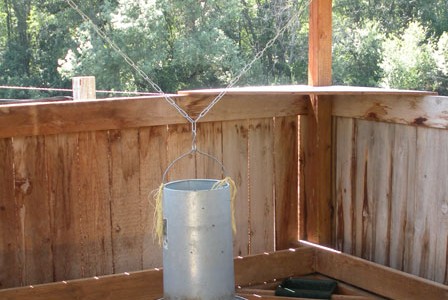
About three weeks after our first lambs are born, we set up a small feeder in a small area with small openings or slats so the lambs can get in but their mothers cannot. This allows the lambs to have free choice of the special lamb food, called for some reason “lamb creep.” Here is an early version of our creep feeding area:

080506-080a.jpg

The good news is that adding a coccidiostat to the lambs’ menu for a few weeks gets the lambs past their most vulnerable point. And besides, the lambs just cannot get enough of the lamb/kid creep. Have a look at these pictures, all taken right at the time we were weaning last year’s lambs:

090726-005a.jpg

If you’re thinking the container in that first picture looks like a chicken feeder, you would be correct. For up to about 10 lambs, it is just the ticket, as long as you suspend it above ground so the lambs will not tip it over in their enthusiasm.

Here are the lambs at the moment they heard the sound of the creep feed bag. As you can see, the lambs had become little ovine Pavlov’s dogs, racing for the goody.

090726-013a.jpg

090726-019a.jpg

If you are thinking this chicken feeder is not big enough for all those lambs, you would be correct again. Based on last year’s experience, this year we are using a battered old turkey feeder, same general style, but much bigger and with a wide enough footprint that we do not need to suspend it.

090726-025a.jpg

No possible way any of the lambs are going to let their bratty little sisters or brothers have exclusive rights to this trough!

The creep feed we use consists of a combination of grain and forage products, contains about 16% protein, includes all the minerals a lamb needs (including Selenium), and a coccidiostat trade-named “Bovatec” (generic name: lasalocid sodium). Your feed store will have something like this if they have any sheep or goat supplies at all. For the lambs, it is their first solid food; it is even easier to digest than the hay they pilfer from their mothers’ feeders. So it provides a nice transition to solid food. At first, the very young lambs will just nibble at it, but as they grow, you will notice you are refilling the creep feeder more frequently.

More good news: as the lambs eat more creep, they make less demands on their mothers’ milk, particularly nice for ewes nursing twins. Our ewes finish up lambing season these days in much better condition than the years before we started using creep.

Even more good news: apparently you do not have to worry about precise measurements or overdosing the lambs on the coccidiostat. The label says nothing about limitations and instead calls for giving the lambs “free choice.” Once you turn them out into the pasture where they have unlimited access to luscious grass, they won’t exactly forget about creep, but they will be eager to get back to the grass — they are wired to eat grass and hay, after all. The next picture shows just that, the lambs heading out to pasture. I suggested they turn and pose for a class picture, but they would have none of it. With the promise of grass ahead, they were not about to dilly dally for the camera.

090726-041a.jpg

While the lambs are eating creep, they get all the mineral they need. As they move off milk and creep and onto grass at weaning time, their bodies still want mineral, so they will naturally gravitate to a mineral feeder in their own pasture area away from their mothers. The last step in our anti-coccidia program is to include Deccox in their mineral for about a month after we quit feeding them creep.

Ready for more good news? Soay lambs gradually develop resistance to coccidia as they grow up, and by the time they are adults you do not need to worry about them falling victim to an outbreak. Strictly speaking, they will never become immune, but they will tolerate the base load always present in your barnyard or pasture (higher in wet climates, much lower in very dry climates). Thus, the goal with the lambs coming up to weaning is to balance their own developing resistance (i.e., allow it to happen) with the need to supplement while their overall resistance drops during the stress of moving from a mostly milk diet to exclusively grass and hay.

Now let’s all close up this blog and head out to the pasture or barnyard to enjoy our healthy Soay lambs!

For now …