Archive for February, 2007

Soay Sheep — International Ambassadors of Good Will

Tuesday, February 27th, 2007

I never can predict when owning Soay sheep will enrich my life in a new and different way. Last Wednesday an e-mail showed up out of the blue that read, in total: “Here is a photo of yorkshire soay in the snow and being bottle fed.” That’s it, no signature, no mailing address, no explanation of why I was the beneficiary  of the photographs, only a return e-mail address and the pictures.

Ever wonder what Yorkshire soay look like in the snow?  

                                                     small_279.jpg       

Intrigued, I return e-mailed:  ”I have an embarrassing question to ask:  I do not recognize your name.  It sounds vaguely familiar to me but I am drawing a blank.  I guess that is what happens when a person turns sixty years old! So, to be blunt, who are you?”

That same day, but in the middle of the night, back came this note from Anne: “Hi Priscilla [at least we knew each other’s names by then].  I’m also the wrong side of 60.  I’m from Yorkshire and have a flock of 12 soay and other beasts as well as a husband. We are from near the town of James Herriot, the vet author (you may have heard of him). He used to be our vet as well as my customer and his old practise still services our animals. I taught with his daughter at school.”

What a lovely surprise!  My father was a large animal veterinarian in Iowa and my family fairly worshipped the most famous veterinarian in the world.  We read and re-read his books until they fell apart.  Mom cross-stitched the endearing four-line hymn that provided titles for four of Dr. Alf Wight’s [a.k.a. James Herriot] books and the sampler hung over my parents’ living room fireplace for many happy years, a quiet reminder of the centrality of animals to our lives.

As you can imagine, I was immediately drawn to with this new person in my Soay life.  Anne and I continue to exchange notes, and I relish the thought of learning more about her animals and how she tends them.  With luck, she will remain agreeable to sharing her Soay lore with you.  For example, Anne sent me a dandy picture of her hay feeder, a somewhat different design than we have.  I intend to use her photo in a post, already in draft, about hay and hay feeders – nice timing.  In exchange, I hope to address her curiosity about how Soay have developed differently over here, a topic on which U.S. Soay breeders can expound for hours and hours and hours, can’t we?

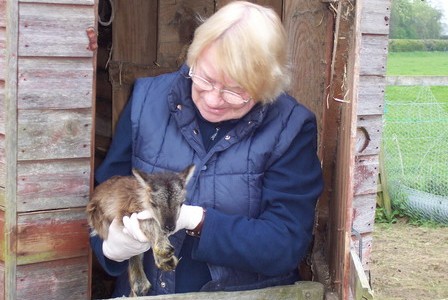
Without further ado, allow me me introduce you to my new friend Anne.  Here she is holding her adorable Soay lamb, Young Bonny:

                                        small_100_0160.jpg

Welcome to The Soay Sheep Chronicles, Anne!  Please feel free to participate in this blog with your comments and explore the websites you can find by clicking on the links in the right hand column of this page.  I am delighted you found me all the way across The Pond in the American Wild West.

For now …

The Soay Lamb Kit: Thermometers

Friday, February 23rd, 2007

Will Rogers once said, “The best doctor in the world is the veterinarian. He can’t ask his patients what is the matter–he’s got to just know.”  Will Rogers was right, but his vet almost certainly relied on a good thermometer as a substitute for a patient interview.  

When we have a listless lamb, one who is not up and nursing robustly pretty quickly after birth, we may need to call a vet, but before we do, we take advantage of the best, most cost-effective diagnostic tool we’ve got – the plastic digital  thermometer from some place like Target or Walgreen’s waiting there in the Lamb Kit.  The thermometer often can confirm what is wrong even though the lamb and ewe cannot.  In the rare circumstance where we have had lambs in trouble, the first thing we do is take its temperature.  Odds are the lamb is cold and that almost certainly means he is not nursing at all or not nursing enough to get the bonfire in his tummy going.  If we can get him eating, he should come around.  And if not, we know the first thing the vet is going to ask is, “what is the lamb’s temperature?”  So that is where we start, and here is an example of an inexpensive thermometer, this one available from Target. 

 Thermometer 

In our experience, lambs with temperatures between 102.0 and 104.0 Fahrenheit are almost certainly okay; they are eating; they are turning milk into fuel to keep them warm and healthy.  Last year we had almost 40 lambs and with two exceptions, their temperatures when we first assessed them were just fine.  The two lambs in distress each had temperatures lower than 102 the first time we checked them. In both cases, it was urgent that we get the lambs up and nursing and pronto.  Cold lambs do not live very long, period.  Remember the blue gloves?  We put them on and took the lamb back to the ewe’s udder and did our darnedest to persuade the little guy to eat.

We had mixed success.  One of the lambs seemed lethargic after the first four hours and his temperature was 101.8 degrees, not alarmingly cold, but low enough to check on him frequently.  Although we did not actually see him nurse, when we came back to check on him a couple of hours later we could tell by feeling his belly that he had gotten a little milk.  This was confirmed by taking his temperature, which had risen to 102.6 degrees.  He only weighed 3 pounds 15 ounces at that time, so we were relieved to see such a wee one fighting hard to make it, and he did.  By 11 hours, his temperature had risen another .2 of a degree and from then on he was fine.  

The lamb we lost, by contrast, had a temperature of only 100.8 the first time we assessed her shortly after birth, critically low.  Although we immediately gave her NutraDrench, tube-fed colostrum-laden milk stripped from the ewe, and put the lamb under a heat lamp, she did not rally, never could get up and nurse on her own, and never showed any signs of being able to survive.  Her temperature fell to 100.4, then 99.6, and she died.  It was our first face-to-face experience with the concept of “failure to thrive” and a blunt reminder that even with the renowned hardiness of Soay sheep, not every lambing has a happy ending.     

A note about thermometers.  They do not feel any better in the lamb’s little bum than they do in yours, so give the lamb a break and apply just a smidgen of KY to the tip of the thermometer.  You could use Vaseline as well, but KY works better if you make and use one of Steve’s Pretty Good Goo Syringes.  Read on.

After the first time Steve wasted the better part of a tube of KY trying to squeeze it out onto the tip of the thermometer, he rigged us a nifty applicator by fitting a 6cc syringe with a 16 guage needle, breaking off the tip of the needle, smoothing the rough edges of the now-blunt end with emery paper, and filling the syringe with KY.  With the needle guard back on, we can keep our Goo Syringe around forever.  It also comes in handy when we are applying eartags to lambs and adults.  

For now …   

I Llove Llucy

Wednesday, February 21st, 2007

Allow me a brief detour from the Lamb Kit to introduce Llucy, our guard llama. Steve took this picture last lambing season. I was watching a new lamb cavorting when without warning Llucy snuck up behind me, I felt warm damp air on my neck, just barely heard a soft shwoosy sound, and I was nose to nose with my friend.

Llucy and Priscilla

I like retelling the story of Llucy’s arrival at Saltmarsh Ranch. For me, it says a lot about how Soay and their guardians worm their way into our hearts.

We had just gotten our first four Soay when a broadcast e-mail arrived from another Soay breeder looking for someone to take a whole flock (almost 20 as I recall) from a couple who had to find a new home for their Soay quickly for health reasons. There was only one condition: the Soay’s guardian llama Llucy was part of the package deal.

What did we know from llamas? We were a couple of greenhorns newly arrived from “back east” in Chicago who thought shepherding consisted of little more than acquiring a few sheep, a pre-battered stonewashed cap from LL Bean, and a set of Pan pipes, with perhaps a shepherd’s crook thrown in for good measure. In short, we were ignorantly giddy at the thought of jump-starting our Soay operation and a llama sounded like a good bonus for a Christmas card picture. We volunteered to take the whole lot of them, including Llucy, with not even a passing glance at the llama literature to see what we were getting ourselves in for.

The sheep arrived late at night in a huge trailer unlike anything we had ever seen. I do not remember whether there was a full moon but let’s say there was for the sake of atmosphere. Backing the trailer down our narrow lane and nestling it up against the gate to the nearest pasture to prevent escapes was quite a trick, but nothing compared to the bravura performance that followed. The driver cautioned us Llucy must come out first or there would be general confusion and panic in the sheep. Fine with us. Llucy came out first. And then began the procession, the remarkable sight of Llucy the second grade teacher, standing on duty at the gangplank, wearing sensible shoes, with her clipboard, on a field trip with her students, checking each Soay off the list with her nose as it came down the ramp. She took roll, and we know to a moral certainty that there would have been hell to pay for the driver if even one of the sheep had turned up missing.

Whatever the disadvantages of having llamas, with or without sheep to guard — and we are told there are such drawbacks — for Steve and me there was no question about the rightness of having Llucy. Any animal so committed to her charges would be a welcome member of our Saltmarsh Ranch menagerie. And so she has remained, faithful to her Soay and utterly endearing to us. May you also have the good fortune to find just the right guardians for your flock!

For now …

The Soay Lamb Kit: Iodine

Tuesday, February 20th, 2007

Dousing a newborn lamb’s umbilical cord in iodine as soon as possible after birth is an inexpensive way to guard against infection. Later when our lambs go back out into the pasture, they have to fend for themselves as far as scrapes and cuts go; it is not cost-effective to treat them for everything. But at the outset, when the raw cord and navel are exposed and the lamb is lying down all the time, it just makes sense to apply iodine.

We strongly recommend 7% iodine, much stronger than what you will find on display at grocery stores and pharmacies, but necessary for the dousing to be effective in the unavoidably unsanitary conditions of a lambing area. An aside: In Jackson County where we live, we have to sign for 7% iodine at the Grange (farm supply store), apparently because it can be used in meth production. They didn’t teach us that in the good old days, did they?

The applicator of choice is a contraption with the show-stopping name of “teat dipper.” Don’t believe me? Google the term and you will find pages and pages of hits for dairy cattle supply catalogs and stores. We just call it a “dipper.” Less to explain when someone drops by while we are working a lamb.

The dipper is a great invention, if sheep equipment gets your pulse going. It has a nifty hook on one side so you can hook it over the side of the Lamb Kit container and it will not tip over and spill (Big Lie #1). It also has a round cup-like opening you can press right against the lamb’s belly (or the cow’s teat if that is what you are using it for), again to prevent spills (BL #2). You can see the dipper in the Lamb Kit container in my earlier post introducing the Lamb Kit. Ours came from the Premier Sheep Supply catalog but I promise you can find them anywhere two or more dairy tools are gathered together.

Put some iodine in the dipper, no need to fill it full. Gather the umbilical cord into the opening of the dipper so the cord will get drenched with iodine. Place the round side opening of the dipper firmly against the lamb’s belly and then turn the lamb over so the iodine gets on the navel as well as the cord. Count to 3, turn the lamb right side up, and voila! All the iodine will drain back into the dipper (BL #3), where it stays put until time to disinfect the next lamb (BL #4). It is completely reusable.

Hmmm, how to say this discretely.  If you are working a ram lamb, be careful to capture only the cord in the dipper or you will have a seriously wriggling and even more seriously unhappy lamb on your hands. 

Should you have the misfortune of spilling iodine on your hands at any point in this process (go back and review Big Lies #1-4), through either innate clumsiness or a well-placed lamb kick or whatever, you will have a bright orange stain and it will sting like the devil.  You should have worn your blue gloves!  It will look dreadful. You will be convinced your days of balancing sheep chores with manicures in town are over. But trust me (BL #5?) the stain will come off if you apply rubbing alcohol promptly. The quicker you pour alcohol on it, the more comes off.  Note to self: probably not a bad idea to add a bottle of rubbing alcohol to the Lamb Kit.

As for your clothes, they too will look dreadful, but not all that different from the effect placental goo, lamb poop, adult sheep lanolin (aged), or a variety of other substances have on your coveralls.  After all, isn’t this why we wear them even though they are the single most unflattering garment ever invented?  Although I still find it hard to believe, every time one of us has spilled iodine on our clothes they came clean in the wash. And no, I am not going to write a post on recommended laundry products for shepherds. Life is too short already.

Perhaps, however, once lambing starts I will add a photo demonstrating the application of iodine for your amusement. Last year at this time I had no idea I would be doing a blog, so taking pictures of teat dippers was the farthest thing from my mind.

For now …

Jugging with your blue gloves on

Sunday, February 18th, 2007

When I looked at the first draft of this post I nearly cancelled the whole blog in despair.  Nitrile gloves — now there’s a headline grabber.  If I did not lose you to generalized boredom, I was sure to lose you to a bad case of MEGO.

Then I remembered the “dance” I describe here, the task where the (blue) gloves come in so handy, is part of “jugging.”  All of a sudden I was no longer in the throes of writer’s block.  I was back at a 10th grade sock hop in rural Iowa, flailing to the sounds of “Devil with the blue dress on.”  Talk about random access.  

Back to the Lamb Kit. 

Nitrile gloves are the only equipment required for a task unique to the lambing phase –”jugging” the ewe and lamb.  Here is how jugging works and where gloves fit (oops) in the picture.  Stay with me and stop tapping your toes.  DWTBDO was a truly awful song and I’m sorry I brought it up.

A couple of weeks before lambing begins, we bring our pregnant ewes up from the pasture to a fenced paddock named, in a fit of originality, the “Maternity Ward.”  The MW consists of a small area near the barn where we keep the ewes at night, and a surrounding area beyond that where they can graze during the day with our guardian dogs.  This setup allows us to keep close tabs on the ewes and quickly spot the newborns.  Having a small inner sanctum also allows the dogs to “patrol” the perimeter around the sleeping quarters at night.  The combination of scent and their physical proximity to the ewes is enough to ward off coyotes looking for dinner, a bigger problem for us when the tender baby lambs start arriving.

To be sure, the Maternity Ward is a bit crowded, especially at feeding time, and once a lamb is born, it can be stressful for the ewe, especially a first time mother, to keep track of and stay focused on her young one in the general chaos.  Now we (finally) get to “jugging.”

As soon as we discover a new lamb, we move the ewe and newborn to a “jug,” one of several 5′ x 5′ paneled areas within the Maternity Ward that are warm and and have dry fresh bedding straw.  Here the mother and lamb can be alone for the first 24 hours or so while the lamb learns its mother’s voice and smell (and vice versa), and here the gloves (finally) come in handy. 

We want to avoid human scent on the lamb until it has bonded with its mom and the reciprocal “imprint” is firmly in place.  Steve wades right in, picks up the lamb with his gloves on, and starts the jugging dance, walking slowly backwards, holding the lamb low enough for the nearsighted ewe to follow closely, nervously licking at her lamb and usually gurgling and muttering a lot.  It takes just a couple of minutes to get them into the jug and is guaranteed to work as long as the ewe’s nose is close enough to smell the lamb.  This is one time when I wish I had had a camera.  There is no dance quite as odd as the 6-step the shepherd and the ewe perform in jugging.  

After the ewe and lamb are safely ensconced in their jug, everyone relaxes and the ewe gets back to work cleaning and feeding her baby, savoring the relative tranquility until the next ewe/lamb pair displaces them.

Our gloves of choice are made of nitrile, rather than rubber.  Nitrile is much stronger and just as thin as rubber, so you also can wear them to do the fine work necessary to vaccinate, tag, or otherwise handle the lamb if you do not want to work bare-handed.  Nitrile gloves are easy to locate in the farm supply store or pharmacy.  They are the blue ones, disposable and inexpensive.

Oh yes, if you have nothing better to do in late March/early April, you are welcome to stop by the ranch and watch a demonstration of jugging with blue gloves on.  I probably do not have to tell you what 1966 “hit” tune by Mitch Ryder and the Detroit Wheels will be  piped into the Maternity Ward to accompany the dance. 

For now …

Lambing Chapter 1: the Soay Lamb Kit

Saturday, February 17th, 2007

Anticipation, excitement, and a certain tension are in the air – a sure sign it is almost time for lambing to begin. When we start getting edgy about all we have left to do before the first lamb appears, one of us inevitably asks how we are doing on supplies and equipment. On a rainy late winter day it helps to go through the calming exercise of laying out what we have, taking inventory, and restocking from catalogs or a quick trip to town.  It’s an important event in the Soay Year Calendar.

The really critical lambing “stuff” goes in the Lamb Kit itself, so I will start there – the subset of supplies we actually bring with us as we head out to greet each new arrival.

A brief aside: When Soay breeders brag about how easily their ewes give birth, they are not exaggerating. The ewes just do it, no muss, no fuss. As soon as the lamb is on the ground, the ewe cleans it off, gets it on its feet and encourages it to start nursing. Once the lamb has a full tummy and is producing its own heat, the immediate crises of birth are past.

But because we live in an area extremely deficient in selenium, an essential element, our vet recommends giving both the ewe and her lamb a selenium injection as well as a shot of vitamins. And, because Steve’s focus is pedigrees and tracking genetic characteristics, ear tags also are essential identification tools. The ewe cannot address these issues, so we help out. We have a standard routine we follow with each lamb, usually about 2 or 3 hours after birth or the first thing in the morning after an overnight birth.

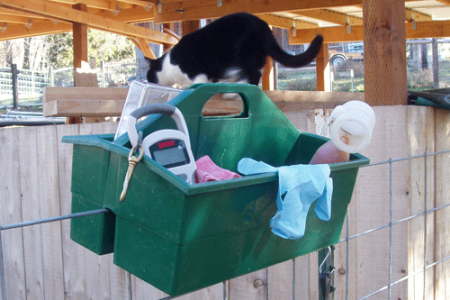
And that brings me back to the Lamb Kit itself. Here is what it contains:

  • Nitrile gloves
  • Iodine for the umbilical cord
  • Thermometer
  • Portable scale
  • Clean rags or towels
  • Syringes pre-loaded with selenium and vitamin supplements
  • Baby ear tags & applicator
  • Lambing cards & pencil
  • Flashlight

All of this fits neatly in a rectangular plastic container with a handle that looks sort of like the removable top tray of a tool box only much deeper. We got ours from the local farm store and I think it is designed for use with horses. It has a nifty groove on its bottom side so it straddles the wire fence and can’t tip over, always a plus when you are working with slightly gooey, wriggling new lambs.

Here’s a picture of our Lamb Kit, partly loaded, sitting on a fence in front of one of our sheep shelters.  Cat, contrary to appearances, is not part of the kit.

 Lamb Kit

This post has gotten long enough.  Details on what the various items in the Lamb Kit contribute to the mix in the next few posts.

For now …


Got hay?

Thursday, February 15th, 2007

The realization that lambing starts in five weeks sent Steve out to the barn today to count what’s left of our winter hay supply.  Do we have enough to last until the pastures green up?  When we put in our order last summer for winter hay, we factored in the extra needed for gestation and nursing, but the thought of running out is so scary that Steve ran the “are we sure” count again.  I would like to say we always remember to check about this time each year, but without reminders in the datebook, the final pre-lambing hay supply check might get lost in the shuffle.

We buy enough for November through April, more or less.  The grass is getting pretty crummy by the end of September, but hay is so expensive that we let the Soay scrounge the remaining grass in the fields for as long as we can.  And when we put our breeding groups together in late October, we can’t rotate the sheep any more so we have to turn to hay.  In terms of the end of hay season, some years we have lush fields by mid-March, some years it’s a little later depending on when the ground warms up.  The hay keeps pretty well so we err on the side of having a few bales left over.  Last-minute orders of hay in February can really poke a big hole in your Soay budget. This year, both the Capital Press and our local paper report that for all intents and purposes, there is no hay left to be bought.  Southern Californians suffering through drought apparently bought up all the extra Oregon hay.    

The formula we use is one we heard about in a seminar on pasture management run by Woody Lane, who by the way knows more about grass and how to maximize pastures than anyone we’ve come across.  To calculate the amount of hay you’ll need, start by assuming pounds of hay at 5% of body weight per day per animal.  We use 55 pounds as our ewe weight, 75 pounds as our ram weight, and 40 pounds as the weight of our lambs born the prior spring.  So for a lamb, .05 x 40 = 2 pounds of hay per day.  If you’ve remembered to ask your hay supplier for an average bale weight, you can easily calculate how many bales you need.

From watching our pregnant ewes the last couple of years, we estimate they eat about 1.5 times as much during the last month of gestation and easily twice as much while they are lactating (nursing).  But by the time they are nursing, the rams and the non-pregnant ewes are converting from hay to spring grass in the pastures, so with these offsetting factors, the original 5% calculation is sufficient.  These numbers worked well last year and based on our bale count this afternoon, they’re holding steady this year as well.

More on how we choose our hay later. 

For now …

Welcome to Priscilla’s Soay Blog

Tuesday, February 13th, 2007

If you managed to find this site, you must like Soay Sheep. Good. So do I, and so does my husband Steve, the head shepherd here at Saltmarsh Ranch. It is almost lambing time, which means those of us who are hopelessly addicted to these little creatures have much more to talk about than our non-Soay friends will tolerate.

As the chief observer of all things Soay on our farm (that just means I don’t do the heavy lifting like building fences and shelters), I have filled my head with a lot of practical knowledge about the actual care and feeding of Soay. The time has come to share what I have learned with other people so I can reassign these brain cells to new tasks, Soay-related and otherwise.

What’s the topic for today? Just introductions, since the sun is setting and it is time to figure out what’s for supper. But over the next few weeks, I plan to talk about specific ways of dealing with our Soay that have worked for us in hopes they will help you, too.

Time to run. I’ll be back in a day or two to dig in and start the Soay Sheep Chronicles.

Priscilla Weaver