Archive for September, 2007

Weed-free pasture or blackberry pie? You can have both!

Saturday, September 29th, 2007

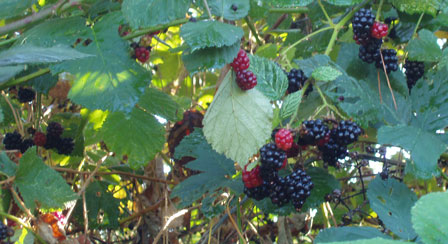
For eleven months of the year, I watch with glee as our sheep search and destroy the wild Himalayan blackberry vines that are the curse of fields and streams here in Oregon and throughout the Pacific Northwest.  Each year we are amazed at our animals’ ability to forestall the re-infestation of our fenced pastures.  Nary has a week gone by but we scheme how to fence even more areas in order to rid the farm of another impenetrable, 10-to-15-feet high blackberry thicket.  Aptly named Rubus discolor, the non-native, invasive blackberry has met its match in Soay sheep.  Once they strip the canes of leaves, we mow the stalks down and watch as our otherwise sweet-tempered flock attacks the emergent re-growth.  Little did we know when we got our first small Soay how effective they would be as warm-blooded WeedEaters.

And then August arrives and our eradication resolve evaporates with the ripening of the remaining blackberries.  Talk about nectar of the gods.  There is nothing quite like a handful of sun-warmed, perfectly ripe berries right off the vine.  With that first mouthful, I am thankful that once again we have failed in our quest to rid Saltmarsh Ranch of Rubus discolor. 

07blackberries-005a.jpg

True confession time.  I am a blackberry addict.  Moreover, I tend to go overboard in nearly every new adventure I try.  So it did not surprise my friends and family when I took up blackberry pie-making with a vengeance the first August after we moved here from Chicago.  At first, the pies were welcomed by our new neighbors, but soon they became the zucchini of Little Applegate Road, as in “close the curtains, Fred.  Here comes Priscilla with another one of those darned pies.”  Just in the nick of time, a Minnesotan named Anne Dimock came into my life.  Anne has written an engaging book entitled Humble Pie in which she argues strenuously (and in my case, effectively) for the return of serious pie-making in America.  Anne, her mother Mary before her, her grandmother GeeGee before that, and various other members of their families are pie professionals and I am delighted to have made their acquaintance long-distance through Humble Pie.    

Anne permits and even encourages the practice of freezing uncooked pies for doling out over the winter.  Now why didn’t I think of that?  Life became a lot more sane around here, and relationships with our neighbors were given a welcome boost, when I switched to frozen blackberry pies.  Here’s a pretty good recipe cobbled together from Humble Pie, Better Homes & Gardens, and experimentation at Saltmarsh Ranch:

1.  Pick at least 6 cups of blackberries.  The task goes faster if you wear a long left hand glove designed for rose gardeners, drape an empty marguerita mix bucket over your left forearm to hold the berries, reach in and grasp a cluster of ripe berries with your left thumb and index finger, snip off the cluster with your Felco garden shears or any comparable scissors held in your right hand, and pluck off all the berries at once over the bucket.  Wash and drain the berries.

2.  Toss 5 and 1/2 cups of the berries with the zest of 1/2 lemon, 1/2 cup sugar, and 2/3 cup flour.

3.  Make a double pie crust however you can.  Anne provides a lot of help with crusts in her book.  The only thing she missed is what music to play while making pies, and I am working on that omission.  Recommendations to date?  Any of the Brahms symphonies.  They are sufficiently robust to provide needed support when you are struggling to get the crust just right.      

4.  Put the blackberry mixture in the bottom crust and put on the top crust. 

5.  Freeze the pie as is.  If I plan to use the pie within a few weeks, I usually just put it in a 2-gallon plastic freezer bag, Ziploc or whatever you can get that’s big enough.  If I plan to keep the pie frozen until winter, I cover it with aluminum foil and freeze it, then take off the foil and run the pie through my FoodSaver to minimize air damage in the freezer.  If you are making a 9-inch pie, when frozen it will just barely fit in the larger size FoodSaver bag.

6.  When you are ready to bake the pie, take it out of its freezer bag, cut a couple of slits in the top crust, and pop it in a 425-degree oven right away.  Bake it at 425 degrees for about 20 minutes, then an additional 45-60 minutes at 350 degrees.  It takes a long time to bake a frozen two-crust pie chock full of blackberries.  If you start with a frozen pie, you probably do not need to cover the fluted edge with aluminum foil to prevent over-browning.

Should you be lucky enough to have, in the aggregate, a couple of acres of blackberries as we still do, and you become addicted to pie-making, here is  a tip for conserving space in the freezer, thus allowing you to make even more pies:

Forget the crusts altogether during blackberry-picking season.  Simply put the blackberry/lemon/sugar/flour mixture in an empty pie tin, cover it with foil, freeze it, then pop the mixture out of the pie tin and run it through your FoodSaver.  These pie “innards” stack nicely in the freezer.  When you are ready for a pie, get out the same pie tin, make the crust, add the completely frozen innards (which will fit perfectly if you use the same pan for both steps), pop on the top crust, and bake.  You will need to adjust for your own oven.  Mine does the job well if I cook the pie with aluminum foil covering the fluted edge for 45 minutes and then cook it for another 25-30 minutes with the foil off. 

Besides saving room in the freezer, eliminating the crust part until you are ready for a pie means you can spend all your time in August picking, rather than making crusts.

Maybe some year we will have no noxious blackberry thickets left on our farm and I will spend August lounging in a hammock on the deck, but until then, feel free to drop by Saltmarsh Ranch any time of year for a slice of homemade blackberry pie.  Give me about 3 hours’ advance notice so I can drop what I’m doing, whip up a crust and have the pie coming out of the oven as you arrive.  If you want it a la mode, you will need to stop at the Ruch Country Store for ice cream, preferably vanilla bean.   

For now … 

Pasture rotation by any other name is still a good idea.

Monday, September 24th, 2007

Loyal readers, I must apologize.  It has been suggested that what I described in my last post was not, technically speaking, pasture rotation, but rather something with the intriguing label of “strip grazing.”  I don’t know about you, but visions of a major thoroughfare in Las Vegas featuring a bevy of either restaurants or another kind of treat come to mind when I hear that term. 

Be that as it may, let me set the record straight for the terminology perfectionists in the audience.  Here at Saltmarsh Ranch, we engage in both pasture rotation and strip grazing.   Pasture rotation refers to the placement of parts of our flock within, and the infrequent move out of, a large section of pasture delineated by stout permanent fencing. Depending on the weather, irrigation, and number of sheep involved, we need to rotate pastures every few weeks.  Within each pasture, however, we strip graze by moving the sheep every three or four days to a new small section of the same pasture using temporary fencing. 

To make jargon matters worse, one or both of these practices sometimes is referred to as “managed grazing” and I have no doubt there are other terms as well.  Call it what you like, the key is to keep moving the sheep every four days so the animals will only eat the grass once before it has a chance to grow back.

I promise there will be a more interesting post next time.

For now …

Pasture rotation: making hay while the sun shines

Wednesday, September 12th, 2007

As we approach the autumnal equinox, we begin our annual fretting about how long the pasture grass will last and when we have to convert to pricey hay feeding for the winter.   The worry meter reads particularly high this year because much of the Pacific Northwest got far too little rain, so the demand for hay outstrips supply.

Short of taking the flock down the road to the knacker, we have few options for keeping the hay bill in check.  Our most promising tactic is disciplined pasture rotation.

For the grass novice, pasture rotation is neither an astrological gimmick nor a game of chance.  It refers to the notion of putting grass-eating livestock on very small portions of a pasture in succession so they will of necessity eat all the green stuff – grass and weeds alike – evenly and not move through the entire pasture all at one time, cherry-picking the tastiest new grass and leaving everything else to flourish in its place.  Move the animals  systematically, before they take the vegetation down too far, and each part of the pasture recovers nicely, ready for the animals again when the rotation starts a second time.

Let me illustrate.  The following picture shows five sections of one of our pastures, labeled sequentially according to when the sheep first grazed on them in this rotation.  Please bear with me in this labeling and description and I will do my best not to be unduly pedantic.  Section ”A” was the first section eaten, B the next place we moved the sheep to, and so forth.      

pasturerotation-011crop_edi.jpg

The sheep are in section D, which still looks pretty green.  They already have eaten, in turn, sections A, B, and C.  When I took these pictures on August 24, the sheep had been on section D for one day.  Mind you, there are over 50 sheep and two llamas, our adult Llucy and her cria Hank, eating this pasture.  At least from a distance, section A, which they ate 7 or 8 days earlier, already is in pretty good shape, regenerating nicely.  Section B doesn’t look very good in this picture, but take my word for it, it has turned over a new leaf or two.  In fact, I will show you a closeup of section B in a minute to illustrate how much has regrown in just one week.  Section C of course looks awful because the sheep have only been off it for a day or so.  Section E, to which the sheep will be taken next, looks even better than a “last” section usually does because no sheep have been on it for several weeks while we worked other paddocks.     

The downside to pasture rotation is that to make it effective, you need to enclose areas smaller than your instincts tell you or than you want to.  Even more important, you need to move the sheep every 4 days.  If you have the right sized group for the right sized area, the sheep should eat it down in those 4 days.  Even if you guess wrong and all the grass has not been eaten down, you still need to take the sheep to the next area.  Grass starts regenerating after 4 days and you must get those hungry mouths moved before they start eating the new growth.  You can move the animals before all the grass is eaten, of course, but then you are not taking full advantage of your pastures, are you?

Here’s the good news:  if you use something lightweight for your interior pasture dividers, it is really easy to move the sheep from one section to another.

Now let’s look at the same section of our fields from a different angle. 

 pasturerotation-007crop_edi.jpg   

Areas A and E, where the sheep have not been for the longest time, are quite lush.  The most recently-munched areas, B and C, are starting to recover.  Area D is in the process of disappearing into rumina.  And by the way, the far and near paddocks in this picture held a good portion of our flock about 3 or 4 weeks before this picture was taken.  Recovered nicely, didn’t they?

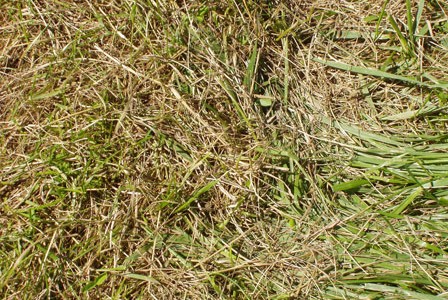
What is amazing about pasture rotation is how effective it is, and how fast pastures recover in the summer and early fall if they are irrigated.  Let me show you comparative closeups, actual photos with zero retouching and zero tampering from any photo software program.  In the next picture, you are looking at section C taken with my zoom lens, the section the sheep left just a day or so earlier.  From a distance, it appears a wasteland (look back at the first picture above), but look more closely and you will see a lot of live green grass shoots under the scruffy-looking stuff on  top.  Those shoots are healthy enough to start growing robustly again now that several dozen efficient mowers have moved on to greener pastures.

pasturerotation-014a.jpg

Truth to tell, Steve left the sheep on this section one day too long.  Live and learn.

Next I want to show you what 5 or 6 days of recovery had done to section B by the time I photographed it on the 24th.  First,  look at this medium-range picture of section B, tucked between the “virgin” section E below and the first-eaten section of this pasture, section A up there in the left-hand corner.  See how “hurt” section B looks from mid-range?

pasturerotation-013cropa.jpg

Now look at this same section B up close through my zoom lens.  Again, absolutely no retouching and taken within minutes of the other pictures. Not bad recovery for land that had several dozen sheep on it just a few days ago, eh?

pasturerotation-016a.jpg

And finally, here is what the grass looked like up close in section E, where the sheep had not been for several weeks.  Obviously it is the most lush, lots of high quality grass, lots of clover, pasture yearning for a bunch of cute little Soay mouths.

pasturerotation-017a.jpg

Because this is our first year of disciplined pasture rotation, it is too soon to know know how far we can extend the grass-eating season into the fall.  For our large flock of about 130 Soay, every week we can keep them on grass and off hay saves us a lot of money, easily enough to get a shepherd’s attention.  Even if we had a small flock, perhaps 8 -12 animals, the process of moving temporary fencing every few days would still be cost- and time-effective.  Using the theory of compensatory cash flow, any shepherdess worth her salt can readily convert the savings into a weekly visit to the local spa, perhaps a leisurely pedicure, or something equally worthy.

As for how you divide up a large pasture area into the small sections required for effective pasture rotation, almost anything portable and capable of fooling the sheep into staying in one section at a time will work.  The best and easiest setup uses three “sides” worth of divider material, one for the leading edge of the procession across the pasture, one for the trailing edge (so the sheep will leave the “used” section alone and let it recover), and a third one to create the new leading edge while leaving the current setup in place.  You can do it with two pieces, but try persuading the sheep to wait in their well-worn section while you set up the yummy new one next door. Life’s too short.

If you happen to have a bunch of lightweight plywood panels, or sheep panels, or horse panels, you can string them together into dividers.  Or you can do what we did, and spend part of the savings in hay costs to purchase three lengths of ElectroNet, a dandy product from Premier that is lightweight and effective.  The amount of electricity it uses is miniscule, and it is remarkably easy to move around.  It will not suffice as your permanent perimeter fence, because once in a while a determined Soay will simply walk through it and accept the electric shock, but since the animals get moved before they perceive themselves as starving, they generally do not want to escape.  I have assigned myself the director of hay procurement so I can pilfer the remains of the savings for the aforementioned compensatory self-indulgence.

Before closing this interminable post, I have to boast a bit.  I just went down to the fields  to be sure the pasture featured in this recitation (South Cannon by name, but that’s a story for another day) still looks good.  Wow!  Have a look.  The first of these “after” pictures was taken from the same angle as the first picture in this post.  The second “after” picture shows the same area as the section B mid-range wedgie photo above. 

pasturerotation070912-002a.jpg

pasturerotation070912-003cr.jpg

Data report: (What, you thought the wife of the geneticist-turned-shepherd could get away with zero data in a post?)  I took these pictures and their counterparts above 19 days apart.  You can judge for yourself whether pasture rotation works.    

Educational note:  If you ever see a flyer announcing a pasture management seminar given by Woody Lane, by all means attend.  We learned more about caring for our fields in a couple of hours with him than anything we had picked up from books.  If you can’t find a Woody Lane seminar near you, here’s a link to an excellent summary of what he and others of his ilk have to say about pasture rotation and pasture management.  For serious pasture managers, the bottom line is that we shepherds do not keep Soay for their fleece, their meat, their genetics, their attractive appearance as lawn statues, or their status as a rare and endangered breed — all attributes near and dear to a Soay breeder’s heart.  To the contrary, sheep exist only as grass conversion machines.  Not a bad way for all of us to think about our flocks, actually.  If nothing else, it turns the beautiful fleece, tasty meat, and intriguing genetic puzzles into appealing bonuses beyond the core pasture rehabilitation function.   

We are still experimenting with the right size for each section as we march the sheep across pastures of differing grass density and quality, but one thing we know already.  To every field there is a season: turn -  turn -  turn.

For now …