Archive for November, 2008

The mystery of slow-growing Soay sheep lambs

Thursday, November 27th, 2008

When I started this blog, it was my intention to write only about subjects on which Steve and I felt we had a basic grasp of the research or professional writing about the problem confronting us.  This time, I am stumped and so is Steve, and we can rely only on our own observations of a number of our Soay sheep.  The topic:  lambs who do not reach sexual maturity in time for fall breeding, and who frankly evoke an image of “runts.”  Let me explain.

During the last three lambing seasons, we have had over 170 Soay lambs born on our farm, and three or four of the ram lambs, and a couple of the ewe lambs, have failed to mature by fall.  We have been unable to find anything in the literature or on the web about why this happens or how we can prevent it.  We know it is not a case of breeding too late in the year, because the vast majority of our ram lambs go roaring through ovine puberty right on schedule in late summer, early fall and cannot wait to show their stuff, and show it they do! 

But occasionally a ram lamb does not butt heads, sniff other animals’ private parts, show dramatic horn growth or impressively-sized you-know-whats for his age.  Or a ewe lamb simply does not grow anywhere near as quickly or as much as the other ewe lambs and her horns do not grow, either. It is as though, if they do not reach a certain hormonal point by, say, September, their hormones go into arrest and they do not mature sexually until the next spring.  Let me say right up front that we have not figured out the biological explanation for this phenomenon, but we have found ways to address it successfully on our farm.

The first couple of times this happened, we assumed it was worms even though the little ones did not have dirty bums, and we dutifully treated them with Ivomex.  Nothing happened.  We also noticed that the apparently stunted ram lambs were much less asssertive about bellying up to the feeder once we took them off grass for the winter.  In one or two instances, we have moved a slow-growing ram or ewe lamb into a small pen with some other small sheep and supplemented them with grain until we felt it safe to return the small lambs to the general melee of the bull pen or the ewe pasture.  The nutrition boost at least keeps them growing generally so they will not fail to thrive, but does not provoke them into puberty and does not kick-start them into the kind of rapid growth we expect from our lambs for at least a full year.  Quite apart from their small size, they are clearly way to immature to breed.

In each case, thankfully, once the days began to lengthen in the winter, and especially when the dramatic increase in daylight started in March, the slow-growing lambs began catching up with an impressive growth spurt in all respects.  By their second fall, the rams were stomping their feet to get at the ewes and the ewes were ready to breed.

How do you know if you have one of these slow-growing Soay lambs?  Not surprisingly, they are unusually small (even more so than some lambs who have sexually matured quite nicely by fall), generally they have far less horn growth than their sexually mature pasture mates, and most conspicuously, they will not assert themselves at the feeder and none of the more mature ram lambs will butt heads with the slow-growing lamb. 

We do not want to lose even one healthy lamb, of course, so we devote enough time to watching our littlest lambs’ behavior to catch problems before the lambs give up and wither away.  In fact, this year we had the mixed fortune of having both a little ewe lamb — our cute bottle baby Patterdale — and a little ram lamb who needed to be sequestered for a few weeks because they simply were not keeping up in the big pen.

Since I have done all the talking about Patterdale in the past, I think I’ll let her pick up the story from here and explain the problem of being a slow-growing lamb and how to deal with it. 

Dear readers,

You are such nice people to keep reading Priscilla’s blog.  But she really talks too much, especially about me.  I wanted to be the one to talk this time so I can tell you how to help your sheep if you have a little lamb who grows too slowly, like I did. 

As you know, I arrived in less than ideal circumstances and frankly, it has been a struggle ever since to catch up.  Once Priscilla and Steve took me out to the Maternity Ward where I did not have to live in their kitchen in a dog cage, I was very happy.  Whenever Priscilla would ring the dinnerbell, I would let out a loud “whoopee” and come running for my bottle.  I loved being in the nursery with Sedgwick and Threlkeld and their moms because they had just been born so they were my size (I’m very small for my age, but I’m really smart).  I missed my own mom, of course, but since I never really knew who she was, I didn’t know who to look for so I was content just being in the same small area with my friends and their moms and they were very nice to me. 

When Steve let us all out onto the pasture grass in early July after the other lambs were weaned, I was even happier.  I love grass.  It is just my size.  I can put my head down, see the grass, and snarf it up whenever I am hungry and I get to behave just like the bigger lambs and their moms.  It is really nice to be on grass.  There is plenty of room for everyone to have her own space on the pasture. 

And that is why I was so sad when fall came and the grass ran out.  Steve puts a lot of hay out in the feeders for the ewe group — a whole bunch of big sheep who are not very sympathetic to us wee ones.  It’s not that easy for me to get my head up high enough to reach the hay and to make matters worse, those rude old ewes shove me out of the way all the time so they can have my share of the hay to themselves.  It’s not fair.

So I went out into the barren pasture by myself and kept trying to find enough grass to stay alive.  It got really cold out there way before winter was supposed to start.  I have a spunky personality for such a little sheep and I was trying so hard to be like the big girls that Steve and Priscilla didn’t realize how much trouble I was having.

We have a big dog named TJ who lives with the ewes and takes care of us so the coyotes don’t eat us for their dinner.  I really like TJ.  He’s really furry and sometimes he lets me lie down beside him when it’s extra cold outside.  He dug a big hole in the ewes’ winter pasture so he can have a place that feels like a bed to him.  One cold day Steve found me in TJ’s hole all by myself.  I didn’t understand that if TJ was not in his hole with me, it would be too cold to be there alone, but I was so tired from trying to find enough little grass nubs to fill my tummy that I just could not get up enough gumption to stand up any more and I figured I was done for. 

But Steve never gives up.  He took me back to the nursery in the Maternity Ward and put me in there with another little sheep — my buddy Sedgwick actually — who also was having trouble being with the big kids, especially for him because rams are supposed to be tough but he isn’t.  He’s just a nice little guy and I like being with him.  Now the two of us are living happily in the nursery together.  Sedgwick has not grown up yet, if you know what I mean, so it is okay for us to be together for now.  

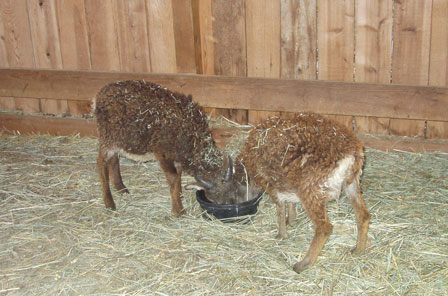
Steve gives us our own grain

081109rams-007a.jpg

 and our very own customized hay feeder, a scrap of “hog” panel tilted up on the batter boards of the nursery.  I don’t know why shepherds call it a hog panel when it is so perfect for a little Soay sheep like me.

081109rams-010a.jpg

We can reach right up and get all the grass we want and there are no big ewes or rams to push us around.   I hope Steve will make more of these beginner feeders for the lambs next spring because they are a really fun way to practice eating hay without having to compete at the regular feeders.

I’m glad you were willing to listen to my story.  I have to ask you something, though.  Please watch out for your little Soay sheep who avoid the feeders after they have lived on grass for awhile.  It is scary to look up at those big feeders and at the same time be careful not to get stepped on or shoved by the grownup sheep.  It just seems easier to try to make it on the old grass in September but we can starve if you don’t pay attention to us and help us make it through until we grow some more.  And by the way, Steve says that even though I think I am precocious (it is the longest word I know), I really am not, and that I am both physically and psychologically immature.  I call it being scared. Me and Sedgwick are growing okay, I guess, but Steve says we have to eat a lot, and that is why I can’t go back to the winter pasture with the ewes until later.  I really need to pay attention to eating and besides, I don’t do very well with grownups yet.  But I am determined to become a big sheep so I can have lambs and Steve thinks I will grow up much faster when the seasons change in the spring and my body tells me it is time for one of those growth spurts you humans talk about in serious voices with your teenage children. Maybe you can come out and visit me in my new home, which is really my old home but I am much bigger now than when you saw pictures of me as a Soay bottle baby last summer.

Your friend, Patterdale

Christmas Stockings for Soay Shepherds: A No-Spill, All-Purpose Feed Bag

Friday, November 21st, 2008

Looking for a gift for your favorite shepherd, especially a slightly clumsy one?  Can you sew a straight seam?  I have just the one-hour project for you.

Experienced shepherds, of Soay sheep or otherwise, and almost any do-it-yourselfer will sympathize with what I am about to say.  When you feed your livestock guardian dogs in the pasture, there is nothing more annoying than to have your bucket tip over, requiring a trip back to the barn for more goody.  Not the kind of catastrophic event that puts a flock in jeopardy, of course, but enough to make you grit your teeth and who needs that?

Same thing if you are in the midst of a home fixup project, your selection of nails-in-old-coffee-cans is sitting on the workbench, and your sweatshirt sleeve knocks a couple of them over onto the floor.  Or you are trying to repair a fence and your can of fence staples tips over in the lush pasture grass.

Wouldn’t you rather have a no-cost, tip-proof container for this stuff?

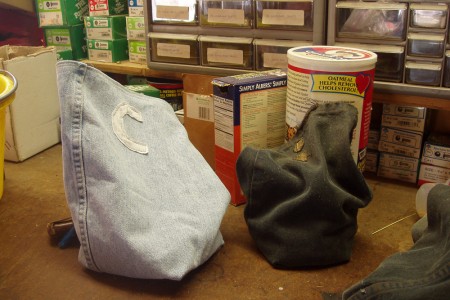
Luckily, as with so many other aspects of keeping a flock of Soay sheep, help is readily at hand, this time in the form of a square-bottomed cloth bag, a transportation system for your dog food or nails that cannot tip over and spill.  Here are two of our dogs’ “stockings” filled with half their daily ration and ready for the evening feed:

080928denimbags-003a.jpg

As you can see, Chuy and Isaac’s stockings are tip-proof.  You just pick them up and off you go. 
isaacbag-007a.jpg 
Why don’t these bags fall over and spill?  The secret is in the square-shaped bottom end, illustrated by Isaac’s upended stocking: 

isaacbag-012a.jpg
The bottom really is more or less a square, and whatever its geometrically accurate name, that bottom surface keeps it upright just fine.  In fact, when the top of a longer bag droops over, it helps keep out rain, dust, and inquisitive border collie noses. 

The ideal raw material is old jeans, so heavily worn that the owner can no longer go out in public in them (holes you-know-where) or torn enough to make them unsafe to wear near moving machinery parts.  And there is a side benefit.  If you do not make bags out of them, you eventually will have to throw the jeans away, so these sewing projects should qualify as “green” even though they are a sorry excuse for blue.  Here is a good example of a recent candidate for reinicarnation.

jeansbags-002a.jpg 

The only other materials you need are a sewing machine, a few straight pins, and any color thread.   No zigzag or button hole or other “foots” to discourage the novice seamstress in this project.

Before I launch into the illustrated directions for making a square-bottomed feed/nails sack, a credit is in order.  We adapted this idea from generations of rock climbers, including Steve in his younger, more agile days, who use stuff sacks to keep their carabiners, pitons, ropes, and legendarily minimal toiletries organized in their backpacks.  You can still find this kind of sack in outdoor gear stores, but you will pay a relative arm and leg for them, and why not use your own free jeans legs instead?

Making the Saltmarsh All-Purpose Carrier

Step 1.  Cut one leg off the jeans, leaving the bottom hem intact, or what passes for intact.  An initial length of about 14 inches will yield a bag about 10 inches tall that easily can hold a quart and a half of dry dog food or a coffee-can’s worth of nails and still have enough fabric to grab onto. 
 makingsacs-001a.jpg
 

Step 2.  Turn the severed leg inside out and lay it flat with the existing side seams more or less forming the edges.  If you are using a tapered jeans leg, this will not be an exact science. 

 makingsacs-004a.jpg

Sew the open end (not the already-hemmed bottom edge of the leg) shut with a plain straight seam about one inch from the raw edge.  Here’s what the prepped material looks like and how you sew it: 

makingsacs-005a.jpg 
makingsacs-007a.jpg 

Step 3.   The goal now is to create a box-shaped bottom that will not tip over.  First, put the new seamed edge in front of you running vertically — up and down. 
makingsacs-010a.jpg 
Grasp some material on either side of the seam and pull outwards to form a diamond/box shape.
 

makingsacs-012a.jpg
You want to turn the pointed ends at the top and bottom of the diamond into the sides of a square, which, when you turn it back rightside out will form a box.  Take my word for it, please.

Figure out where you can hem crosswise to create the sides for your box.  In the following picture, I have marked with a black dotted line the two “sides” you will create by sewing these two new seams.  I recommend you mark yours as well, unless your dogs will be offended at having the seams of their stockings show.  We girls endured black-seamed stockings for decades without permanent emotional damage, as I recall.   

makingsacs-013a.jpg

Now sew each of the marked seams.  You will be sewing through quite a bit of heavy fabric, so use a heavy needle and your trusty straight pins. 

makingsacs-014a.jpg
 
Be patient and gently work the machine through the material.  Don’t forget to sew both seams.

  
 makingsacs-015a.jpg
Here is what it looks like, still wrong side out, when both “sides” have been made.  For reference, I marked the very first straight seam with a wiggly line so you can see how the various seams fit together.

makingsacs-018a.jpg 

Once you’ve got both seams done, turn the whole thing right side out again.  Nudge the fabric into the corners to see if you have made two decent-looking square corners.  We’re not talking engineering precision here, just something that will work.

 makingsacs-020a.jpg

Step 4.  To check your work and my directions, fill the bag with some rocks or beans to be sure it is stable.  Hint:  it will be!

To tidy up the inside of your new stocking and leave more room for goodies, turn it inside out one more time and trim off the extra hunks of material, always leaving about an inch of material outside the seam so it will not ravel.  
makingsacs-027a.jpg 


  makingsacs-028a.jpg

Be careful, of course, not to cut off the working parts , or you will dribble dog food down the lane and have nothing left for your loyal protectors to eat. 

  
makingsacs-029a.jpg 
Turn the whole thing right side out one final time, wrap it with festive Santa wrapping paper, an artsy bow, and you’re all set. 

Accessorizing your stocking.  What, you thought I was going to stop at the basic bag?  Not a chance. 

Monograms.  If you have two or more dogs who eat different kinds or amounts of food, or more than one kind of nail, you can make a good-enough identifying monogram by cutting an initial (as in “i” for Isaac or “C” for Chuy) from any contrasting scrap of cloth you have lying around.  Sew it on near the open end of the bag, high enough to let you slip the open end of the bag over the sleeve arm of your sewing machine. 

makingsacs-025a.jpg

This one would work nicely for oatmeal for the birds, or a sack of “O” rings if you are putting together your own satellite.  

 makingsacs-026a.jpg

Drawstrings.  In the days of yore, pre-velcro, the climbers’ stuff sacks had drawstrings with jim-dandy clamp-like things to keep them shut.  Are you are going for the Martha Stewart award here?  If so, you can add rickrack, or use extra jeans legs for fireplace sachets (I am not making this up), or you can add drawstrings by cutting off the hemmed bottom edge of the jeans and making your own open-ended, tube-like hem, with those little slits for threading through a drawstring, etc.  Personally, I would rather clean gutters than thread drawstrings through anything, much less a jeans leg, but if you’ve got a good movie to watch, have at it. 

Once you figure out how to make these bags, you can crank them out in assembly line fashion and have a selection of sizes to pick from when you need to take a handful of insulators, a few nails, and a spool of electric tape out to work on your fence, or when you need to take a couple of irrigation pipe fittings and a small or medium-sized wrench or two out to a malfunctioning riser or rainbird.  And when the winter rains or snow arrive in earnest, you can fritter away whole days re-organizing your nails, nuts and bolts, screws, all those PVs (Potentially Valuables) in your tool shed.

If I don’t get back here before the end of the year, may your Christmas stocking be coal-free and not tip over.

Happy holidays!