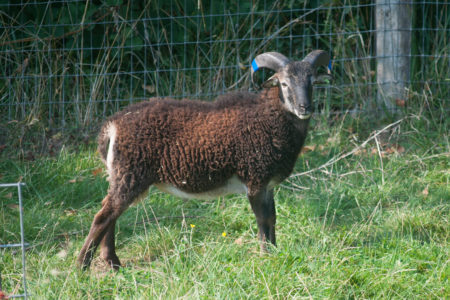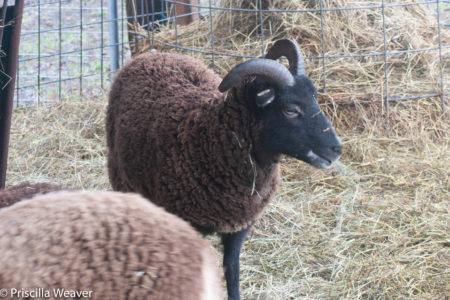
Want more Soay twins? Try flushing your ewes

September 9th, 2008

No, I am not referring to your trusty Kohler or Toto.  Flushing is shepherd lingo for increasing a ewe’s nutrition in the weeks leading up to breeding in order to trick the ewe into releasing a larger number of eggs.  Most of the sheep literature we have read, and a number of Soay breeders we know, report higher multiple birth rates if flushing is part of the pre-breeding regime.  The concept is straightforward:  ewes ovulate more readily and release more eggs if their bodies sense that times are good, that food is plentiful, and so it seems a good opportunity to raise a larger litter.  As I understand it, commercial breeders use flushing routinely.  They must have a high ratio of multiple births to make sheep-raising financially viable.

 080411-059a.jpg

Here is how it works from the shepherd’s standpoint.  Two weeks before you put your breeding groups together, start feeding your breeding ewes a little something extra along with their normal diet of grass or hay.  We use a product called “ewe/lamb ration” from our favorite feed store.  It is 14 % crude protein.  COB (corn, oats, barley) or other pelleted feed with 9 % crude protein is another alternative.  If you don’t mind the hassle of soaking beet pulp pellets (also 9% crude protein) every day, you can use that as well.

080411second-057a.jpg 

The goal is a gradual and modest increase in the ewes’ “nutritional plane” — to boost them slightly from where they start.  If they are already fat, flushing probably will not help and it might be counterproductive, because really fat ewes are reported to have lower fertility rates.  But if your ewes, like ours, are starting to complain about the quality of the late-summer grass in your fields, or you are down to the last few sorry bales of last year’s hay, the increased nutrition should have the desired effect. 

 080413-001a.jpg

We start with 2 ounces per ewe per day and gradually increase that amount to 4 ounces by the end of the first week.  You do not want to change your ewes’ diet abruptly for at least two reasons:  their rumens need to adjust to the change in composition of the material to be digested, and apparently if the new stuff passes unprocessed into the intestines, the ewe is at risk for scours.  In other words, ramp up rather than change abruptly.   

How do these numbers play out?  Here are a few examples:

# ewes     Days 1&2      3&4              5&6            7                   8-14

1                      2 oz       2.5 oz           3 oz             3.5 oz            4 oz

4                      8 oz       10 oz            12 oz           14 oz             1 lb 

8                      1 lb        1 lb 4 oz       1 lb 8 oz      1 lb 12 oz       2 lb   

Stay at the increased level for a second week (days 8-14), then put your your ram(s) with your ewe(s) for breeding.  On the day you begin breeding, start tapering off the goodies gradually until you quit supplementing them at all after two more weeks.  In other words, four weeks total of supplementation, gradually up, gradually down. 

080413-023a.jpg 

For the same reasons flushing is designed to increase the number of ova released, it also encourages the ewes to start ovulating a little sooner, which may put them in sync, and that in turn may concentrate your lambing so it does not drag on for weeks.

 080417-003a.jpg

Most books recommend a second trick to get your ewes ready for action, i.e., getting them to cycle well.  If your pasture situation and prevailing winds allow it, place your ewes near or at least downwind from the rams.  The smell of the rams (and believe me, they smell at this time of year) helps trigger cycling, as does the shortening of the days.  If you can put your ewes in a location adjacent to your rams – a stout fence and a view block separating them – all the better.  That way, the rams also can smell the ewes and get charged up.  But – and this is crucial, you must have sturdy fence and you really should use view blocks.

 080525-015a.jpg

Will you agree with me that these pictures of some of our 2008 twins provide yet another reason to flush your ewes — the sheer pleasure of looking at the little ones together?

080419-001a.jpg 

If you flush your ewes, you’d best get your lamb kit ready because before you know it, lambs will begin arriving two by two to entertain you. 

For now … 


Getting started with Soay sheep: a basic checklist

August 28th, 2008

If your first Soay sheep are about to arrive, you may be a little apprehensive about whether you have the right “stuff” and the right setup for your new flock.  There are a number of detailed “how to” accounts online and in books, but here is a rock bottom list that will get you started.  Details in subsequent posts. 

1.  Food.  Grass and forage in the summer if you are lucky enough to have grass all summer, either naturally or because you irrigate.  When the grass gives out, switch to good quality grass hay.  Sheep do not need anything as rich as alfalfa hay and you should not feed it to your rams anyway.

2.  Water.  A stock tank will do just fine.  Where we live, they come in tall and short – get the short one.  If you only have one or two animals, you can make do with a big plastic bucket secured so it will not tip over.  Sheep need access to water 24/7/365, which means if you live where water freezes in winter, you need to make provision for that sooner or later.

3.  Mineral.  Get sheep-appropriate granulated (not a block) mineral from your farm store.  Cow mineral contains too much copper and is toxic to sheep. Put a pan of the sheep mineral where the animals can get at it 24/7.  Keep it out of the rain, preferably in a container up off the ground so it will not get kicked over or pooped in.

4.  Treats are an easy way to persuade your sheep to follow you. Use just a little in a bucket (so you can shake it and make a sound the sheep recognize), but do not give it to the sheep on a regular basis or they will follow you all the time and become a nuisance.  Any sort of treat will do:  ewe/lamb mix, beet pulp (soaked overnight), COB (corn, oats, barley mix).  See what is on order at your local farm store.  Caution:  never give more than a few particles of a grain-based treat such as COB to the rams.  The only times Soay need supplement beyond grass or hay are when you are flushing them or they are gestating or lactating ewes, and all that comes later.

5.  Fencing to keep your new flock from running away.  You need mesh with fairly small holes, e.g., 2 x 4 no-climb or similar, or else a solid wood barricade fence.  Sheep can get their heads stuck in ordinary field fence trying to reach for grass on the other side (remember, “the grass is always greener … “), and lambs can crawl right through.  If you are buying both genders in order to breed later in the fall, you need two separate areas, and a view block if they adjoin.  You do not want your new ram(s) bashing down your new fence(s) to get at your new ewe(s).

6.  Shelter.  In the summer, any structure or area with a roof  that is big enough to let the sheep to get in out of the sun.  A tarp over a section of the fenced area will do in a pinch.  In the winter, depending on your climate, the sheep will need an area they can retreat to in heavy rain or snow, and in severe winter areas, the shelter will need sides to cut down on wind.  If you have a barn, all the better.  The sheep do not need heat, just protection from rain/snow and wind.

7.  Predator control.  Unless you are sure there are no coyotes or mountain lions in your area, protect your sheep at night by (1) bringing them into a barn or other enclosed shelter that coyotes can’t get into; (2) procuring an experienced livestock guardian dog or llama that can live with the sheep outside 24/7; or (3) electrify your fences with a hot wire on top and on the bottom (coyotes will dig under).

8.  Medical.  Locate a veterinarian who will treat sheep and if you can, get to know him or her before a medical issue comes up.  Buy a rectal thermometer and keep it where you can find it, since it is your number one ally in diagnosing whatever may ail your sheep.  If you do not already own a large airline dog crate (hard plastic, slatted sides for ventilation, we’ve all seen them), go out and get one so you can take a sheep to the vet if necessary.

9.  Book learning.  If you do not already own either Storey on Sheep or Ron Parker’s The Sheep Book, go online to your favorite book purveyor and get yourself one of them to read in your spare time (see below).
.
10.  A comfortable chair.  How else will you be able to sit and fritter away hours watching your irresistibly adorable Soay?

That’s enough for now …

Pasture rotation — spring growth, summer growth

July 23rd, 2008

Everyone here at Saltmarsh Ranch, animals and shepherds alike, heaves a sigh of relief each spring when the sheep and their guardian llamas first move out of their winter hay feeding areas and onto pasture grass.  To be sure, the sheep cannot help but gorge themselves, creating havoc with their excretory functions but putting huge smiles on their faces and ours.  It is a ritual we never tire of.

The trick with starting grass grazing and taking the animals off pricey hay is to figure out the optimal time for the transfer.  Neither of us knew when we first started this Soay sheep madness that the timing decision would carry financial and farm management consequences.  It is not that the wrong decision is fatal to the operation, or even a mortal wound, but it is an aspect of sheep raising that creates an opportunity for sound fiscal management and better animal health if done right.  Here’s what I mean:

It would be a straightforward matter, and frankly make life in April and May easier on the shepherds’ daily routine, if we simply put the sheep out to pasture as soon as the grass starts turning green and quit lugging hay around.  The sheep would be elated.  Spring is when they get not only live grass, but also their favorite delicacies, the new growth of poison oak and blackberry leaves.  Each year we are tempted by the simplicity and the intuitiive correctness of getting the sheep onto grass as soon as possible.  Shove them out of their winter living quarters, a small section of the fields where they appear to create a desert wasteland out of a perfectly nice stretch of pasture and where they consume hay at a rate calculated to create heartburn in the resident accountant. 

But if we were to put the sheep onto grass as soon as the grass turns green, we would  regret our haste come July.  The grass needs to get a really good start, untouched by ovine mouth, if it is to recover in the 2-3 week cycle required for successful grazing through summer and into October.  We have not actually measured the height and density of the grass, but we have to wait roughly until the first growth is about knee high or more, and by golly it is hard to look at all that grass and not immediately open the gates.  Here’s what it looked like the day we put a big bunch of ewes, and their guardian dog Isaac, on the South Cannon pasture in early June:

080529-072a.jpg

The same terminology used for haying — first cut, second cut — applies to our pastures.  When the sheep make their “first cut” in a section of grazing area, they leave a lot of stemmy grass behind.  First grass growth is the plant’s reproductive phase.  (Note:  I have no idea what the correct botanical terms are, but if anyone reading this is bothered by the casualness of my word usage, please feel free to comment and I will update this post).  The plant concentrates its energy on making seed and the stiff stalk, I believe called “carrying stock,” that holds the seed heads high off the ground where the wind can blow the dry seed across the pasture so that come next spring, a whole new crop of grass will appear as if by magic.  There is not much leaf on the grass at this point; that comes later.

We were surprised to find a lot of the seed-laden stalks left untouched by the sheep.  They really are looking for the soft leaf growth, such as it is at first, down by the ground.  Their preference against the seeds seems odd considering how much the sheep love other grains (oats, corn, barley) and how rich in protein those grass seeds must be.  I mentioned it to a professional landscape friend of ours yesterday.  She too was surprised but surmises the seed heads contain something icky-tasting (from the sheep’s perspective) that serves to protect the seed from being eaten before it can get to the ground, rest for the winter, and then germinate in the spring.

It is this reproductive phase of the grass plant that explains why we see the almost ghost-like appearance of the pasture after the Soay make their first pass through — nothing but a lot of greenish-brown sticks topped with fronds of seeds.  And the need to make seed first, and then leaves, serves as a caution against putting the sheep out too soon.  We need to let the seed growth and dispersal happen first, or next year we will not have a lush new pasture.  We could knock down the seed stalks with a mower and make the pastures look tidier, but our timing would have to be at a level of precision – too soon and the seeds are not mature, too late and our sheep miss days on grass — we prefer to avoid when we can.  Better to let the sheep tromp down the seed stalks; their little hooves are just the right size to act as miniature ploughs poking the seeds into the ground.  

Before we stopped to figure out what was happening in the reproductive phase,  I was convinced we had ruined our pasture by incorrect rotation practices.  Have a look at that same first area after our ewes made their first pass through it a few weeks ago:

080607-007a.jpg

For comparison purposes, here is the picture of the same part of this pasture that I included in my post last September:

pasturerotation070912-002a.jpg 

Back then, I was bragging about our expertise in pasture rotation.  Compared to last year’s lush green, it sure looks like the shepherds at Saltmarsh managed to ruin a perfectly good pasture, doesn’t it?

But wait.  Let’s look beyond those dry stems leftover from the Soays’ “first cut” a couple of weeks ago.  Here is how that same section looks up close 18 days later.

080625-013a.jpg

  You can still seeing the drying stems, but now there is a wonderful new layer of vegetative growth down closer to ground level.  Not only is it green, it is a good mix of various grasses and nitrogen-fixing clover.  When we return the ewes to this area in a few weeks, their little feet will trample the remaining dry stems as they work their way through the new growth.

Another temptation in the spring, and throughout the summer actually, is to leave the sheep in an area for more than four days.  Big mistake.  Regular readers will recall that grass begins to regrow four days after it is cut/eaten.  Actually, I was told by another breeder in Wisconsin that he has to move his animals every three days — must be the effect of all-summer-long rain.  But whether it is three days or four days where you live, if the sheep remain in one area longer than that, they will begin eating the new growth and the pasture will not recover as quickly or as well, nor will the new vegetative growth have time to store nutrients in the roots for next spring’s reproductive growth.  The cycle continues.  And here is where Electronet comes in so handy.  It allows us to make larger feeding areas for our groups during the spring and early summer to ensure the sheep eat down the grass to the right level, and then shrink the areas later in the summer when the grass growth slows down, but still allowing the proper amount to be eaten. 

Now that our flock, including the newly-weaned lambs, are busy making their way, 3 or 4 days at a time, through all the sections of our pasture, both sheep and shepherds reap the benefits of waiting for the grass to get a good start before starting the rotation a bit later in the spring.  Remember the old folksong, “green green, it’s green they say”?   Green it is on the near and far sides of our hills … for now.     

Even bummer lambs grow up, sigh

May 30th, 2008

I have such mixed feelings about Patterdale, our first and only bottle baby.  She seemed so vulnerable when she first arrived and then as she started to grow in our breakfast nook, yattering away to be sure we knew she was there and needed milk — all the time.   Both Steve and I had to resist the urge to smother her with attention, lest she get too attached to us.

We need not have worried.

These days, Patterdale hangs out with the friends she made in the Nursery when she first moved outdoors:  Sedgwick and his mom Yalo, and Milburn and his mom Catalaya.  We are relieved that she does not cling to us, or pay any attention to us at all, truth to tell, except when she wants milk.  Yalo and Catalaya will not let her nurse, of course, but Patterdale beds down with one or both of them nearby.  It is a surprisingly endearing family group scene for “just” sheep.

During the day, Patterdale is one of the crowd, exploring the hay feeders, running in and out of the creep feeder,

080506-080a.jpg

and generally learning the only skill — eating adult food — she will need until the Ancient Rituals — breeding and lambing — kick in.

But back to milk.  Notwithstanding her increasing independence, all it takes is a ring of the dinner bell hanging on a nail, or simply calling Patterdale’s name, and she comes racing over from whatever games or other mischief she’s gotten into with her lamb colleagues.

It is not very often I allow Steve to act as the official Saltmarsh Ranch photographer, mostly because he is somewhat of a perfectionist and I get impatient waiting for him to take the ideal picture.  But a few days ago he grabbed the camera as I was strolling down the gravel lane in the Maternity Ward to feed Patterdale.

080525-001a.jpg 

Does the old Al Jolson tune, “Me and My Shadow” come to mind?

When Patterdale first moved inside with us, we used a purchased lamb nursing bottle, but once she moved out to the Maternity Ward with her buddies, we needed something a bit bigger so as not to be running back and forth to the house all the time.  Enter a no-longer-needed-for-human-consumption Schweppes Diet Tonic bottle — just the ticket.

080525-005a.jpg

As you can see, there is no shortage of enthusiasm for eating in this little ewe lamb. 

I have to laugh at our naivete in this whole episode, especially our unwarranted fear that we would not be able to find Patterdale amidst the throng of lambs in the Maternity Ward.  We actually put a big swath of green marking crayon, the stuff we use to tell us which of our Soay have been vaccinated when we work the ewes or rams, on Patterdale’s head. 

080525-013a.jpg

Oh yes, the red nipple.  For such a mundane tool, it has an awfully fancy name, “Pritchard teat,” and it is widely available in farm stores.  Unfortunately, as you can see it is way too big, as is a lot of sheep-related equipment not made especially for the little Soay, lambs or adults.  So far we have not had any luck finding a reliable smaller nipple and we welcome any advice on where to find one.  The nursing/watering equipment for rabbits and such in the pet stores never seems to include a nipple and we cannot imagine the Soay taking a liking to one of those stainless steel “straws” that little rabbits are supposed to lick on for liquid intake.

I haven’t decided whether to submit this next picture to the American Dairy Board or whoever it is that puts out the ads featuring celebrities with milk mustaches, but if life gets boring around here, I may just give it a whirl.

080525-017a.jpg

Meanwhile, as endearing as Patterdale is, on balance I will be relieved when her rumen is fully operational so she can live exclusively on hay and grass and we can commit the Schweppes bottle to the recycling bin.

For now …

Saltmarsh Soay Pioneers

May 19th, 2008

One of the most enjoyable, ordinarily light-hearted rituals on our farm is the annual selection and implementation of lamb naming themes.  This year, picking the right theme took on a certain solemnity as we welcomed lambs with the first-ever new genetics in the British Soay flock here in the U.S., thanks to the wonders of AI

As you can imagine, selecting a naming theme for these historic sheep has occupied many hours around our dinner table, the hay feeders, and points in between for the last several months.  One day as Steve walked the pastures, he had a small “Eureka” moment:  why not name our Soay pioneers for members of the Saltmarsh family who settled here along the Little Applegate River in southern Oregon?  It was the Saltmarshes, after all, who as earlier pioneers homesteaded and lived on our farm for nearly one hundred years.   

Down off the bookshelf came the local histories.  Some of the names were easy to identify.  We presented our first draft list of names for review by our consultative body, which convenes each Wednesday for breakfast at the local cafe to discuss the weather and other urgent matters.  To our delight, we learned that Melvin and Curtis Saltmarsh, sons of Arthur B. (”Bird”) and Dora, had been named after the father and uncle of one of our favorite breakfast companions, Jerry McGrew.

Connie Fowler, a close-by neighbor and co-author of a wonderful book about Buncom, a ghost town three miles down the road, provided a wealth of additional detail about the Saltmarsh “begats.” She also pointed out a couple of unsavory characters undeserving of a place on our list. 

How we wish we had known the namesake, Genevieve Eliza (”Vieva”) Hamilton Saltmarsh, of our first AI ewe lamb, Saltmarsh Vieva.  Here is the “real” Vieva as a happy, rosy-cheeked young bride, dressed in her overalls:  

vieva_and_glen0001a.jpg 

Vieva obviously engendered genuine affection and admiration from everyone she knew; we began hearing about her as soon as we purchased the Saltmarsh Ranch and we are still learning about her exploits during the decades she lived here.  Vieva farmed right alongside her husband, Robert Glen Saltmarsh, shown here at the gate leading down to the barn.

 vieva_and_glen0002a.jpg

Vieva also kept the local weather records for the U.S. weather bureau for many, many years.  She was widely known for keeping a pet deer and protecting it from hunters by painting its antlers day-glow orange.

Here are Vieva and Glen in front of the farmhouse some years later.

vieva_and_glen0003a.jpg

The story goes that Vieva went to town the day after Glen died to buy the piano she had always wanted, becoming the first in the valley to have a piano at all.  To this day, Vieva’s Sunday musicales are remembered here with fondness. 

We are grateful to Vieva’s best girlfriend, Emily Savage of Montague, California, who found us a couple of years ago when she read an article about our Soay sheep in The Capital Press, for providing us with these photographs and for sharing wonderful memories of Vieva and Glen with us.  Emily and her husband John also pioneered in our valley.

But back to the sheep.  Here are our AI twins Glen (on the left) and Vieva, basking in the sunshine at Saltmarsh Ranch at the ripe old age of two weeks:

080411second-068a.jpg

You may admire all eleven of our AI lambs by going to the 2008 Lambs album in the Open Flockbook Project Gallery.

Earlier generations of Saltmarshes built the barn that still stands as a landmark in the valley over a hundred years later.  Pictured on the home page of our website, the barn served as the nighttime home of our AI ewes throughout their pregnancy, keeping them safe from predators and dry during our wet winter.

We would like to think that Vieva, Glen, Cap, Bird, Arzie, Emmett, and all the other Saltmarshes would approve of the new turn of events on their homestead and in their valley.  Who knows, perhaps one day we will paint our AI progeny’s horns with day-glow paint to keep them safe!

For now …

Bummer Lamb Update: More Lessons Learned

April 29th, 2008

When last we met Patterdale, she was just a few days old, traumatized by her mother’s rejection, confused by her wanderings in the Maternity Ward, wishing she could have continued as Tolcarne’s adoptee, and a bit uncertain about her prospects in the makeshift pen in our breakfast nook.  Not to mention the nearly hourly strife of going nose-to-nose with a border collie through the wire dog crate.  Weighing a mere 2 pounds 4 ounces at birth, she had a long way to go.

What a difference a week makes!  This morning as I was feeding her, I realized we should weigh the little darling to see if she ihas made any progress.  To our great surprise and delight, she has put on nearly 2 full pounds in just 12 days, to a whopping 4 pounds 3 ounces.  Not only that, she is no longer fazed by Molly’s border-collie intensity (see Molly back there quietly observing the proceedings?), and she has decided every Soay lamb should have a kindergarten chair as her personal gym equipment.  Have a look:

 080429-005a.jpg  

A few minutes ago, I turned the chair sideways and she actually jumped right over the seat.  Time to get her out in the nursery, that’s for sure!

So what have we learned thus far?  Patience.  Now there’s a newsflash, patience with a baby.  But a particular kind of patience – not feeding too much.  Patterdale never actually scoured, thankfully, but she did not pass the … hmm … how to say this, the ”solid waste products” test.  She has been slow to pass this second test of potty training despite her best efforts.  Fortunately, Steve had squirreled away for just such an occasion a bag of an energy supplement with electrolytes by the grand name of “ARREST,” to be used for “scouring calves, pigs, foals, lambs and kids.”  As near as I can tell, it is the ovine equivalent of Gatorade or one of the other energy drinks.

In any case, it works just dandy.  We mixed up an empty water bottle of the stuff per the dilution directions.  The first day we used equal parts of the supplement and milk replacer, reducing Patterdale’s total milk intake.  The next day we used one part supplement to 3 parts milk, again substituting the supplement for part of the milk.  By the third day, Patterdale was tired of reduced milk rations and let us know in no uncertain terms.  She may be only the temporarily-adopted sister of Otley the Noisy, but by golly they have the same robust vocal cords even if they are not biologically related.

One caution about electrolyte supplements for scouring:  do store the mixture in the refrigerator.  Unlike milk replacer, which can sit out at room temperature without spoiling, at least for a day, the electrolyte mixture will start to ferment at room temperature.  What we do not need around here is a tipsy lamb; she and her ilk are not exactly rocket scientists stone-sober, after all.  Besides, I don’t know about you, but an exploding plastic bottle of sugary solution in my kitchen is not my idea of a good time.

Patterdale, you’ve come a long way, baby.

For now …

A Bummer Soay Lamb: Lessons Learned

April 23rd, 2008

It was a dark and stormy morning last Thursday.  I was in town and Steve was running the lambing operation solo.  Delighted to find Fulmar with a big (5 lbs, 4 oz) ewe lamb in the area reserved for pregnant ewes, he jugged them and then went about the normal routine of quieting the din in the Maternity Ward proper with several flakes of fresh hay and a little beet pulp for the nursing mothers.

And then all the wheels came off.  There, amidst the nursing moms and their big three-week old lambs, was a little bitty brown thing with no distinctive markings and no ear tag – a newborn lamb.  But whose? And where was the mother?  Someone was where she did not belong.  Either the mother had panicked, jumped out of the adjacent lambing area, and lambed instead with the 3 dozen mothers and 4 dozen lambs in the comparatively chaotic main part of the Maternity Ward and lost her lamb there.  Or, the lamb had been born in the lambing area but then crawled out.  But which ewe and where was she?  Was Steve really going to have to lift up 3 dozen tails to see which ewe besides Fulmar had lambed overnight? 

Step one:  count noses in the pregnant ewe area.  Sure enough – one short.  The most likely candidate to have had a really little lamb was Gweek, and Steve did not see her.  Thinking he would find her by carrying the little lamb around the Maternity Ward sort of like a sniffing dog at the airport looking for drugs in luggage, Steve was hoping the lamb’s mother would smell her “work” and follow along to a jug.  Lo and behold, that is exactly what happened.  When Steve picked up the lamb, all the ewes but one scurried away, and only the presumptive Gweek paid any attention to the little lamb in Steve’s blue-gloved hands.  She sniffed and gurgled at the baby and dutifully toddled along right into a jug, where she (the ewe) and the little lamb proceeded to nuzzle and slurp approvingly at each other, sounds that always reassure a shepherd that all is well.  Steve’s sigh of relief probably could have been heard far beyond the friendly confines of the Maternity Ward.  Only the ritualistic checking of the ewe’s ear tag remained (remember this is a lab scientist who used to keep meticulous records of several hundred of his tagged lab mice).  I can only imagine the sound of Steve’s jaw dropping open when he discovered that the little lamb’s “mother” was not Gweek at all, but rather Tolcarne, who already had a three-week old lamb!  And not just any lamb, but one with such distinctive markings that no mother with even minimal visual acuity could mistake her for someone else.  (Never mind the universally accepted common wisdom that any ewe worth her salt can recognize her lamb 100% of the time by smell alone).  Look at Tolcarne’s lamb Buttermere.  Does she look like a little bitty nondescript brown sheep?

 080422-047a.jpg

 What … on … earth … was … going … on?

See what I mean about wheels coming off?  Mind you, I was still in town at this point, calmly going about my non-sheep business, while all this was taking place.

Back to the pregnant ewe pen went Steve to find Gweek, who he persisted in believing was the lamb’s mother.  With no small amount of relief, Steve realized he had miscounted by one and all the pregnant ewes were in fact accounted for, including Gweek.  And that, faithful readers, left only one explanation: Fulmar had twinned, and the little one had wandered off.  A sense of deja vu crept crept into Steve’s consciousness.  The same thing happened to us last year with another little bitty lamb, Otley, who crawled out of the same kind of opening — the slot between the bars of a Shaul panel – only to be found lost and wandering around the Maternity Ward bellowing like a miniature hippo.  You would think we would learn, eh?   Would you be surprised to learn that as of this moment, there are no more slots for tiny lambs to crawl through?  Maybe.

But I digress.  Fortunately, this year’s little bitty lamb was warm and clearly had managed to get a meal off Fulmar or Tolcarne or somebody, so Steve caught the little one, took her temperature just to be sure, and put her in with Fulmar and the other twin while he pondered how he could possibly figure out whether the little one had gotten any colostrum from Fulmar during the night.  Fulmar, however, was not about to buy into the proposed new arrangement.  She wanted nothing to do with this unfamiliar creature and she proceeded to bash the poor unsuspecting little lamb against the plywood sides of the jug.  Ack!  We never want to lose a lamb, but especially not at a point where we are behind in the lamb gender lottery.

Armed with the knowledge that a ewe’s milk is always the first choice for a lamb and so is living with sheep rather than with people, Steve considered whether to try to graft the little one (since named Patterdale, which beats referring to her as “hey ewe”) onto Tolcarne on a permanent basis.  Even though Tolcarne seemed willing enough, it nonetheless seemed too risky, especially given the disparity in age between Tolcarne’s own lamb and the proposed adoptee, and also the fact that Steve had no idea whether Patterdale had gotten any colostrum.  And so, for the first time in our tenure as shepherds, we had ourselves a bottle baby. 

From then on, the process has taken on a certain regularity using well-established guidelines for dealing with bummer lambs.  Most importantly, we needed to get colostrum into Patterdale immediately.  She was approaching the 12-hour-old point after which her system would no longer absorb the critical antibodies that will protect her for several weeks until her own immune system kicks in.  Fortunately for her, in the rare cases we have lost a lamb, Steve has been diligent about milking out the ewe beginning right away and continuing for about a week, in order to have an ample supply of frozen milk for just such occasions.   In this case, Steve was able to strip some milk from Fulmar and boost Patterdale with another ewe’s frozen first milk as well.  Once Patterdale had her furnace running, Steve quickly dipped her navel, tagged her (at last!), and off to our house she went. 

Patterdale is pleased to report that her home-away-from-home, a wire dog crate lined with clean straw and a little fresh hay, and seated on the cement floor near our breakfast nook, was quite satisfactory for the first few days.

080418-001a.jpg

The crate continues to be her bedroom, but she spends her days in a “run” composed of a leftover set of wire puppy panels and lined with an old college dormitory bedspread in a lovely shade of ovine brown plaid.

080421-031a.jpg

Relying on our references of choice, Storey and Parker, we set up a feeding regime to meet the twin goals of getting Patterdale growing, but also avoiding scours by overfeeding.  She only weighed 2 pounds 4 ounces at birth (even smaller than the sainted Miss Otley), so the temptation to stuff her with ewes’ milk (never cows’ milk!) was strong.

Here’s a really short course in bottle feeding an animal the size of a very small Soay lamb, adaptable to your circumstances:  Day one, 2-4 ounces of colostrum if you have it, plus 1-2 ounces more of milk — no more.  Best to administer one ounce (that’s two tablespoons) at a time.  Days 2-6, between 6 and 12 ounces of milk total, depending on the lamb’s enthusiasm for eating.  Second week, 12 ounces or so per day.  If the lamb is getting milk but still hollers, it is probably thirsty.  Feed plain water in the bottle or heavily dilute some milk.  If the lamb starts to scour (diarrhea), cut back on milk but dilute it so the lamb will not dehydrate.  The warnings about scours in Storey and Parker are surprisingly strong.  One of them says bluntly that you can kill a bottle-fed lamb by overfeeding it, so err on the side of underfeeding it.

We have not yet faced the issue of when and how to re-unite Patterdale with her twin, mother, cousins and aunts in the Maternity Ward.  Not surprisingly, we have grown quite attached to our little house companion and Steve delights in sitting in her playpen on a chair scavenged from my kindergarten classroom back in rural Iowa that lets him get closer to her without having to sit his middle-aged carcass on a cement floor.  Molly, our border collie, sits remarkably quietly on the other side of the cage, enjoying the sight of a rescued lamb frolicking around the huge sandals belonging to the gentle giant.

 080421-034a.jpg

Just a minute, you may ask, haven’t you left out a critical part of this report?  What was going on with Tolcarne?  What on earth possessed her to adopt the little lost soul?  Almost never does a lamb successfully poach off a ewe who is not her mother.  Remember Otley, the lamb who wandered off last year?  Only readers with truly impressive memories will recall that Tolcarne is in fact Otley’s mother, so for Tolcarne, perhaps there was a sense of “been there, done that” this time.  Perhaps Tolcarne remembered her plight last year and was simply returning the favor. On the other hand, shepherds far more experienced than we are long have cautioned that, however altruistic sheep may appear, they are not rocket scientists.  Attributing both long-term memory and a social conscience to Tolcarne seems a bit of a stretch.  We simply will never know why she, of all the ewes, took Patterdale under her care.  I guess that’s the beauty of shepherding – never a dull moment.

For now …

Soay Ewes-in-Waiting: a Study in Tranquility

March 23rd, 2008

Anyone learning about Soay sheep for the first time and who embarks on a literature search commonly will encounter numerous references to the Soay ewes’ legendary ability to lamb easily.  In fact, if you find an article about Soay sheep that does not remark about how easy lambing is, I would be surprised.

The good news: it’s not just easy at lambing time.  During the final weeks leading up to lambing, the pregnant ewes loll about, sleep, eat then ruminate, and generally do a pretty darned good imitation of furry blimps.  We hear no demands for trips to town to stock up on chocolate chip praline meringue ice cream, no extra manicures, and no natural birthing classes.  If we give our girls plenty of good quality grass hay to eat, and an occasional scoop or two of COB (a mix of corn, oats, and barley with a smidgeon of molasses thrown in for good measure, should be readily available at your local feed/farm store), they quietly gestate and then effortlessly (on our part, not theirs) produce irresistible lambs.

Pictures tell the story.  Look at our pregnant girls yesterday afternoon out in the sun of an early spring day.  Lambing has not started here yet, to our dismay, but as you can see, it cannot be far away. 

Carolina is one of our original ewes.  We did not breed her last year, which explains her thick, rather unkempt fleece.  In our experience, ewes that do not lamb often do not shed their fleece that year.  When Carolina does cast her fleece this spring, it should be quite a spectacle.

080322pregnantewes-020a.jpg

Next comes one of our British ewes, Catalaya, lying in the barren wasteland that is our young lamb playground.  We long ago despaired of keeping grass in this area, what with all those little rambunctious hooves racing around pounding it to pulp.  We are hopeful that Catalaya is carrying twins, but we know better than to count on it.

080322pregnantewes-027a.jpg

Portia gave us black twins last year.  This year we bred her to our one-of-a-kind tan ram Fenugreek, he of the gorgeous fleece.  We can hardly wait to see what their offspring look(s) like.

080322pregnantewes-018a.jpg

I cannot resist sharing a picture of Holly, a nearly-polled, beautiful ewe we bred for the first time this year.  She is so regal when she moves through our pastures –check out her other pictures on the OFP Gallery – that it is hard to believe this big lumpy thing is really our lovely Holly.

080322pregnantewes-045a.jpg
 

Finally, pictorial evidence that pregnant Soay ewes are a tranquil lot who will lower your human blood pressure if you spend a little time wandering quietly among them in the week or two before they lamb.  I took this last picture in the late afternoon, shortly before the second hay feeding of the day, when all was peaceful here at Saltmarsh Ranch.  I know our British ewe Sequoia is up there on the left because I recognize her white-spotted face, but I did not want to disturb the matrons’ sleep by getting close enough to confirm who the other three are, especially the one facing away from me.

080322pregnantewes-059a.jpg

Whether or not I have convinced you that pre-lambing is a special time on the Soay calendar, at least taking the photos for this post kept me from going crazy yesterday waiting for our lambs to start arriving.

For now …
 

Horn growth update — what about the gimmers?

March 9th, 2008

Several readers brought me up short by chastising me for unfairly omitting the yearling ewes (gimmers) from my report on the late-winter spurt of ram horn growth.  I was tempted to ignore their criticisms, so certain was I that only rams could possibly exhibit dramatic horn growth.  But then good manners and a little nagging voice in my head prevailed, and it was back to the pastures to corner and photograph the girls.

Lo and behold – the yearling ewes also experience the burst of horn growth, albeit proportional to their overall horn size.  Here are three of our yearling ewes. starting with our British gimmer Darrowby, who you will recall is named for James Herriott’s fictional town in Yorkshire: 

080301aigim-006xhb.jpg

I decided not to interrupt the yearling rams’ strutting and preening so that I could actually measure their horn growth against Darrowby’s, but I dare say her horns have grown every bit as much as the boys’ horns.  As with the rams, her new horn material is somewhat lumpy and gnarly-looking right now, and quite a bit larger in circumference than her first-year, “baby” horns.

Ewe lamb Leyburn, also British, shows a similarly robust pattern of growth:

080301aigim-032xhb.jpg

Compare Leyburn’s horn growth to that of her half brother Grassington (both offspring of Jerry Lee Lewis), shown in my original — and obviously incomplete — posting about horn growth a couple of weeks ago.  If anything, Leyburn has more new horn material.  No wonder people were crabbing about the omission of the girls!

My third example of ewe horn growth is our farm website covergirl, Ellerbeck, she of the assymetrical white nose spot, which I just realized I cropped off in this picture.  Sorry about that.   

080301aigim-009xhb.jpg

Ellerbeck’s new horn material is visually more interesting than the boys’ horns because of her partially white horn.  The portion of her new stuff that eventually will be white illustrates through its pink cast just how “alive” the new horn material really is, with blood and soft tissue at work creating what will harden into a good sturdy horn. 

With hopes that my friends from the good old days of feminist activism will forgive me . . .


Soay ram lambs: Whether to wether, when, and how

March 2nd, 2008

Absent a big win in the gender lottery, we end lambing season with more ram lambs than we need or can sell.  When the lambs are about 8-14 weeks old, we convert some rams to wethers, i.e., we castrate them.
 
Why castrate at all, rather than leave things be?

I can think of at least four reasons, all tied in to marketing Soay sheep: 
 
1.  Wethers make flexible, good-natured companions.  No sheep likes to be alone, even an independent, no-commitments ram.  Worse, keeping a ram in solitary invites his bad behavior, especially bashing structures and fences.  In a one-ram breeding flock, providing a companion wether avoids some of these problems.   When the ram moves in with the breeding ewes, the wether can toddle right along and not have to be alone for several weeks.  Similarly, in a two-ram situation, the wether stays behind with the reserve ram while the lucky one visits the ewes. Wethers can live with their intact ram buddies or with the ewes, wherever makes most sense for pasture or personality management.  We also use our senior wether, Troon, as a 24/7 attendant when we have an injured ewe or ram in recovery isolation.

2.  All-wether flocks provide a low-cost alternative when you have customers who want to avoid sex (in their Soay) — so they can test whether they really want to have sheep at all without the added management issues in lambing, or when an all-ram flock is a poor choice, e.g., because they have small children.  Customers focusing on fleece often keep wethers for their simplicity – the only characteristic the owner cares about is the quality of the wool.  For example, here are two of our teenage rams, both self-colored dark (”black”) born in May 2007, pictured in February 2008 at age 9 months.  

080220yrlngrams-009_edited.jpg 

Ventana (L) is intact.  Reddington (R) was wethered at about 8 weeks.  Reddington’s thick black fleece suffered not a bit for his having been castrated.

3.  Butchering flexibility.  Unlike rams, wethers can be butchered year-round.  To avoid the strong taste of ram meat during rut, which our occasional meat customers generally do not like, we must butcher our yearling rams no later than June or early July, before they start accumulating hormones and related chemicals in their muscles.  Wether meat has excellent mild flavor that does not change with the seasons.    

The timing constraints for ram butchering create a related problem.  Soay need to grow for at least a year, and preferably 18 months, in order to yield 20-25 pounds of cut and wrapped meat.  Any less time and the revenue/cost balance goes south.  Remember free grass vs. expensive hay?  We want as many of those 18 months as possible to be on grass, both for economics and for flavor.  We cannot avoid one winter’s worth of hay for our male lambs, be they rams or wethers, but we sure do not want to add the cost of a second winter to the butchering balance sheet. 

Here’s the catch:  if we butcher our intact ram yearlings in June, they will be barely past one year old; they will miss the whole long summer of growth on free grass; and they won’t yield much meat.  The only way to keep growing them until they are 18 months old is to feed them a second winter’s worth of hay and butcher them the next April after rut ends and the “rut” taste wears off.  By constrast, we can leave the yearling wethers on grass until October, when they are about 19-20 months old, and then butcher them just before the grass runs out. 

4.  More and better meat.  We believe, based on unscientific observation, that wethers put on more weight than rams of equal age, probably because while the rams are running around jousting, the wethers just sit, ruminate, and grow.   Here are Amado and Calabasas, born on March 25 and April 3, 2007, respectively, photographed in late  February 2008 at the age of about 11 months.

080220yrlngrams-026_edited.jpg 

Intact tan Amado over on the left is noticeably smaller than his wethered buddy Calabasas, who pretty clearly was lounging around while Amado wasted a lot of energy showing off for the pregnant ewes next door.

So why not wether all the excess ram lambs and be done with it?

There are at least two reasons not to castrate, one economic and one aesthetic.  Rams generally sell for more than wethers, and animals on the hoof sell for more than the net revenue after butchering, even if you do it yourself.  So we consult tea leaves about how many rams we might be able to peddle over the winter, and wether the rest.  The other disadvantage is that the wethers’ horn growth slows to a relative snail’s pace for the rest of their lives, so they will no longer have the signature Soay ram look – big handsome curled horns.

The wethers’ horn growth varies a lot from animal to animal, as you can see in the pictures, and some will end up with okay horns, but never even close to their intact friends.  Intact Eloy (L) and wethered Douglas, born one day apart in April 2007 and shown here in February 2008, make the point.  After less than a year, Eloy is distinctly smaller, but his horn growth far outpaces Douglas’ horns.

080220yrlngrams-004_edited.jpg

This is the first time we have looked carefully at the differences in our yearling rams and yearling wethers.  We were so struck with the size and horn differences in less than one year that we decided to see whether the disparities persist over time.

Two years ago, our “herbs and spices” year, we had several sets of twins and, as usual, extra rams.  Our friend Angela Percival up near Portland wanted an “estate” flock — no breeding ewes — and she bought our wethers Lemon (twin of our tan ewe Lime) and Curry (twin of our intact ram Cumin).  Let’s take a look at Cumin and Curry to see how the intact ram compares to his wethered twin after almost two years.  Here they are as baby rams at about 8 weeks, before we neutered Curry.   

venuscumincurry-002xhb.jpg

Curry is the darker lamb in front with a small white spot on top of his head.  Cumin, much lighter, had a large white spot and a fetching little white button on his nose from day one.  They were about as endearing a pair of lambs as we’ve ever had.

Now let’s see how they and their horns have grown since then.  We do not have the luxury of putting them side by side any more since we live several hours away from Angela, but we sure can compare their horns.  Here is Cumin, still an intact ram, pictured in February 2008 at the age of 22 months:

080226miscsheep-011xhb.jpg

Not only does he have an excellent rack for his age, his expression still is rather whimiscal with that little white spot on his nose, his white head, and his partially white horns.

Curry, the wethered twin, also has remained a very handsome Soay sheep, with his coat still darker and much deeper mahogany than Cumin’s, and the tell-tale shorter horns of a wether.  This picture was taken in May 2007 when he was 13 months old.  Notice how nicely proportioned Curry is; his horns do not look “funny” or “odd.”  They actually match his body size quite nicely, don’t you think?

img_3238xhb.jpg

To us, Curry is a walking advertisement for the benefits of having some mellow wethers as part of your flock.

What wethering methods work on Soay rams? 

The elastratorRubber bands made especially for castrating small livestock are readily available at your local farm store.  They are not your basic bundle-the-pencils bands, so do not try to economize with a home remedy here.  Banding is nearly free (100 bands for about two dollars) once you acquire the ten-dollar applicator.  Doing the dastardly deed is straightforward:  stretch the band on the applicator and slip it over the lamb’s testicles.  The band cuts off the blood supply. 

One drawback:  banding only works during a narrow window when the lamb is about 8-14 weeks old, after the testicles descend, and before they get too big for the band to slip over, i.e., when they are not much bigger than a grape.     

Health concerns:  It is important that the ram lamb have a sufficient level of tetanus antibodies at the time he is castrated.  Other than that, when we band our little guys, they appear confused and uncomfortable at first, but within a hour they are up playing with their buddies as though nothing had happened.  In a few days you can check your work – you should feel two hard little peas in the scrotum; after a month or so the scrotum will fall off and you may find it in the pasture.  The wethers continue to grow and thrive over the rest of the summer and winter and we can continue to offer them for sale on the hoof, or schedule the trip to the butcher any time of year.

As you probably can tell, banding is our method of choice. 

The burdizzo allows you to wait until the ram lambs get more horn growth, or until you have a better estimate on how many intact rams you can sell.   Let me state right upfront that we have no experience with this method so I am relying on published descriptions and anecdotes from fellow shepherds.  The burdizzo basically crushes the spermatic cords and the testicles atrophy.  But you need a lot of precision, placing the tool accurately and squeezing hard enough to crush the cords without severing the skin and creating an open wound.  The burdizzo tool sells for about $35 and up.   The same caution about tetanus applies.  Breeders who are comfortable performing the procedure prefer it because they can let their ram lambs develop for a longer period of time before making the irrevocable decision to wether them.  

The knifeAlthough cutting off the testicles allows complete flexibility in timing and avoids the precision required for the burdizzo, you will either have to remove them yourself, creating an open wound, or have your veterinarian perform full-blown surgery.  Vet-performed surgery may be your only choice other than euthanasia if an adult ram is injured to the point that the other rams turn on him.

Which ram lambs to wether?

Here again, it depends on the owner’s goals.  We designate our American/British lambs for ramhood vs. wetherdom based on their soundness and conformation, fleece color and probable final horn shape, and requests from customers for particular characteristics.  We select which British ram lambs to keep intact based strictly on the needs of our conservation breeding program and which ram lambs will be the best genetic match for the ewes selected for our customers’ starter flocks. 

End note:  I must say this has not been my favorite topic.  If only we would get that elusive lopsided gender split so we would have just the right number of ram lambs to sell.  As the Cubs fans would say, wait until next year.

For now . . .